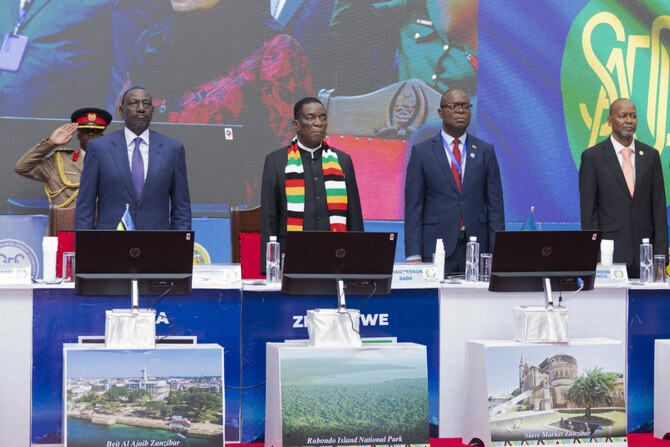
KAMPALA, Uganda: Leaders from eastern and southern Africa on Saturday called for an immediate ceasefire in eastern Congo, where rebels are threatening to overthrow the Congolese government, but also urged Congo’s president to directly negotiate with them.
Congolese President Felix Tshisekedi, who attended the summit in the Tanzanian city of Dar es Salaam by videoconference, has previously said he would never talk to the Rwanda-backed M23 rebels he sees as driven to exploit his country’s vast mineral wealth.
A communique at the end of talks urged the resumption of “direct negotiations and dialogue with all state and non-state parties,” including M23. The rebels seized Goma, the biggest city in eastern Congo, following fighting that left nearly 3,000 dead and hundreds of thousands of displaced, according to the UN
The unprecedented joint summit included leaders from the East African Community bloc, of which both Rwanda and Congo are members, and those from the Southern African Development Community, or SADC, which includes countries ranging from Congo to South Africa.
Rwandan President Paul Kagame attended the summit along with his South African counterpart, Cyril Ramaphosa, who has angered the Rwandans by deploying South African troops in eastern Congo under the banner of SADC to fight M23.
Rwanda has blamed the deployment of SADC peacekeepers for worsening the conflict in North Kivu, a mineral-rich province in eastern Congo that’s now controlled by M23. Kagame insists SADC troops were not peacekeepers because they were fighting alongside Congolese forces to defeat the rebels.
The rebels are backed by some 4,000 troops from neighboring Rwanda, according to UN experts, while Congolese government forces are backed by regional peacekeepers, UN forces, allied militias and troops from neighboring Burundi. They’re now focused on preventing the rebels from taking Bukavu, the capital of South Kivu province.
Dialogue ‘is not a sign of weakness’
The M23 rebellion stems partly from Rwanda’s decades-long concern that rebels opposed to Kagame’s government have been allowed by Congo’s military to be active in largely lawless parts of eastern Congo. Kagame also charges that Tshisekedi has overlooked the legitimate concerns of Congolese Tutsis who face discrimination.
Kenyan President William Ruto told the summit that “the lives of millions depend on our ability to navigate this complex and challenging situation with wisdom, clarity of mind, empathy.”
Dialogue “is not a sign of weakness,” said Ruto, the current chair of the East African Community. “It is in this spirit that we must encourage all parties to put aside their differences and mobilize for engagements in constructive dialogue.”
The M23 advance echoed the rebels’ previous capture of Goma over a decade ago and shattered a 2024 ceasefire, brokered by Angola, between Rwanda and Congo.
Some regional analysts fear that the rebels’ latest offensive is more potent because they are linking their fight to wider agitation for better governance and have vowed to go all the way to the capital, Kinshasa, 1,600 kilometers (1,000 miles) west of Goma.
Rebels face pressure to pull out of Goma
The Congo River Alliance, a coalition of rebel groups including M23, said in an open letter to the summit that they are fighting a Congolese regime that “flouted republican norms” and is “becoming an appalling danger for the Congolese people.”
“Those who are fighting against Mr. Tshisekedi are indeed sons of the country, nationals of all the provinces,” it said. “Since our revolution is national, it encompasses people of all ethnic and community backgrounds, including Congolese citizens who speak the Kinyarwanda language.”
The letter, signed by Corneille Nangaa, a leader of the rebel alliance, said the group was “open for a direct dialogue” with the Congolese government.
But the rebels and their allies also face pressure to pull out of Goma.
In addition to calling for the immediate reopening of the airport in Goma, the summit in Dar es Salaam also called for the drawing of “modalities for withdrawal of uninvited foreign armed groups” from Congolese territory.
A meeting in Equatorial Guinea Friday of another regional bloc, the Economic Community of Central African States, also called for the immediate withdrawal of Rwandan troops from Congo as well as the airport’s reopening to facilitate access to humanitarian aid.


![]()

African leaders urge direct talks with rebels to resolve DR Congo conflict
Short Url
https://arab.news/v55fc
African leaders urge direct talks with rebels to resolve DR Congo conflict
- communique at the end of talks urged the resumption of “direct negotiations and dialogue with all state and non-state parties'
- Rwanda has blamed the deployment of SADC peacekeepers for worsening the conflict in North Kivu, a mineral-rich province in eastern Congo that’s now controlled by M23


Latest updates


© 2026 SAUDI RESEARCH & PUBLISHING COMPANY, All Rights Reserved And subject to Terms of Use Agreement.