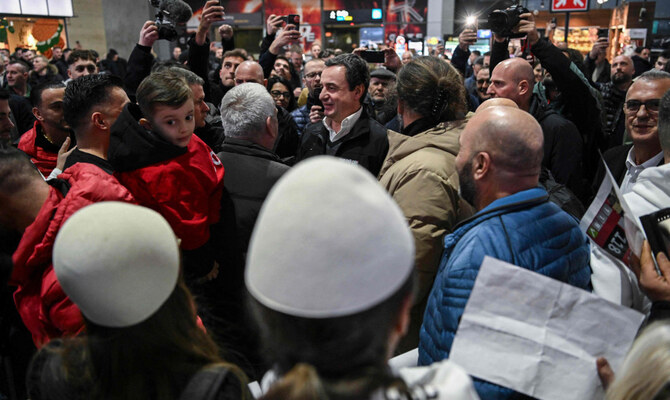
PRISTINA: Kosovo votes on Sunday after a combative election campaign in which opposition candidates clashed with Prime Minister Albin Kurti over the economy, corruption and relations with the country’s old foe and neighbor Serbia.
Kurti, a leftist and Albanian nationalist, came to power in the small Balkan country in 2021 when a coalition run by his Vetevendosje party received more than 50 percent of votes and secured a seven-seat majority in the 120-seat parliament.
Political analysts say his popularity has been bolstered by moves to extend government control in Kosovo’s ethnic Serb-majority north. But critics say he has failed to deliver on education and health, and his policies in the north have distanced the country from its traditional allies, the European Union and the United States.
The EU placed economic curbs on the country in 2023 for its role in stoking tensions with ethnic Serbs, cutting at least 150 million euros ($155 million) in funding, Reuters has found.
A drop below 50 percent of the votes for Kurti’s party could potentially prompt coalition talks after the election.
Leading opposition parties include the center-right Democratic League of Kosovo which has campaigned on restoring relations with the United States and the EU, and joining NATO; and the Democratic Party of Kosovo, also center-right, which was founded by former guerilla fighters of Kosovo Liberation Army.
Nearly two million voters are registered in Kosovo. Voting starts at 7 a.m. (0600 GMT) and ends at 7 p.m. Exit polls are expected soon after, and results later into the night.
KURTI’S DIVISIVE RHETORIC IN FOCUS
Kurti’s government has overseen some gains. Unemployment has shrunk from 30 percent to around 10 percent, the minimum wage is up and last year the economy grew faster than the Western Balkans average.
He says his policies in the north, which include reducing the long-held autonomy of Serbs living in Kosovo, are helping to bring ethnic Serbs and Albanians together under one system of government. But his rhetoric worries centrist politicians.
“When you have a bad neighbor, then you have to keep your morale high and your rifle full,” he said in a campaign speech near the Serbian border this week.
Differences of opinion have contributed to a bitter war of words with the opposition. The Elections Complaints and Appeals Panel, which monitors party and candidates’ complaints, has issued more than 650,000 euros in fines to parties this election season, three times the 2021 tally, data from NGO Democracy in Action show.
Kosovo, Europe’s newest country, gained independence from Serbia in 2008 with backing from the United States, which included a 1999 bombing campaign against Serbian forces.

Kosovo heads to election clouded by tensions with Serbia
https://arab.news/nap2q
Kosovo heads to election clouded by tensions with Serbia
- A drop below 50 percent of the votes for Kurti’s party could potentially prompt coalition talks after the election
Nobel peace laureates who did not pick up their prize
PARIS: Venezuelan opposition leader Maria Corina Machado, who lives in hiding, is not the first Nobel Peace Prize winner who could not pick up their prize. Here are other notable absentees at the Oslo awards ceremony:
2023: Narges Mohammadi
The Iranian activist had to celebrate her Nobel Prize from a cell in Tehran’s Evin prison.
Mohammadi, who has campaigned against the compulsory wearing of the hijab and the death penalty in Iran, was represented by her 17-year-old twins, both living in exile in France, who read a speech she managed to smuggle out of her cell.
She had been in prison since 2021 but was released in December 2024 for a limited period on medical leave.
2022: Ales Bialiatski
The Belarusian human rights campaigner was in jail. He was represented by his wife Natalia Pinchuk.
Bialiatski, the founder of Viasna — the main human rights defense organization in Belarus — was sentenced in 2023 to 10 years in prison for “foreign currency trafficking.”
2010: Liu Xiaobo
The Chinese dissident was in prison serving an 11 year jail term for “subversion.” His chair remained symbolically empty, where the prize was placed.
His wife, Liu Xia, was placed under house arrest after the prize was announced and his three brothers were blocked from leaving China.
A veteran of the 1989 Tiananmen Square protests. Liu died in 2017 of liver cancer in a Chinese hospital at the age of 61, after being transferred there from prison.
1991: Aung San Suu Kyi
Myanmar’s democracy champion won the 1991 Nobel Peace Prize when she was under house arrest as part of a crackdown by the military leadership on the pro-democracy opposition.
Though given permission to travel, she declined due to fears of potentially not being able to return to her country.
Aung San Suu Kyi was represented at the ceremony by her two sons and her husband, who accepted the award on her behalf. Symbolically, an empty chair was again placed on the stage.
1983: Lech Walesa
The Polish trade union activist who forced authorities to recognize the communist bloc’s first and only free trade union, Solidarity (Solidarnosc) feared he would not be allowed back into Poland if he traveled to Oslo for the ceremony. His wife Danuta and his son represented him.
1975: Andrei Sakharov
The Soviet dissident and physicist was honored by the Nobel committee for his “fearless personal commitment in upholding the fundamental principles for peace between men.” Sakharov was barred by Soviet authorities from traveling to Norway and was represented by his wife Elena Bonner, also a rights activist.
1973: Henry Kissinger and Le Duc Tho
The 1973 award, one of the most controversial in the history of the peace prize, was given in the absence of the two recipients, who had reached a Vietnam ceasefire agreement that soon failed.
Le Duc Tho turned down the prize, saying that the ceasefire was not respected. Kissinger did not go to Oslo for fear of demonstrations.
1935: Carl von Ossietzky
German journalist and pacifist Carl von Ossietzky was imprisoned in a Nazi concentration camp when he won the 1935 Nobel Peace Prize.
Von Ossietzky had been arrested three years earlier in a raid on opponents of Adolf Hitler following the Reichstag fire.
A German lawyer tricked his family into allowing him to pocket the prize money and was sentenced to two years of hard labor. Ossietzky died in captivity in 1938.