UN agency names Pakistani teen as Youth Advocate for Climate Action, Girls Empowerment

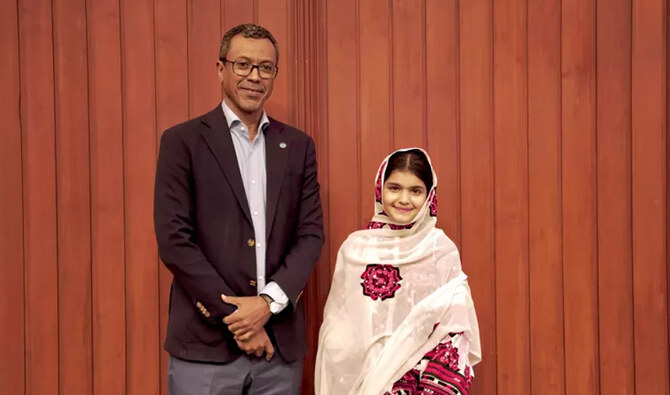
In this handout photo, released by UNICEF Pakistan on February 8, 2025, UNICEF Representative in Pakistan Abdullah A. Fadil gestures for a photograph with 14-year-old Pakistani girl Zunaira Qayyum, who hails from Hub district in Balochistan, in Islamabad, following her appointment as the Youth Advocate for Climate Action and Girls Empowerment in the country. (Photo courtesy: UNICEF)
Short Url
Updated 08 February 2025
Follow

UN agency names Pakistani teen as Youth Advocate for Climate Action, Girls Empowerment

  • 14-year-old Zunaira Qayyum hails from Hub in Balochistan and has previously collaborated with UNICEF
  • Her research on the impacts of climate-induced floods on girls’ education won the agency’s 2023 award

ISLAMABAD: A 14-year-old Pakistani girl championing climate action was appointed on Friday by the United Nations humanitarian and developmental agency for children as Youth Advocate for Climate Action and Girls Empowerment in the country, making her express the resolve for “meaningful change.”
Zunaira Qayyum, who hails from Hub district in Balochistan, has previously collaborated with UNICEF. Her research on the impacts of climate change-induced floods on girls’ secondary education in her native district was among the winners of the UNICEF Policy Research Challenge in 2023.
She has since trained adolescents in her hometown on advocacy, policy engagement, research and network building.
“I am honored to join UNICEF Pakistan as a Youth Advocate to champion children’s rights and well-being,” Qayyum was quoted as saying in a statement shared by the UN agency. “Meaningful change starts with listening to the voices of children and youth and making sure we can participate in decisions that shape our future.”
UNICEF appoints Youth Advocates to amplify children’s voices on critical issues such as climate change, education and child rights. The initiative aims to empower young leaders to engage in policymaking and raise awareness on global platforms. Similar appointments have been made in other countries, with young activists working on issues from environmental justice to gender equality.
Pakistan is increasingly vulnerable to climate change, with floods, droughts and heatwaves disrupting the lives of millions, including children. The UNICEF statement said climate-induced hazards disrupted schooling for 26 million children in 2024 alone.
In Punjab, 16 million children were affected when severe air pollution forced school closures in November.
“The climate crisis poses one of the biggest challenges we have ever faced, but when I listen to Zunaira and the children of Pakistan, I find hope and inspiration for the future,” said Abdullah Fadil, UNICEF Representative in Pakistan. “We must do more to empower children and young people with opportunities to lead, act and help this country prosper.”
Qayyum, who has represented Pakistan’s youth at national and international forums, including COP29, was appointed at the Dawn Media Breathe Pakistan Climate Conference. The UN agency expressed hope her advocacy will encourage more young people to take an active role in addressing climate and education challenges.


Pakistan to showcase BYD, Samsung, Google assembly push at ITCN Asia expo

Updated 15 January 2026
Follow

Pakistan to showcase BYD, Samsung, Google assembly push at ITCN Asia expo

  • STZA pavilion backed by SIFC highlights shift from tech services to manufacturing
  • Electric vehicles, electronics and data centers featured at Lahore exhibition

KARACHI: Pakistan will showcase electric vehicle and electronics assembly by global brands including BYD, Samsung and Google at ITCN Asia 2026, its largest tech expo, as the government seeks to signal a shift from technology consumption toward local manufacturing under its investment-led growth strategy.

The display will take place through a flagship national pavilion led by the Special Technology Zones Authority (STZA) at the three-day ITCN Asia exhibition beginning Jan. 17 at the Lahore Expo Center, with facilitation from the Special Investment Facilitation Council (SIFC), according to a statement issued on Thursday by the cabinet division. 

The move comes as Pakistan pushes to deepen industrial capacity and attract long-term foreign investment amid pressure to boost exports and reduce reliance on external financing. While Pakistan has traditionally positioned itself as a provider of IT services and outsourcing, officials have increasingly emphasized localized production in sectors such as electric vehicles, electronics, cloud infrastructure and data centers.

According to the statement, the STZA pavilion will be organized around three themes: “Manufactured in Pakistan,” “Powered by Pakistan,” and “Pakistan as a Tech Destination,” highlighting the country’s effort to integrate technology with manufacturing and physical infrastructure.

“Manufactured in Pakistan [is] a clear demonstration of Pakistan’s shift from technology consumption to localized production, featuring global brands manufacturing and assembling within STZA-notified zones for domestic and international Markets,” the press release by STZA said. 

“Exhibits include BYD Electric Vehicles, Google Chromebook Assembly through NRTC, and Samsung Electronics through Sapphire Group, underscoring Pakistan’s growing role in global manufacturing value chains.”

The digital infrastructure segment will showcase investments in data centers and computing capacity, with participation from firms including Multinet, a Pakistani telecom and data services provider, and Sky47, a local data center and cloud infrastructure operator, focusing on cloud services, connectivity and enterprise-grade digital platforms.

A third segment will highlight investment-ready technology zones, including Tech7 STZ and Winston STZ, privately developed Special Technology Zones that are building large-scale facilities such as offices, data centers and industrial space to support technology firms seeking to expand domestically and internationally.

STZA said it has notified 32 Special Technology Zones nationwide since its inception, hosting more than 250 technology enterprises and around 27,000 professionals across sectors including artificial intelligence, fintech, cloud computing, agritech, business process outsourcing and high-tech manufacturing such as drones, electronics and electric vehicles.

Under existing policy, technology firms operating within notified zones are eligible for income tax, customs duty and foreign exchange incentives until June 30, 2035, the statement said.

ITCN Asia is one of Pakistan’s largest annual technology exhibitions, drawing local and foreign investors, industry leaders and policymakers, and is being used this year to project Pakistan’s readiness for technology-driven manufacturing and infrastructure development.