

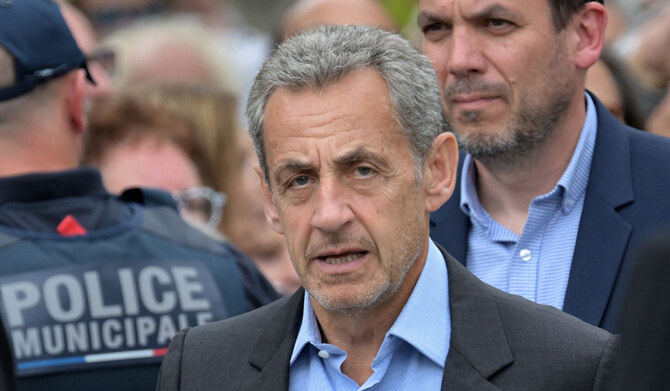
French ex-president Sarkozy gets electronic tag

Former French president Nicolas Sarkozy arrives to attend the funeral ceremony of the late French singer Francoise Hardy at the Pere Lachaise cemetery, in Paris, on June 20, 2024. (AFP)
Short Url
Updated 08 February 2025
Follow

French ex-president Sarkozy gets electronic tag

  • Sarkozy’s lawyer Jacqueline Laffont said he continued to contest the conviction for influence peddling and would lodge an application with the European Court of Human Rights this month, after exhausting all legal avenues in France

PARIS: Nicolas Sarkozy was fitted with an electronic tag Friday after being convicted of graft, prosecutors said, in a first for a former French president.
France’s highest appeals court in December ordered Sarkozy to wear the tag for a year, after finding him guilty of illegal attempts to secure favors from a judge.
Sarkozy, who turned 70 last week, was fitted with the ankle monitor at his home, the Paris prosecutor’s office said.
A judge summoned the ex-president on the day of his birthday and told him he would wear the monitor from February 7, a source close to the case said. The ankle bracelet was imposed as an alternative to spending one year in jail.
The right-wing politician, who was president from 2007 to 2012, would only be allowed out of his home between 8.00 am and 8.00 pm, the prosecutor’s office said.
He would however be allowed an extra hour and a half in the evenings three days a week when he attends court as an accused in another case.
In hearings that started last month and run through to April 10, Sarkozy has been charged with accepting illegal campaign financing from Libya before his 2007 election.
Sarkozy’s lawyer Jacqueline Laffont said he continued to contest the conviction for influence peddling and would lodge an application with the European Court of Human Rights this month, after exhausting all legal avenues in France.
Theoretically, the former head-of-state could also apply in France for a conditional release that can be given to people aged 70 and above.

Sarkozy has been shadowed by legal troubles since he lost the 2012 presidential election.
But he remains an influential figure and is known to regularly meet President Emmanuel Macron.
Before the latest trial, Sarkozy, his wife singer and former supermodel Carla Bruni and daughter went on holiday to the Seychelles. He is no longer able to travel.
In the case which led to the ankle bracelet, a court found that Sarkozy and a former lawyer, Thierry Herzog, had formed a “corruption pact” with judge Gilbert Azibert to obtain and share information about an investigating judge.
The deal was done in return for the promise of a plum retirement job for the judge.
The trial came after investigators looking into a separate case of alleged illegal campaign financing wiretapped Sarkozy’s two official phone lines, and discovered that he had a third, unofficial one.
It had been taken out in 2014 under the name “Paul Bismuth,” and only used for him to communicate with Herzog. The contents of these phone calls led to the 2021 corruption verdict.
Before Sarkozy, the only French leader to be convicted in a criminal trial was his predecessor Jacques Chirac, who received a two-year suspended sentence in 2011 for corruption over a fake jobs scandal.
But Sarkozy is France’s first post-war president to be sentenced to serve time.


Congressional candidates slam AIPAC influence in US elections

Updated 7 sec ago
Follow

Congressional candidates slam AIPAC influence in US elections

  • Democrats Joseph Ruzevich, Kina Collins, Bushra Amiwala say pro-Israel lobby group interfering in their races
  • They represent districts with large and growing Arab and Muslim constituencies

CHICAGO: Candidates in three Illinois congressional districts denounced the American Israel Public Affairs Committee at a press conference attended by Arab News on Thursday.

Democrats Joseph Ruzevich in the 6th District, Kina Collins in the 7th District and Bushra Amiwala in the 9th District accused the powerful lobby group of corrupting US elections and interfering in their races.

The three candidates, all running in the March 17 Democratic primary, represent districts with large and growing Arab and Muslim constituencies.

They said AIPAC pours millions of dollars into election campaigns to defeat candidates who criticize Israel.

“AIPAC and PACs like it do only one thing, fund negative attack ads on candidates and opponents,” said Ruzevich, whose district in the western suburbs of Chicago represents one of the largest concentrations of Arab voters in the country.

“We’d like to educate voters and candidates, offer solutions, and implore current elected officials running for reelection, and current candidates, to reject this money,” he added.

“This money is suffocating the voice of the voters. All three of us are Democrats here. It’s no longer enough to vote blue no matter who. We must make sure that we’re electing candidates who are loyal only to the people of their district.”

Ruzevich said: “AIPAC money undermines the voting rights of Americans and empowers foreign interests over American interests.

“We urge Americans to only vote for candidates who don’t accept AIPAC donations to their election campaigns.”

He added: “Americans must remain sovereign in America, and AIPAC's influence over our elections threatens that sovereignty.”

Ruzevich accused the incumbent in the 6th District, Congressman Sean Casten, of ignoring the concerns of Arab Americans there.

Casten, elected to Congress in 2019, has received hundreds of thousands of dollars in AIPAC funds. He has not responded to repeated requests for comment from Arab News.

Collins said AIPAC spent more than $500,000 to prevent her from winning election to the 7th Congressional District seat two years ago, and made false accusations that distorted her policies “all because I criticized Israel.”

She added: “I’m not for sale and our community isn’t for lease … Let’s be clear about what that money is doing … It’s being used to silence any voice that dares to stand up for human rights, for peace, and for an independent foreign policy that prioritizes people over the weapons industry.”

AIPAC “money goes way deeper than this election,” she said. “This is about a democracy that’s fragile right now. And we have the opportunity to change it.”

Amiwala said AIPAC money undermines the public debate on local issues such as funding families in need, improving education, and holding the line on rising costs for groceries, insurance and healthcare, instead pushing officials to focus on the political and financial needs of Israel’s government.

“Instead of confronting that reality, we’re finding our political system allows powerful interests to … pour extraordinary sums of money to shape American elections and American policy in the service of a foreign government,” she added.

“When you challenge AIPAC they come after you, after your family and after your allies, so you have to decide what kind of leader you’re going to be. Are you here to serve the public or to protect your own position?

“Just yesterday, Congress approved another $3.3 billion in weapons funding for Israel. Shame. Shame.”

The influence of AIPAC money has become a major controversy in this election cycle, with even Republicans speaking out for the first time.

Niki Conforti, who is running in the Republican primary in the 6th District on March 17, last week publicly said she refuses to accept AIPAC money. 

Kentucky Republican Thomas Massie is among 20 members of Congress who have denounced AIPAC’s influence over elections.

Former Republican Congresswoman Marjorie Taylor Greene said recently: “The truth is AIPAC doesn’t like it because I unapologetically represent American. AIPAC needs to register as a foreign lobbyist by US law because they’re representing the secular government of nuclear-armed Israel 100 percent.”

She added: “I believe that political donations from any foreign entity or organization can corrupt our politicians and undermine our democracy. We need to stop foreign entities from dictating our policies and influencing our elections.”

Illinois Democrat Anabel Mendoza, also running for Congress in the 7th District, last week urged voters at a press conference attended by Arab News to “vote against” candidates who accept AIPAC funds.

In the 2022 election cycle, AIPAC endorsed 365 candidates, donating $17.5 million to their campaigns.

A total of 349 out of the 535 members in the current Congress received AIPAC funds, according to data compiled from OpenSecrets.org and TrackAIPAC.com.