

‘World desires peace’: Pakistan’s AMAN-25 naval exercise kicks off in Karachi

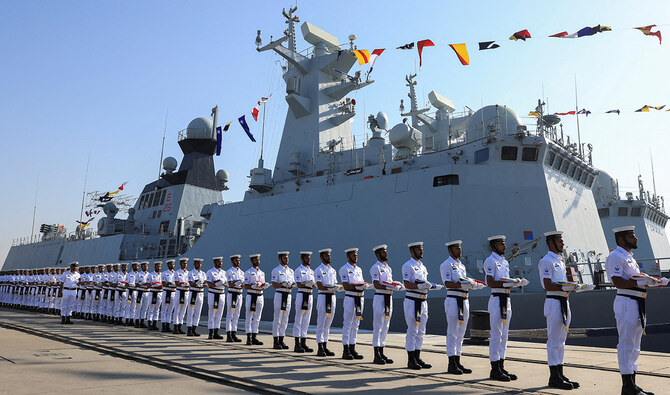
Pakistan Navy’s servicemen stand as they carry national flags of participating countries during the opening ceremony of Pakistan Navy’s 9th Multinational Maritime Exercise AMAN-25, under the slogan “Together for Peace,” in Karachi on February 7, 2025. (REUTERS)
Short Url
Updated 07 February 2025
Follow

‘World desires peace’: Pakistan’s AMAN-25 naval exercise kicks off in Karachi

  • Pakistan has conducted the exercise every two years since 2007 under the theme ‘Together for Peace’
  • The exercise has brought together participants from 60 countries, including officials of the Saudi Navy

KARACHI: Pakistan’s AMAN-25 multinational naval exercise kicked off on Friday with a flag-hoisting ceremony in Karachi, where the Pakistan Navy’s fleet commander lauded the participation of 60 nations as a testament to the world community’s desire for peace.
The Pakistan Navy has conducted the AMAN maritime exercise every two years since 2007 under the theme “Together For Peace,” involving ships, aircraft and special operations forces.
This year’s special feature is the inaugural AMAN Dialogue, themed “Secure Seas, Prosperous Future,” with a focus on security challenges in the Indian Ocean. These include strategic competition, piracy, narco-trafficking, non-state actors, resource exploitation, climate change, emerging technologies such as AI and unmanned systems, the blue economy and the need for global collaboration to ensure stability and prosperity.
“Today, we stand at a record, which is 60 countries participating in the exercise,” Rear Admiral Abdul Munib told Arab News after the inauguration. “That itself speaks to how the world community actually wants to get together for peace.”
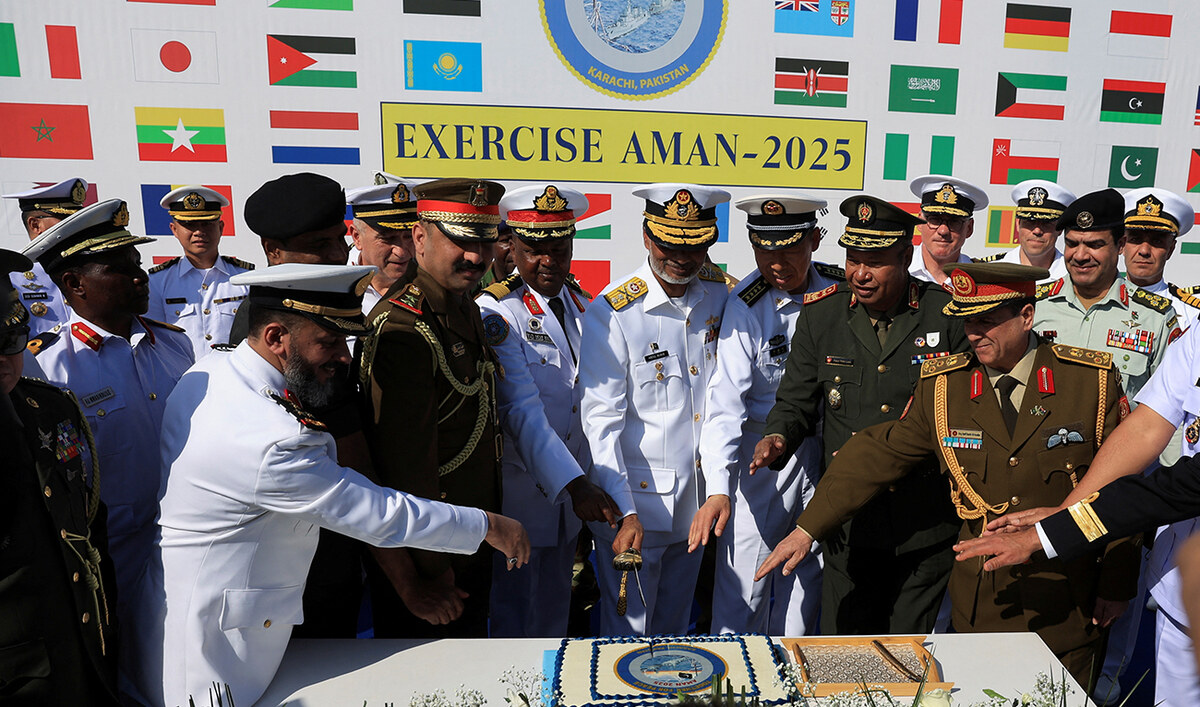


Commander of Pakistan Fleet Rear Admiral Abdul Munib, along with naval commanding officers of participating countries, cut a cake during the opening ceremony of Pakistan Navy’s 9th Multinational Maritime Exercise AMAN-25, under the slogan “Together for Peace,” in Karachi on February 7, 2025. (REUTERS)

He added that since 2007, when the multinational exercise was launched for the first time, strategic leadership was not involved in AMAN, a gap that led Pakistan’s naval chief to propose the idea of a dialogue.
“This was his vision whereby he perceived the idea of the AMAN Dialogue, whereby we invited like-minded nations, and you would see that many countries are being represented by their heads of navies, coast guards, and defense services,” he added.
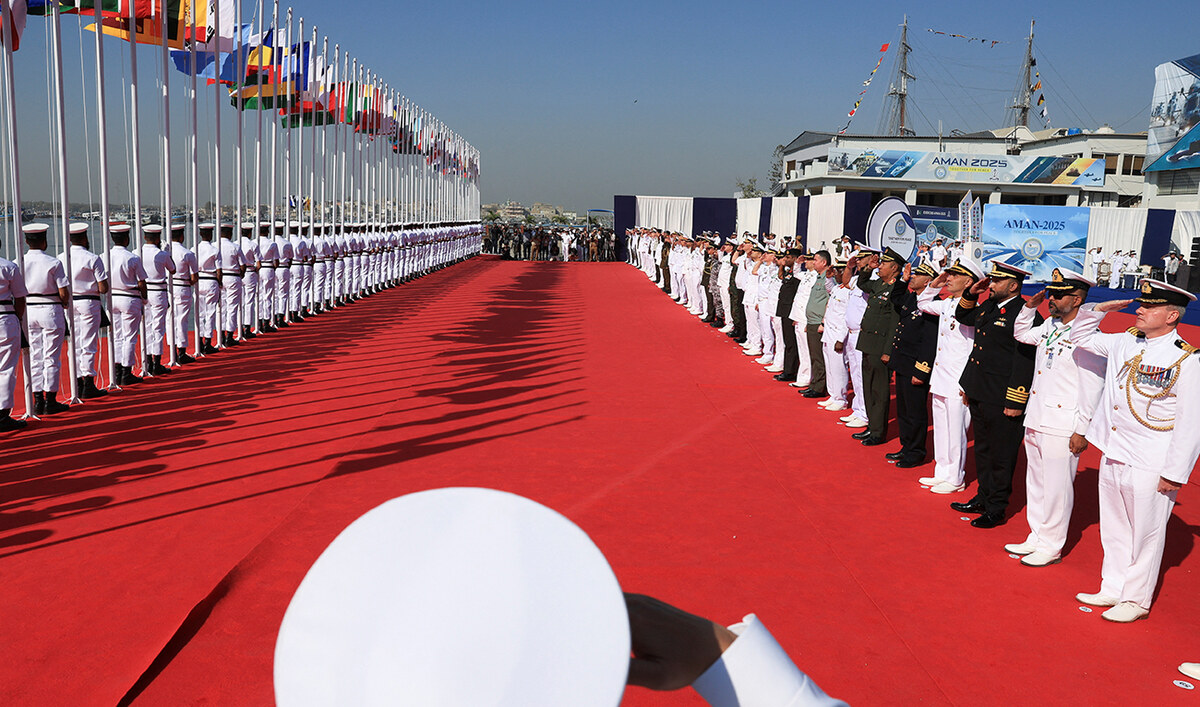


Naval commanding officers of participating countries salute as Pakistan Navy’s servicemen hoist the national flags during the opening ceremony of Pakistan Navy’s 9th Multinational Maritime Exercise AMAN-25, under the slogan “Together for Peace,” in Karachi on February 7, 2025. (REUTERS)

Earlier, he told a ceremony attended by naval officials from other countries that the dialogue aimed to promote a shared understanding of maritime security challenges and their linkage with the blue economy.
In a video message released by the Pakistan Navy, a Saudi official said that the Royal Saudi Navy was proud to participate in the exercises.
“The Royal Saudi Navy is proud to participate, reflecting our commitment to maritime security,” said Brig. (Staff) Bander Hamad S. Al-Hokubani, the Saudi military attaché in Islamabad. “We look forward to achieving its goals and strengthening ties with all participants.”


Pakistan Navy servicemen guard the area during the opening ceremony of Pakistan Navy’s 9th Multinational Maritime Exercise AMAN-25 under the slogan “Together for Peace,” in Karachi on February 7, 2025. (REUTERS)

The Saudi official added that the exercise was a key multinational effort to enhance maritime cooperation and address shared challenges.
According to the Pakistan Navy, the exercise will be conducted in two phases: a harbor phase from Feb. 7-9 and a sea phase, running from Feb. 10-11, which will include search-and-rescue operations, live weapon firings and an international fleet review.
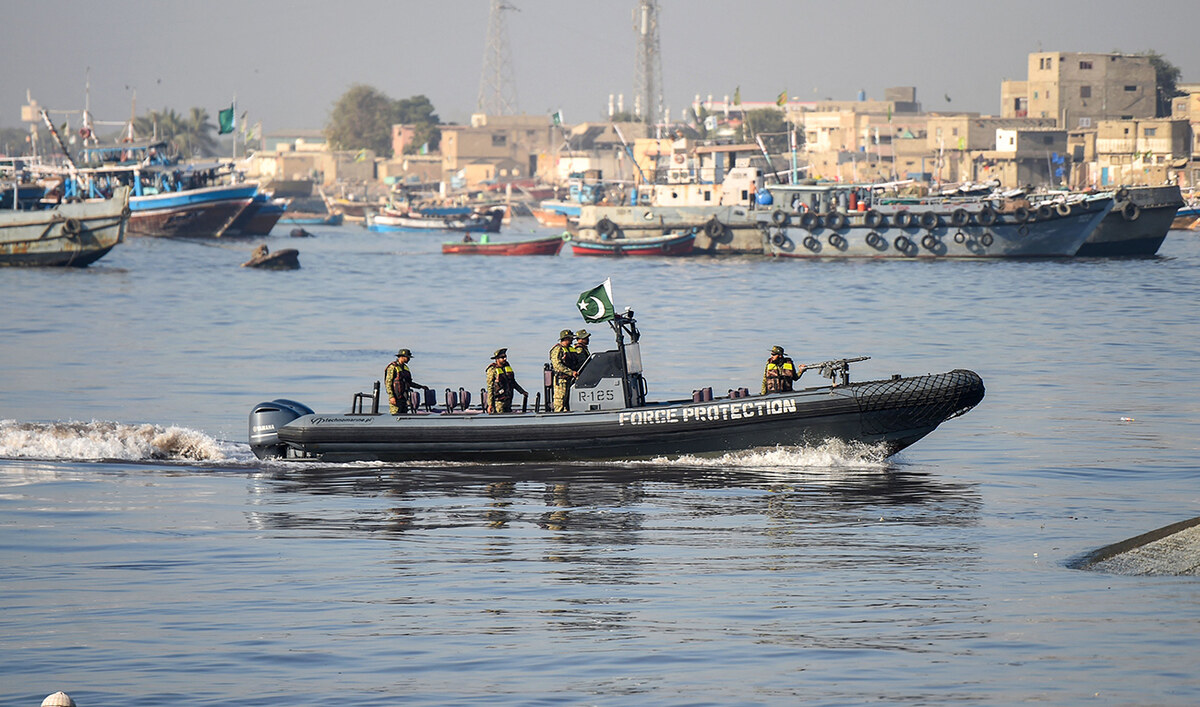


Pakistani navy patrol during a flag hoisting ceremony of multinational naval exercise AMAN-25 in Karachi on February 7, 2025. (AFP)

Main activities during the exercise will include a maritime counterterrorism demonstration by the Special Service Group (SSG) and Pak Marines, tabletop discussions on professional topics, and ship visits.
“An International Fleet Review is scheduled for February 11, 2025, alongside sea exercises to address collaborative security threats, with special operations forces, explosive ordnance disposal teams and marine units participating in developing tactics, techniques and procedures for multinational responses to asymmetric threats,” the Pakistan Navy’s press statement added.


Pakistan sends vessels to Saudi, UAE ports to secure crude supplies amid regional crisis

Updated 5 sec ago
Follow

Pakistan sends vessels to Saudi, UAE ports to secure crude supplies amid regional crisis

  • The development comes as countries scramble to secure energy supplies amid US-Israeli strikes on Iran and Tehran’s counterattacks
  • If Islamabad arranges, Aramco has assured a large crude carrier can be loaded at Yanbu and stationed near Pakistan, minister says

ISLAMABAD: Pakistan has sent vessels to ports in Saudi Arabia and the United Arab Emirates to secure crude oil supplies, the Pakistani petroleum minister said late Friday, as tensions in the Middle East continue to threaten global energy flows.

Global oil markets have been rattled since the United States and Israeli began pounding Iran last week, prompting retaliatory strikes from Tehran across the region. The conflict has raised fears of disruptions in energy supplies, particularly through the Strait of Hormuz, and pushed petroleum prices.

Pakistani Petroleum Minister Ali Pervaiz Malik and others said Islamabad was monitoring international energy markets and domestic supply conditions as they announced a hike of Rs55 ($0.20) per liter in petrol and diesel prices, promising to bring down the prices as soon as the conflict is resolved.

Describing the situation as “extraordinary,” Malik said they did not know how long the Middle East crisis would last and it was important to stretch Pakistan’s available petroleum reserves as much as they could to ensure a steady supply to consumers during the crisis.

“At the regional and global level, you can clearly see that countries are scrambling to secure energy supplies. Pakistan is also part of this effort because a significant portion of our energy supplies comes through the Strait of Hormuz,” he said, adding that Prime Minister Shehbaz Sharif has engaged the Saudi government to secure alternative sources.

“With the help of the Foreign Office, two Pakistan National Shipping Corporation (PNSC) vessels are currently on their way, one toward Yanbu port and the other toward Fujairah port, to bring crude oil from outside the Hormuz region in order to meet Pakistan’s energy needs.”

In addition, he said, Aramco had assured that if Pakistan arranged, a Very Large Crude Carrier (VLCC) can be loaded at Yanbu and stationed near the Pakistani waters.

“From there, PNSC (Pakistan National Shipping Corporation) feeder vessels will ensure a continuous supply of crude oil to our refineries, so that even during this difficult phase Pakistan’s energy requirements continue to be met,” Malik shared.

The statement came as long queues of vehicles were seen outside petrol stations nationwide as Islamabad moved to raise petroleum prices to keep the supplies in check.

Pakistan, which relies heavily on imported fuel to meet its energy needs, is particularly vulnerable to global oil price shocks that can quickly feed into inflation and pressure the country’s external accounts.

Officials at Friday’s presser said Pakistan, which reviews petroleum prices fortnightly, will be considering them more frequently, potentially on a weekly basis, and any reduction in global oil prices would be passed on to consumers.

Finance Minister Aurangzeb said a high-level government committee formed by PM Sharif had been meeting daily to review developments in global petroleum markets and their potential impact on Pakistan’s economy.

“Pakistan currently maintains adequate energy stocks and macroeconomic stability,” Aurangzeb said, adding that the government’s response was based on preparedness rather than panic.