

Saudi Arabia says ‘proud’ to participate as Pakistan’s AMAN-25 naval exercise kicks off 

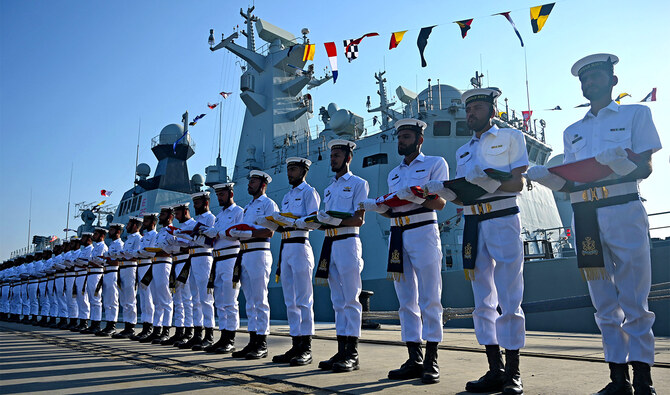
Pakistani navy carry flags of foreign countries participating during the multinational naval exercise AMAN-25 in Karachi on February 7, 2025. (AFP)
Short Url
Updated 10 February 2025
Follow

Saudi Arabia says ‘proud’ to participate as Pakistan’s AMAN-25 naval exercise kicks off 

  • Pakistan Navy has conducted AMAN maritime exercise every two years since 2007 under the theme “Together For Peace”
  • This year’s edition will include the inaugural AMAN Dialogue for senior naval and other leaders from participating nations

KARACHI: Saudi Arabia said this week it was “proud” to participate in Pakistan’s AMAN maritime exercises that start today, Friday, adding that the multinational effort would enhance maritime cooperation and help address shared challenges.

The Pakistan Navy has conducted the AMAN (peace) maritime exercise every two years since 2007 under the theme “Together For Peace,” involving ships, aircraft and special operation forces. 

This year’s special feature is the inaugural AMAN Dialogue themed “Secure Seas, Prosperous Future,” with a focus on security challenges in the Indian Ocean. These include strategic competition, piracy, narco-trafficking, non-state actors, resource exploitation, climate change, emerging technologies like AI and unmanned systems, the blue economy, and the need for global collaboration to ensure stability and prosperity.

A senior Pakistani naval official said on Tuesday two Saudi warships, HMS Jazan and HMS Hail, would participate in AMAN-25, the exercise’s ninth edition, scheduled to be held from Feb. 7-11.

“Exercise AMAN is a key multinational effort to enhance maritime cooperation and address shared challenges,” Brig. (Staff) Bander Hamad S Al-Hokubani, the Saudi Military Attache in Islamabad, said in a video message. 

“The Royal Saudi Navi is proud to participate, reflecting our commitment to maritime security. We look forward to achieving its goals and fostering stronger ties with all participants.”

According to the Pakistan navy, nearly 60 countries will participate in this year’s AMAN exercise, with a wide range of maritime professionals and over 200 observers from around the world attending. The exercise will be conducted in two phases: a harbor phase from Feb. 7-9 and a sea phase, running from Feb. 10-11, which will include search and rescue operations, live weapon firings and an international fleet review.

The inaugural AMAN Dialogue is also expected to bring together chiefs of navies, coast guards and heads of defense forces of participating countries.

“Due to the growing global participation over the years, PN has initiated the AMAN Dialogue as an adjunct to the exercise and its inaugural session will be held in tandem with AMAN-25,” the Pakistan Navy said in a statement on Jan. 14, adding that the aim of the dialogue was to provide a “dedicated forum” for senior leaders to discuss regional security and evolving challenges at sea.

“AMAN dialogue will include a summit of chiefs of navy and coast guards, a seminar encompassing academic activities and bilateral meetings between delegations.

“The main objectives are to promote peace and regional cooperation, enhance interoperability with regional and extra regional navies, thereby acting as a bridge between the regions, displaying united resolve against terrorism and crimes in the maritime domain.”

Other objectives of the dialogue include understanding maritime security issues and challenges confronting the region and their linkages with the economy.

Main activities during the exercise will include a maritime counter-terrorism demo by the Special Service Group (SSG) and Pak Marines, table top discussions on professional topics, and ship visits.

“An International Fleet Review is scheduled for February 11, 2025, alongside sea exercises to address collaborative security threats, with Special Operations Forces, Explosives Ordnance Disposal, and Marines teams participating in developing Tactics, Techniques, and Procedures for multinational responses to asymmetric threats,” the Pakistan Navy press statement added.


Women traders face ruin as years of work turn to ash in deadly plaza inferno

Updated 5 sec ago
Follow

Women traders face ruin as years of work turn to ash in deadly plaza inferno

  • Traders estimate losses of over $53 million, more than 100 women workers, dozens of women-led businesses wiped out in Gul Plaza fire
  • In Pakistan, where women run a fraction of formal enterprises, disasters like Gul Plaza fire can erase decades of efforts overnight

KARACHI: Yasmeen Bano stood on the edge of MA Jinnah Road, staring at the blackened remains of Gul Plaza, a shopping center that for decades had been a gateway to financial independence for small traders in Pakistan’s commercial capital.

For Bano, a 55-year-old businesswoman, the charred structure represents far more than a shopping mall. It held the labor of two decades, the savings of a lifetime and the fragile economic security of her family, all wiped out in a deadly fire that tore through the multi-story plaza last week.

Bano began her ladies’ undergarments business in the mid-2000s, gradually expanding to own three shops in the bustling market, a rare achievement in a country where women face steep barriers to entrepreneurship. 

That progress vanished in hours as a blaze broke out on Jan. 17, trapping workers and shoppers inside and burning for more than 24 hours before being brought under control. Recovery operations are still underway as teams sift through unstable debris at the site, which housed over 1,200 shops.

“For 20 years, we worked day and night to build this business,” Bano told Arab News, standing near the wreckage. “I had three shops above, which were my own. All of them have been destroyed.”

Like many traders at Gul Plaza, she had restocked heavily ahead of the wedding season and the holy fasting month of Ramadan starting next month, when sales typically peak. Her inventory, worth around Rs15 million ($53,800), was entirely destroyed.

“All the season’s goods came on loan. Everything is finished,” she said. “Now we have nothing [left], we are insolvent financially.”

FRAGILE FOOTHOLD ERASED

Women entrepreneurs were among the hardest hit by the blaze, traders say. Many had invested personal savings, borrowed informally or relied on family credit to run small businesses that served as their households’ sole source of income.

In Pakistan, women own or lead only a small share of businesses. According to the World Bank and government data, fewer than 5 percent of women participate in formal entrepreneurship, with most operating in the informal sector, where access to insurance, credit protection and safety nets is minimal. In cities like Karachi, markets such as Gul Plaza have long offered women one of the few accessible entry points into commerce.

That precarious foothold has now collapsed.

Kainat Memon, an 18-year-old medical student, ran an undergarments shop with her widowed mother. Both were present when the fire broke out in the building, which housed around 1,200 shops selling garments, luggage, crockery and household goods.

“It was time to close the shop. Everyone was closing their shops... Suddenly there was a loud noise. People started saying that there is a fire,” she recalled.

“We were crying and our eyes were burning. We were having a hard time talking.”

The losses are devastating.

“We have incurred a loss of Rs7–8 million ($28,600) because we had stocked up. Ramadan was coming,” Memon said. “The goods are all burnt. We had invested all our savings. Now we are jobless. All our business is gone.”

For women traders, the losses extended beyond their own families. Many employed other women, often from low-income households, who depended on daily wages or monthly salaries.

“From the basement to the fourth floor, women work here. There are more than a hundred women working here,” said Aisha Farrukh, a 37-year-old trader whose family also lost its business in the blaze.

“Our workers are jobless. We can’t do anything for them now.”

Karachi has a long history of deadly fires in markets and factories, often linked to faulty wiring, overcrowding, illegal construction and weak enforcement of safety regulations. Police have said the Gul Plaza fire may have been triggered by a short circuit, though investigations are ongoing.

Farrukh questioned how quickly the fire spread through the building, saying safety measures were inadequate.

“The government would have to compensate for the financial losses but at this moment, it is difficult to understand how in 10 minutes the entire Gul Plaza turned to ash,” she said. 

“In front of our eyes, our 20 years of hard work turned to ash in under 20 minutes.”

LONG ROAD BACK

The scale of the losses has pushed many traders into insolvency. Tanveer Pasta, president of the Gul Plaza Market Association, said all shops in the plaza were destroyed, estimating total losses at up to Rs15 billion ($53.6 million).

“There were big importers sitting here,” he said. “Just three days before this fire, 31 [shipping] containers were unloaded.”

For women like Bano, Memon and Farrukh, the fire has stripped away not just income but autonomy, turning business owners into debtors overnight in an economy already strained by inflation and slow growth.

The traders are now appealing for government support, warning that without assistance, many women-led enterprises will never reopen.

“We are ruined now,” Farrukh said. “Whether it happened accidentally or because of someone, we need a solution.”