

Pakistan Navy announces participation of two Saudi warships in AMAN-25 naval drills

Commander of Pakistan Fleet, Rear Admiral Abdul Munib, addresses a press briefing ahead of Pakistan Navy’s 9th Multinational Maritime Exercise AMAN-25 under the slogan “Together for Peace,” in Karachi on February 4, 2025. (REUTERS)
Short Url
Updated 04 February 2025
Follow

Pakistan Navy announces participation of two Saudi warships in AMAN-25 naval drills

  • The ninth edition of Pakistan’s AMAN exercise will be held this month from February 7 to 11
  • AMAN-2025 will witness the participation of nearly 60 countries with over 200 observers

KARACHI: A senior Pakistani naval official said on Tuesday two Saudi warships, HMS Jazan and HMS Hail, will participate in the ninth edition of his country’s naval exercise, AMAN-25, which is scheduled to be held from February 7 to 11.
The AMAN exercise, held every two years in the North Arabian Sea, is a multinational naval drill organized by the Pakistan Navy to enhance regional maritime security and interoperability among allied forces. The exercise was first held in 2007 and has since attracted participants from across the world.
According to official information, AMAN-2025 will witness the participation of nearly 60 countries and will be conducted in two phases. The harbor phase will take place from February 7 to 9, while the sea phase, running from February 10 to 11, will include search and rescue operations, live weapon firings and an international fleet review.
Rear Admiral Abdul Munib, Commander of the Pakistani Fleet, highlighted his country’s strong maritime ties with Saudi Arabia during a news conference.
“Saudi Arabia is a brotherly country,” he said, as he mentioned the participation of the Royal Saudi Naval Forces in the exercise while pointing out that Pakistan also enjoyed close relations with the United Arab Emirates (UAE).
“Pakistan’s relations with both these countries are already strong, but there is also a very close navy-to-navy collaboration with them,” he continued. “We have conducted a number of exercises with them, and both countries will also be actively participating in this exercise.”
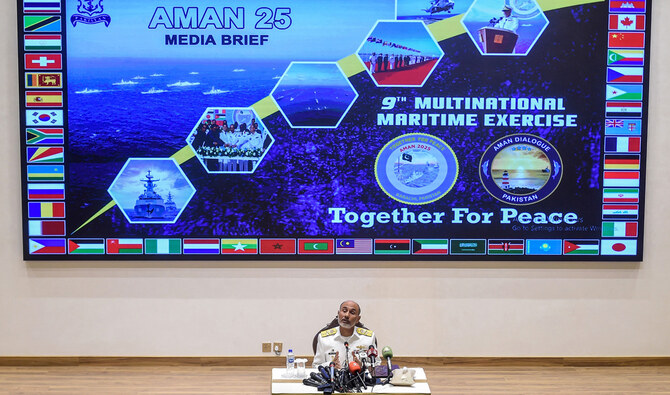


Commander of Pakistan Fleet, Rear Admiral Abdul Munib, speaks during a press conference ahead of the 9th Multinational Maritime Exercise AMAN-25, in Karachi on February 4, 2025. (AFP)

Calling the participation from Saudi Arabia “very encouraging,” the naval official said in addition to the two Saudi ships, the Kingdom’s Special Operations Forces (SOF) and Underwater Demolition (UWD) teams would also participate.
“The UAE has one ship participating as well, and their SOF and UWD teams are also participating,” he added.
This year’s exercise is expected to include a wide range of maritime professionals, with over 200 observers from around the world in attendance.
The Pakistani rear admiral noted the role of the AMAN Dialogue, which is scheduled to take place alongside the exercise. He informed it will bring together naval chiefs, coast guards and defense forces from participating nations.
The forum will allow military leaders to exchange insights and discuss strategies for addressing emerging maritime challenges.
“More than just a military drill, AMAN embodies Pakistan’s unwavering commitment to fostering regional stability, ensuring safe and secure seas and countering nontraditional and asymmetric threats,” he maintained.
“Above all, it serves as a vital platform for strengthening interoperability, information sharing and mutual understanding among like-minded regional and extra-regional navies, thus reinforcing the belief that maritime security is a shared responsibility,” he added.


UNESCO lists Pakistan’s ancient Bareendo instrument as endangered cultural heritage

Updated 10 December 2025
Follow

UNESCO lists Pakistan’s ancient Bareendo instrument as endangered cultural heritage

  • 5,000-year-old Sindhi clay wind instrument placed on UNESCO urgent safeguarding list
  • Only two known practitioners remain as Pakistan launches four-year preservation plan

ISLAMABAD: Pakistan’s 5,000-year-old folk instrument Bareendo has been added to UNESCO’s Intangible Cultural Heritage list for urgent safeguarding, the UN agency said this week, placing it among cultural traditions considered at immediate risk of disappearing.

Believed to originate in the ancient Indus Valley Civilization, the clay wind instrument is the oldest known surviving musical form in the southern Sindh province. Its soft, breath-driven tones have accompanied Sufi devotional gatherings, winter festivals and village ceremonies for generations, forming a core part of Sindh’s musical and spiritual identity.

The inscription was approved at the 20th Session of UNESCO’s Intergovernmental Committee for Intangible Cultural Heritage, which documents vulnerable cultural practices globally, from oral folklore to craftsmanship, to ensure they are preserved and passed on.

UNESCO announced the listing on X on Tuesday:

“New inscription on the Urgent Safeguarding List of Intangible Heritage: Boreendo, Bhorindo: ancient dying folk musical instrument, its melodies, knowledge, and skills.”

Pakistan’s Permanent Delegate to UNESCO, Ambassador Mumtaz Zahra Baloch, welcomed the move, calling it the recognition of a tradition preserved through centuries of community transmission.

“Bareendo is not only an emblem of the Indus Valley’s cultural continuity but also a living expression of Sindh’s artistic and spiritual heritage,” she was quoted as saying by Pakistan’s Embassy in France. 

“This recognition by UNESCO reaffirms Pakistan’s commitment to the protection and promotion of our diverse cultural traditions.”

Only two people are believed to retain full mastery of Bareendo today, musician Ustaad Faqeer Zulfiqar and master potter Allah Jurio, underscoring why the nomination was marked urgent, the embassy said. 

The nomination followed an intensive consultation process between the Sindh government, Pakistan’s Mission to UNESCO and UNESCO headquarters in Keti Mir Muhammad Loond village and led to a four-year safeguarding strategy (2026–2029). Planned measures include a community music school, integration into formal and informal education and digital archiving to open access beyond Sindh’s rural belt.

With this recognition, Bareendo joins existing UNESCO-listed intangible traditions like Suri Jagek (the astronomical knowledge of the Kalash people), Falconry, and Nowruz, the regional spring new year.