

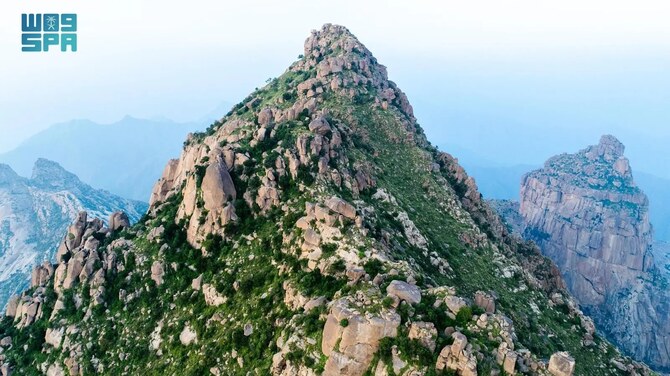
Shada Al-Ala Mountain: Historic gem draws visitors to Al-Baha

1 / 2
The region is also celebrated as the area where Shadawi coffee is cultivated.(SPA)
2 / 2
The region is also celebrated as the area where Shadawi coffee is cultivated.(SPA)
Short Url
Updated 07 February 2025
Follow

Shada Al-Ala Mountain: Historic gem draws visitors to Al-Baha

  • The oratory of Shada Al-Ala Mountain is atop Jabal Shada in Al-Makhwah Governorate, occupying an area of about 9 sq. meters

RIYADH: The Al-Baha region in southwest Saudi Arabia features a rich tapestry of archaeological sites and historic structures that span various eras, highlighting the area’s deep cultural heritage. 

These landmarks not only preserve the region’s historical legacy but also serve as enduring symbols of its vibrant past. 

Among the most notable are Al-Qara Hill and the oratory of Shada Al-Ala Mountain.

The oratory of Shada Al-Ala Mountain is atop Jabal Shada in Al-Makhwah Governorate, occupying an area of about 9 sq. meters, the Saudi Press Agency reported. 

Built along the entire perimeter of the mountain’s peak, it rises more than 2,200 meters above sea level, requiring an arduous four-hour trek from the nearest village to reach it. 

Despite its isolation, the oratory has remarkably preserved its four walls, although its roof has collapsed and remains unrestorable due to the site’s extreme inaccessibility and the rugged terrain leading to it.

During a visit to Shada Al-Ala Mountain, an SPA correspondent met with researcher Saeed Al-Shadwi, who elaborated on the historical significance of Mount Shada and Shadwan as prominent geographical landmarks. 

He highlighted their presence in numerous glossaries, historical records and poetic works dating back to the sixth century.

Al-Shadwi noted that the white rock situated beneath the mountain to the northwest is a triangular formation commonly known as “Al-Marwa” and the summit is named “Qimmat Al-Marwa” after it, as referred to by the villagers. 

The Shada Al-Ala and Al-Asfal mountains are home to a wealth of historical sites and landmarks that date back thousands of years. Among them are ancient caves, rock inscriptions, the Shada Mountain Reserve, and the oratory. 

The region is also celebrated as the area where Shadawi coffee is cultivated.


Sustainability in focus as Madinah marks World Soil Day

Updated 06 December 2025
Follow

Sustainability in focus as Madinah marks World Soil Day

MADINAH: Madinah joined the world in celebrating World Soil Day on Dec. 5, highlighting the importance of soil conservation for food security and ecosystems, according to the Saudi Press Agency.

The day holds added significance in Madinah due to its rich agricultural history, diverse soil types — from clay to sand and volcanic Harrat — and its longstanding connection to date production.

The region’s soil faces challenges, notably salinization from imbalanced irrigation and climate change, the SPA added.

Authorities are addressing this through soil protection programs, improved irrigation techniques and sustainable agricultural practices.

Soil plays a vital role in water purification, acting as a natural filter. As winter begins, it is an opportune time to prepare soil for spring, expanding crop cultivation and harvest, the SPA reported.

The Ministry of Environment, Water and Agriculture in Madinah is implementing initiatives to enhance resource efficiency, raise farmer awarenes and combat desertification. Farmers contribute by using organic fertilization and recycling agricultural waste.

World Soil Day highlights the need for collaboration between government agencies, farmers and stakeholders to ensure soil sustainability, preserve agricultural heritage and support Vision 2030’s sustainable development goals.

Approved by the Food and Agriculture Organization in 2013, World Soil Day aims to raise awareness of soil’s critical role in healthy ecosystems and human well-being.