

Saudi pavilion at Delhi book fair features English translations of Kingdom’s literature

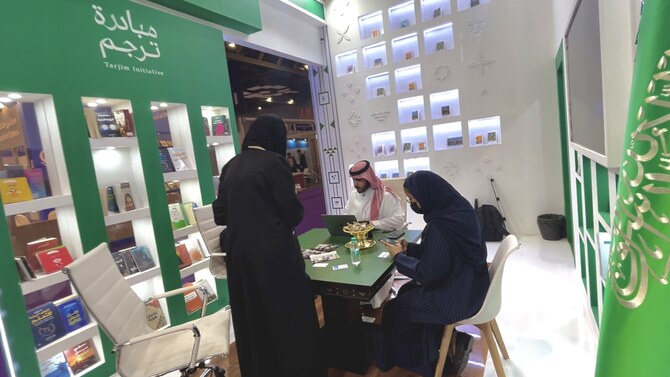
The Tarjuma initiative corner of the Saudi pavilion at the New Delhi World Book Fair in New Delhi, Feb. 4, 2025. (AN Photo)
Short Url
Updated 07 February 2025
Follow

Saudi pavilion at Delhi book fair features English translations of Kingdom’s literature

  • India’s second-oldest book fair attracts 2,000 exhibitors from 40 countries
  • Saudi Arabia was guest of honor of the New Delhi World Book Fair in 2024

New Delhi: Saudi Arabia’s exhibition at the New Delhi World Book Fair is bringing the Kingdom’s literature closer to the Indian audience with a display of its English-language translations under the flagship Tarjim initiative.

Inaugurated in 1972, the fair in the Indian capital is the country’s second oldest after the Kolkata Book Fair.

Organized by the National Book Trust of India, the event started on Feb. 1 at the Pragati Maidan convention center and will run through Feb. 9. It is attended by 2,000 exhibitors from about 40 countries.

Saudi Arabia — which in 2024 was guest of honor of the book fair — this year is represented by the Literature, Publishing and Translation Commission, a government agency regulating and managing literature in the Kingdom.

The part of the exhibition that has drawn significant interest among Indians comprises English translations of Arabic works published under the Tarjim program, which was launched in 2020 to promote international cultural outreach under the Kingdom’s Vision 2030.

The books displayed at the New Delhi fair included classics, fiction, and short stories.

Mona Lisa, a Delhi-based lawyer who visited the Saudi pavilion, appreciated the exhibition as a way to remove linguistic barriers and help Indians grasp the Kingdom’s culture.

“It’s nice to know that Saudi Arabia is trying to bridge the gap in terms of language,” she told Arab News.

“It’s a nice move by Saudi Arabia ... by the way of literature we’ll be able to know the culture, the people better. It’s always good to know something that you didn’t know before. It’s good to know the culture as well. And I’m looking forward to seeing much more.”

Another visitor, Zohra Fatima, was drawn especially to short fiction stories as a way to imagine and understand life in Saudi Arabia.

“It seems very interesting ... to know deep inside their culture, one has to read this kind of tale,” she said.

Besides the translations, Saudi Arabia’s pavilion also presented the country’s national bibliography — a catalog of all publications, including books, articles, and reports, produced in the Kingdom.

“National bibliography is basically a list of books published in a particular country,” said Dr. Prathasari Das, library information officer at the National Library of India, who was studying the works displayed at the exhibition.

“It is very nice to see this bibliography here to introduce the print culture — the print output in Saudi Arabia — to India ... Books are those mediums which connect different cultures around the world, so it’s like a window. I think that it will be a great help or great opportunity for Indians to see and mingle with this culture.”

For some, like Shivani Nagar, a French linguistics student in New Delhi, visiting the pavilion was not only about literature, but also the Arabic language.

“I met the employees here and they taught me some words in Arabic, and I found it really interesting and, in my mind, I’m really hoping to learn more,” she said.

“It’s very good that they are putting English books so that I can learn about Arab culture in English, in my language ... (and) I can know about the culture, and (then) I can turn my goal to learning Arabic.”


Philippines eyes closer cooperation on advanced defense tech with UAE

Updated 7 sec ago
Follow

Philippines eyes closer cooperation on advanced defense tech with UAE

  • Philippine-UAE defense agreement is Manila’s first with a Gulf country
  • Philippines says new deal will also help modernize the Philippine military

MANILA: The Philippines is seeking stronger cooperation with the UAE on advanced defense technologies under their new defense pact — its first such deal with a Gulf country — the Department of National Defense said on Friday.

The Memorandum of Understanding on Defense Cooperation was signed during President Ferdinand Marcos Jr.’s visit to Abu Dhabi earlier this week, which also saw the Philippines and the UAE signing a comprehensive economic partnership agreement, marking Manila’s first free trade pact with a Middle Eastern nation.

The Philippines-UAE defense agreement “seeks to deepen cooperation on advanced defense technologies and strengthen the security relations” between the two countries, DND spokesperson Assistant Secretary Arsenio Andolong said in a statement.

The MoU “will serve as a platform for collaboration on unmanned aerial systems, electronic warfare, and naval systems, in line with the ongoing capability development and modernization of the Armed Forces of the Philippines,” he added.

It is also expected to further military relations through education and training, intelligence and security sharing, and cooperation in the fields of anti-terrorism, maritime security, and peacekeeping operations.

The UAE’s Ministry of Foreign Affairs has described security and defense as “very promising fields” in Philippine-UAE ties, pointing to Abu Dhabi being the location of Manila’s first defense attache office in the Middle East.

The UAE is the latest in a growing list of countries with defense and security deals with the Philippines, which also signed a new defense pact with Japan this week.

“I would argue that this is more significant than it looks on first read, precisely because it’s the Philippines’ first formal defense cooperation agreement with a Gulf state. It signals diversification,” Rikard Jalkebro, associate professor at the Anwar Gargash Diplomatic Academy in Abu Dhabi, told Arab News.

“Manila is widening its security partnerships beyond its traditional circles at a time when strategic pressure is rising in the South China Sea, and the global security environment is (volatile) across regions.”

Though the MoU is not an alliance and does not create mutual defense obligations, it provides a “framework for the practical stuff that matters,” including access, training pathways, procurement discussions and structured channels” for security cooperation, he added.

“For the UAE, the timing also makes sense, seeing that Abu Dhabi is no longer only a defense buyer; it’s increasingly a producer and exporter, particularly in areas like UAS (unmanned aerial systems) and enabling technologies. That opens a new lane for Manila to explore capability-building, technology transfer, and industry-to-industry links,” Jalkebro said.

The defense deal also matters geopolitically, as events in the Middle East and the Indo-Pacific region have ripple effects on global stability and commerce.

“So, a Philippines–UAE defense framework can be read as a pragmatic hedge, strengthening resilience and options without formally taking sides,” Jalkebro said.