

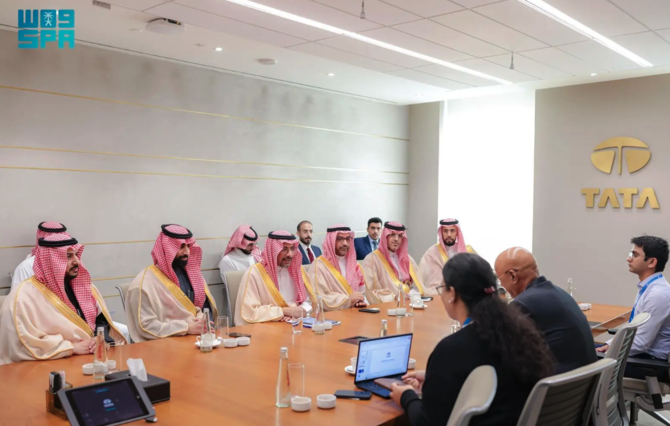

RIYADH: Saudi Arabia is exploring collaboration opportunities with India’s largest business conglomerate Tata Group in multiple sectors, including military, aviation, and electronics.
According to a Saudi Press Agency report, the Kingdom’s Minister of Industry and Mineral Resources, Bandar Alkhorayef, met with officials of the group’s affiliates, Tata Aerospace & Defence, Tata Electronics, and Tata Steel, where he discussed cooperation avenues.
During the meeting, the Saudi minister outlined the economic diversification goals of the Vision 2030 program and highlighted investment opportunities in the country’s industrial sector.
The Indian conglomerate’s affiliate Tata Motors is already operating in Saudi Arabia, with the automobile manufacturer celebrating its 30th anniversary in the Kingdom in November.
India and Saudi Arabia share a strong trade and bilateral relationship, and according to the latest report by the General Authority for Statistics, India was the second favorite destination for the Kingdom’s non-oil exports in November, with outbound shipments to the Asian nation amounting to SR2.52 billion ($670 million) — a rise of 19.43 percent compared to the previous month.
During the meeting with Alkhorayef, Sukaran Singh, CEO of Tata Advanced Systems, showcased the company’s products, including military aircraft and vehicles.
He also highlighted the firm’s expertise in designing, building, and operating military factories.
TV Narendran, CEO of Tata Steel, showcased the company’s expertise in exporting materials in the construction, automotive, and supply chain sectors across various international markets.
SPA added that Tata Electronics and Saudi Arabia’s National Industrial Development Center also discussed potential collaboration opportunities to foster the development of the semiconductor industry within the Kingdom.
Alkhorayef’s visit to India had already seen a new deal prior to the latest meeting, with the countries agreeing to strengthen cooperation in the critical minerals sector on Feb. 4.
The Saudi official and Indian Minister of Coal and Mines G. Kishan Reddy discussed building a resilient mineral supply chain to reduce import dependency and promoting joint ventures in the critical minerals sector to support the energy transition journey.
On Feb. 5, Alkhorayef attended a roundtable meeting in Mumbai, where he highlighted the Saudi-India Business Council’s efforts to strengthen bilateral economic relations, trade, and cross-border investments between the two nations.
The minister also emphasized that Saudi Arabia’s Vision 2030 seeks to diversify the economy and create clear, transparent investment opportunities for investors.
He further noted that the industry and mining sectors are key to achieving the Kingdom’s economic diversification goals under Vision 2030.
“When I review our ambitions in the mining and industrial sectors and see the capabilities that exist here in India, I see a great harmony that makes cooperation between us very feasible,” said Alkhorayef.
He added that India’s 170-year history in the mining sector presents significant opportunities for both countries to collaborate in the minerals industry.
The minister also expressed his readiness to supply critical minerals to India as New Delhi works to accelerate its green energy transition.
“In the past we were talking about energy security, now we are talking about future mineral security, and by working between the two countries together from an early age, we can understand India’s needs in the metals sector,” the minister added.
He noted that both countries can enhance cooperation in sectors such as pharmaceuticals, biotechnology, and petrochemicals.
The minister also revealed that Saudi Arabia imported 700,000 cars in 2024, with projections suggesting that inbound shipments could soon reach one million.
Highlighting progress in Saudi Arabia’s localization efforts, Alkhorayef added that the Kingdom has licensed three car manufacturers to begin local production, aiming for an annual production of 300,000 cars by 2030.
Alkhorayef began his visit to India on Feb. 3, leading a high-level delegation from the industry ministry and the Local Content and Government Procurement Authority. The meeting aimed to enhance industrial collaboration with India and attract high-value investments.
Earlier this month, Saudi Arabia’s Deputy Minister of Finance for International Relations Khalid Bawazier met with Suhel Ajaz Khan, ambassador of India to the Kingdom, where they discussed bilateral relations and other issues of common interest.


