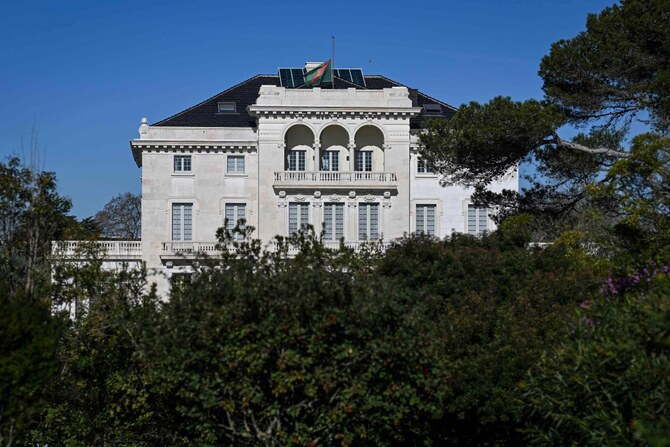
LISBON: The late Prince Karim Al-Hussaini Aga Khan IV, who died on Tuesday in Lisbon after nearly seven decades as the spiritual leader of the global Ismaili Muslim community, will be buried in Egypt on Sunday, according to the Ismaili Imamat.
After a funeral ceremony at the Ismaili Center in the Portuguese capital on Saturday — to be attended by leaders of the community, Portuguese government members and foreign dignitaries — Aga Khan IV will be laid to rest at a private burial ceremony in Aswan, Egypt on Sunday, it said in a statement on Thursday.
Known for his wealth and development work around the world through the Aga Khan Development Network, Prince Karim died in Lisbon, the seat of the Ismaili Imamat, at age 88 on Tuesday.
His son, Prince Rahim Al-Hussaini was named the 50th hereditary Imam, or spiritual leader, on Wednesday, according to his father’s will.
As Aga Khan — derived from Turkish and Persian words to mean commanding chief — he is believed by Ismailis to be a direct descendant of the Prophet Muhammad through the prophet’s cousin and son-in-law, Ali, the first Imam, and his wife Fatima, the Prophet’s daughter.
The world’s Ismaili community, a branch of Shiite Islam, comprises around 15 million people who live in Central Asia, the Middle East, South Asia, sub-Saharan Africa, Europe and North America.
Set up in 1967, the AKDN group of international development agencies employs 80,000 people helping to build schools and hospitals and providing electricity for millions of people in the poorest parts of Africa and Asia.
Aga Khan IV also kept up his family’s long tradition of thoroughbred racing and breeding. His stables and riders, wearing his emerald-green silk livery, enjoyed great successes at the top international derbies.

Aga Khan IV to be buried in Egypt on Sunday
https://arab.news/rrpza
Aga Khan IV to be buried in Egypt on Sunday
- Aga Khan IV will be laid to rest at a private burial ceremony in Aswan, Egypt on Sunday
- His son, Prince Rahim Al-Hussaini was named the 50th hereditary Imam
Syria’s Sharaa calls for united efforts to rebuild a year after Assad’s ouster
- Sharaa’s Islamist-led alliance launched a lightning offensive in late November last year, taking the capital Damascus on December 8
DAMASCUS: President Ahmed Al-Sharaa on Monday urged Syrians to work together to rebuild their country, still marred by insecurity and divisions, as they marked a year since the ousting of longtime ruler Bashar Assad.
The atmosphere in Damascus was jubilant as thousands of people took to the streets of the capital, AFP correspondents said, after mosques in the Old City began the day broadcasting celebratory prayers at dawn.
“What happened over the past year seems like a miracle,” said Iyad Burghol, 44, a doctor, citing developments including a warm welcome in Washington by President Donald Trump for Sharaa, a former jihadist who once had a US bounty on his head.
“People are demanding electricity, lower prices and higher salaries” after years of war and economic crisis, Burghol said.
“But the most important thing to me is civil peace, security and safety,” he added, taking a photo of people carrying a huge Syrian flag and sending it to his friends abroad.
Sharaa’s Islamist-led alliance launched a lightning offensive in late November last year, taking the capital Damascus on December 8 after nearly 14 years of war and putting an end to more than five decades of the Assad family’s iron-fisted rule.
Since then Sharaa has managed to restore Syria’s international standing and has won sanctions relief, but he faces major challenges in guaranteeing security, rebuilding crumbling institutions, regaining Syrians’ trust and keeping his fractured country united.
“The current phase requires the unification of efforts by all citizens to build a strong Syria, consolidate its stability, safeguard its sovereignty, and achieve a future befitting the sacrifices of its people,” Sharaa said following dawn prayers at Damascus’s famous Umayyad Mosque.
He was wearing military garb as he did when he entered the capital a year ago.
‘Heal deep divisions’
As part of the celebrations in Damascus, hundreds of military personnel marched down a major thoroughfare as helicopters flew overhead and people lined the streets to watch.
Sharaa and several ministers were in attendance, state media reported.
Monday’s events, including an expected speech by Sharaa, are the culmination of celebrations that began last month as Syrians began marking the start of last year’s lightning offensive.
Multi-confessional Syria’s fragile transition has been shaken this year by sectarian bloodshed in the country’s Alawite and Druze minority heartlands, alongside ongoing Israeli military operations.
In a statement, United Nations Secretary-General Antonio Guterres said that “what lies ahead is far more than a political transition; it is the chance to rebuild shattered communities and heal deep divisions.”
“It is an opportunity to forge a nation where every Syrian — regardless of ethnicity, religion, gender or political affiliation — can live securely, equally, and with dignity,” he said in the statement, urging international support.
On Sunday, the UN Independent International Commission of Inquiry on Syria, which investigates international human rights law violations since the start of the war, warned the country’s transition was fragile and said that “cycles of vengeance and reprisal must be brought to an end.”
The US-backed Kurdish-led Syrian Democratic Forces that control swathes of northeast Syria said Monday that “the next phase requires launching a real, inclusive dialogue... and establishing a new social contract that guarantees rights, freedoms and equality.”
The Kurdish administration in the northeast has announced a ban on public gatherings on Monday, citing security concerns, while also banning gunfire and fireworks.
Under a March deal, the Kurdish administration was to integrate its institutions into the central government by year-end, but progress has stalled.
On Saturday, a prominent Alawite spiritual leader in Syria urged members of his religious minority, to which the Assad family also belongs, to boycott the celebrations, in protest against the “oppressive” new authorities.


