Pakistan, China sign agreement for lunar mission in 2028

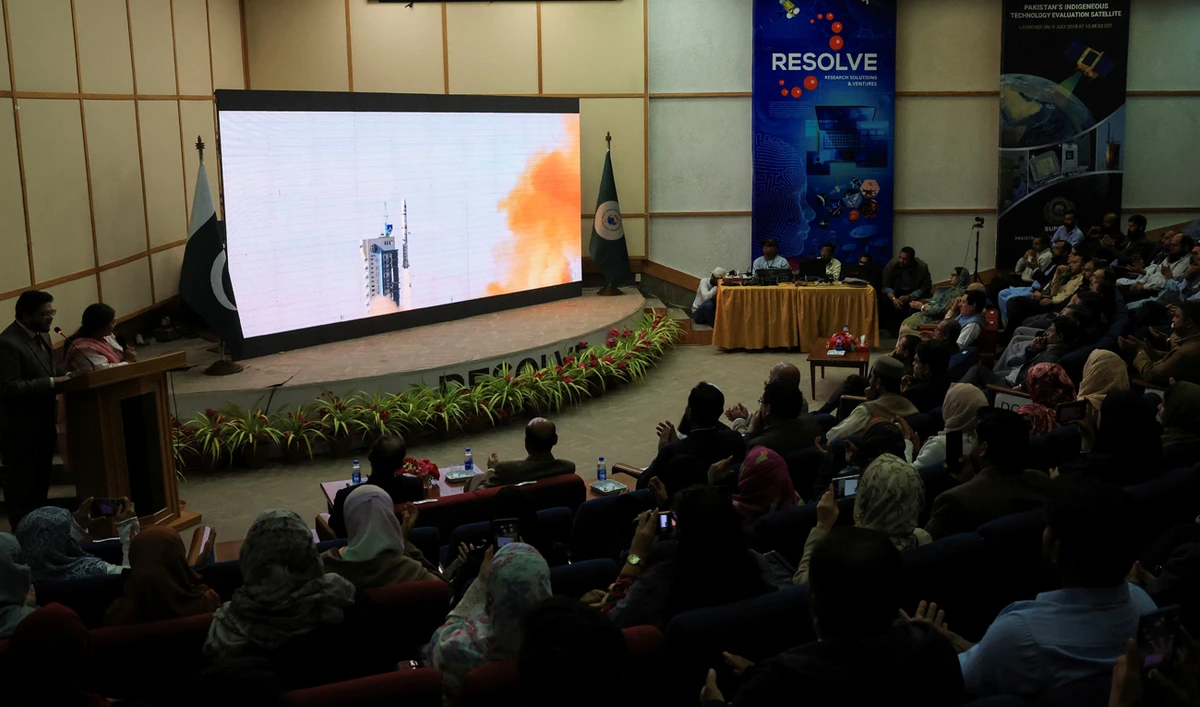
People watch a screen displaying the launch of Pakistan's indigenous Electro-Optical (EO-1) satellite from the Jiuquan Satellite Launch Centre (JSLC) in northern China, at the Pakistan Space and Upper Atmosphere Research Commission (SUPARCO) Complex in Karachi, Pakistan on January 17, 2025. (REUTERS/File)
Short Url
Updated 06 February 2025
Follow

Pakistan, China sign agreement for lunar mission in 2028

  • Pakistan’s first lunar rover will be part of China’s Chang’E 8 robotic exploration of the lunar south pole
  • Last May, Pakistan launched its first lunar satellite aboard China’s Chang’e-6 probe of far side of the moon

ISLAMABAD: Pakistan and China have signed a Memorandum of Understanding (MoU) for the former’s first lunar rover to be included in Beijing’s Chang’E 8 mission, the national space agency in Islamabad said.
The Chang’E 8 mission is a robotic exploration of the lunar south pole expected to launch in 2028. Last year, the Space and Upper Atmosphere Research Commission (SUPARCO), Pakistan’s space program, said its rover would land on the lunar south pole in 2028 as part of the Chang’ E 8 mission but a formal agreement has now been signed during a visit by President Asif Ali Zardari to China this week.
“Pakistan has made a significant leap in deep space exploration with the signing of a historic MoU between SUPARCO and the China National Space Administration,” the Pakistani agency said in a press release on Thursday.
Pakistan’s participation in the mission was a “milestone” in the country’s space program and its contribution to the International Lunar Research Station (ILRS) initiative, the statement added.
“SUPARCO’s lunar rover will be deployed at the Moon’s south pole,” it said. “The rover will carry advanced scientific payloads developed by SUPARCO and an internationally designed scientific payload created through collaboration between Chinese and European scientists.”
The combined effort of Pakistan and China will enhance the mission’s capability to conduct an in-depth analysis of the lunar surface, the statement said, with Pakistani scientists able to operate the rover from Earth, map the lunar surface, study lunar soil composition, radiation levels and plasma properties and test new technologies for sustainable human presence.
Last May, Pakistan launched its first lunar satellite aboard China’s Chang’e-6 probe, which successful landed on the moon’s South Pole-Aitken Basin, an impact crater on the side of the Moon that always faces away from Earth. The mission returned to earth in June, making China the first to bring back samples from the moon’s far side.


Pakistan Airports Authority reports ‘historic’ twin-engine aircraft landing in Lahore

Updated 8 sec ago
Follow

Pakistan Airports Authority reports ‘historic’ twin-engine aircraft landing in Lahore

  • Twin-engine aircraft are usually larger, heavier and require better airport infrastructure, navigation systems to land
  • Pakistan Airports Authority says landing reflects its commitment to enhance aviation sector, strengthen infrastructure

ISLAMABAD: The Pakistan Airports Authority (PAA) announced on Saturday that the New General Aviation Aerodrome achieved a significant milestone when it handled the landing of a twin-engine aircraft. 

A twin-engine aircraft has two engines that provide it redundancy and increased performance compared to single-engine counterparts. These aircraft range from small twin-engine propeller planes to large commercial jetliners. The presence of multiple engines enhances safety by allowing the aircraft to continue flying in the event of an engine failure.

However, twin-engine aircraft are usually larger, heavier and more complex than single-engine planes. They require advanced airport infrastructure such as better runways, navigation systems and air traffic coordination. 

“The New General Aviation Aerodrome, Lahore achieved another significant operational milestone today with the successful landing of a twin-engine aircraft, following the recent arrival of a single-engine aircraft,” the PAA said in a statement. 

It said the flight was also boarded by Air Vice Marshal Zeeshan Saeed, the director general of the PAA. The move reflected “strong institutional confidence” in the aerodrome’s safety standards, operational capability, and overall readiness, it added. 

“The landing was conducted with exceptional precision and professionalism, demonstrating the aerodrome’s robust operational framework, technical preparedness, and effective airside coordination in accordance with contemporary aviation requirements,” the PAA said. 

It said the landing represented a “major advancement” in Pakistan’s general aviation sector and underscores the PAA’s commitment to enhancing regional aviation capacity, strengthening infrastructure and promoting excellence in aviation development.