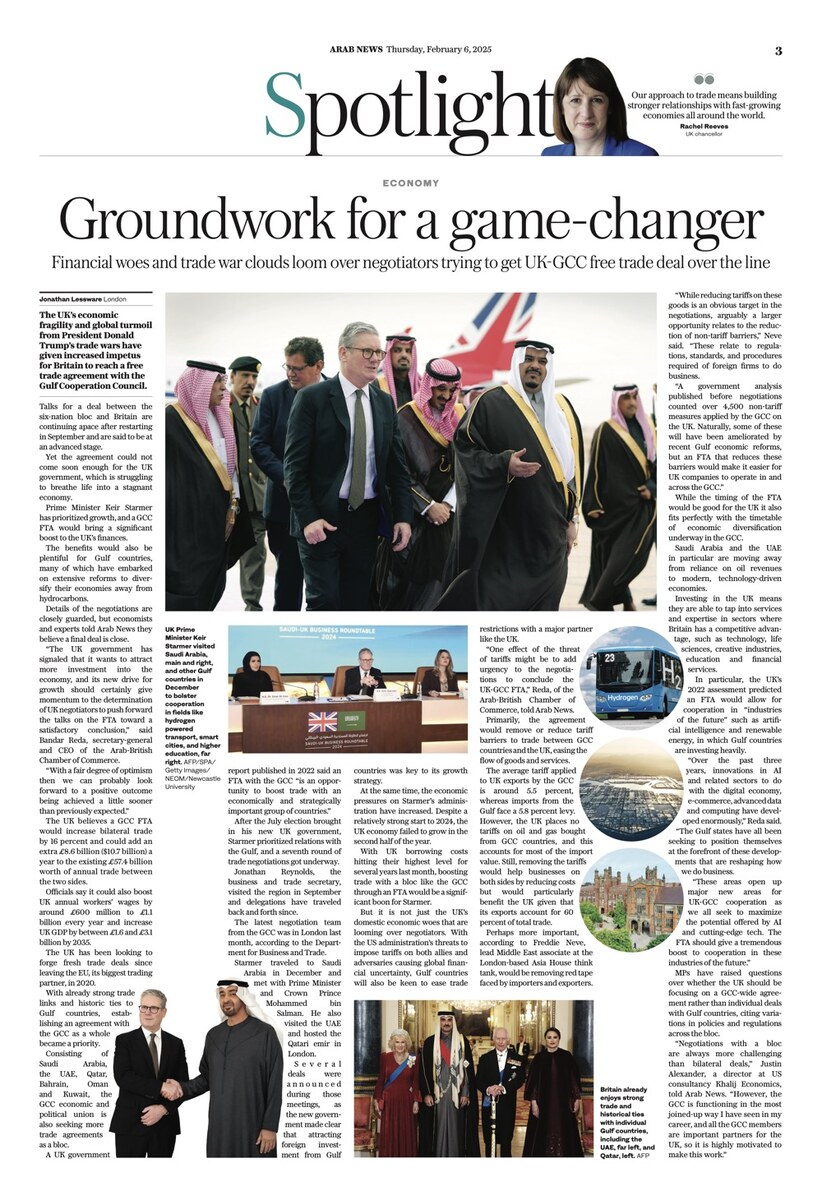
- Britain’s financial woes and US President Donald Trump’s trade wars loom over negotiators working to get deal over the line
- The deal would eliminate tariffs, reduce trade barriers, and facilitate business cooperation in key sectors like AI and renewables
LONDON: The UK’s economic fragility and global turmoil from President Donald Trump’s trade wars have given increased impetus for Britain to reach a free trade agreement with the Gulf Cooperation Council.
Talks for a deal between the six-nation bloc and Britain are continuing apace after restarting in September and are said to be at an advanced stage.
Yet the agreement could not come soon enough for the UK government, which is struggling to breathe life into a stagnant economy.
Prime Minister Keir Starmer has prioritized growth, and a GCC FTA would bring a significant boost to the UK’s finances and the governing Labour Party’s political fortunes.
The benefits would also be plentiful for Gulf countries, many of which have embarked on extensive reforms to diversify their economies away from hydrocarbons and toward modern sectors.
Details of the negotiations are closely guarded, but economists and experts told Arab News they believe a final deal is close and that there is will from both sides to get the agreement in place.
“The UK government has signaled that it wants to attract more investment into the economy, and its new drive for growth should certainly give momentum to the determination of UK negotiators to push forward the talks on the FTA toward a satisfactory conclusion,” said Bandar Reda, secretary-general and CEO of the Arab-British Chamber of Commerce.
“With a fair degree of optimism then we can probably look forward to a positive outcome being achieved a little sooner than previously expected.”
The UK believes a GCC FTA would increase bilateral trade by 16 percent and could add an extra £8.6 billion ($10.7 billion) a year to the existing £57.4 billion worth of annual trade between the two sides.
Officials say it could also boost UK annual workers’ wages by around £600 million to £1.1 billion every year and increase UK GDP by between £1.6 and £3.1 billion by 2035.
The UK has been looking to forge fresh trade deals since leaving the EU, its biggest trading partner, in 2020.
With already strong trade links and historic ties to Gulf countries, establishing an agreement with the GCC as a whole became a priority.
Consisting of Saudi Arabia, the UAE, Qatar, Bahrain, Oman and Kuwait, the GCC economic and political union is also seeking to make more trade agreements as a bloc.
A UK government report published in 2022 said an FTA with the GCC “is an opportunity to boost trade with an economically and strategically important group of countries, support jobs and advance our global interests.”
After the July election brought in his new UK government, Starmer prioritized relations with the Gulf, and a seventh round of trade negotiations got underway.
Jonathan Reynolds, the business and trade secretary, visited the region in September and delegations have traveled back and forth since.
The latest negotiation team from the GCC was in London last month, according to the Department for Business and Trade.
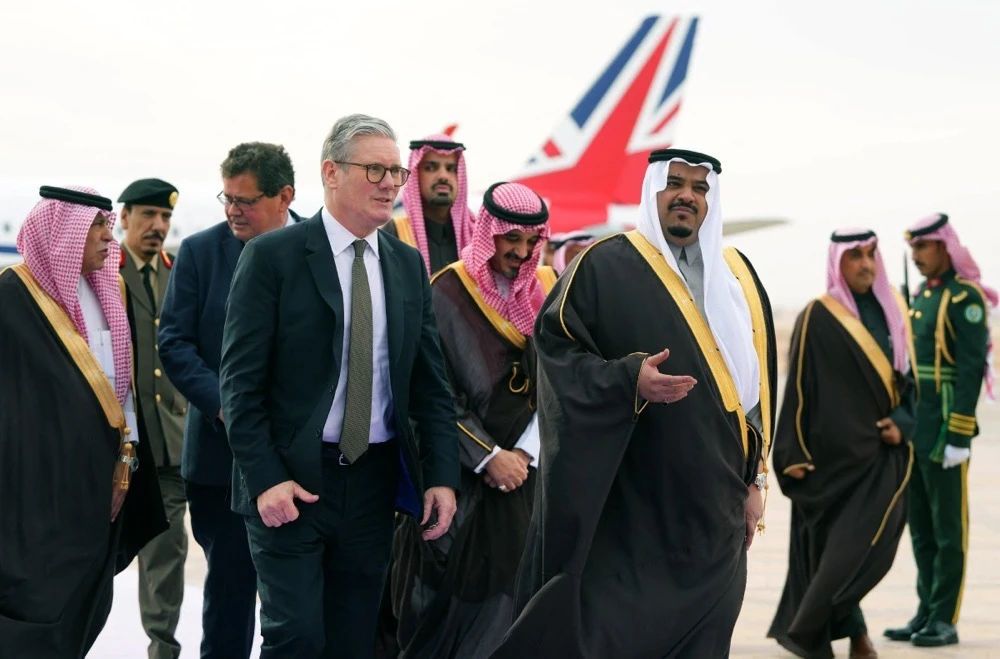
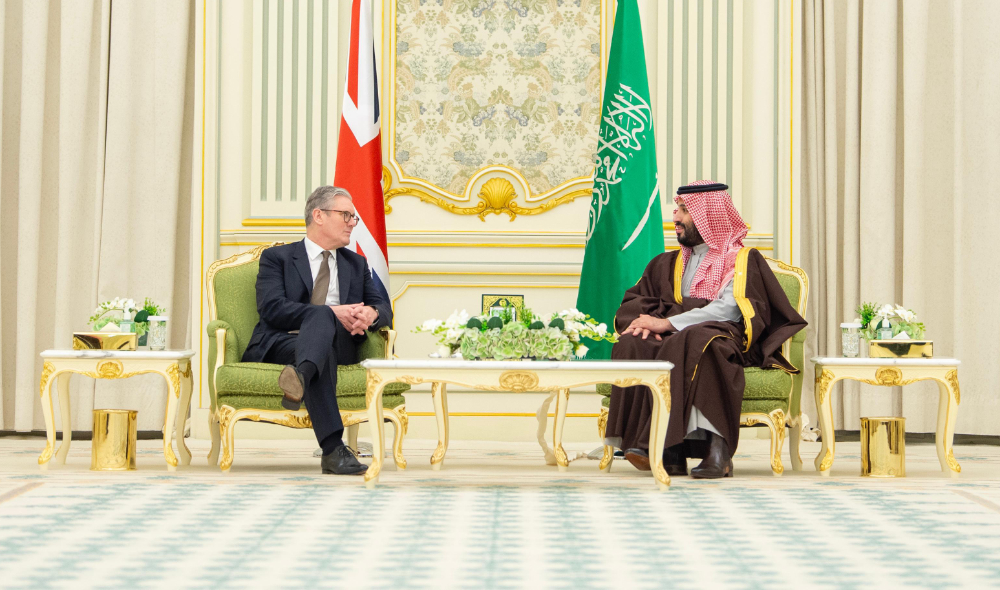
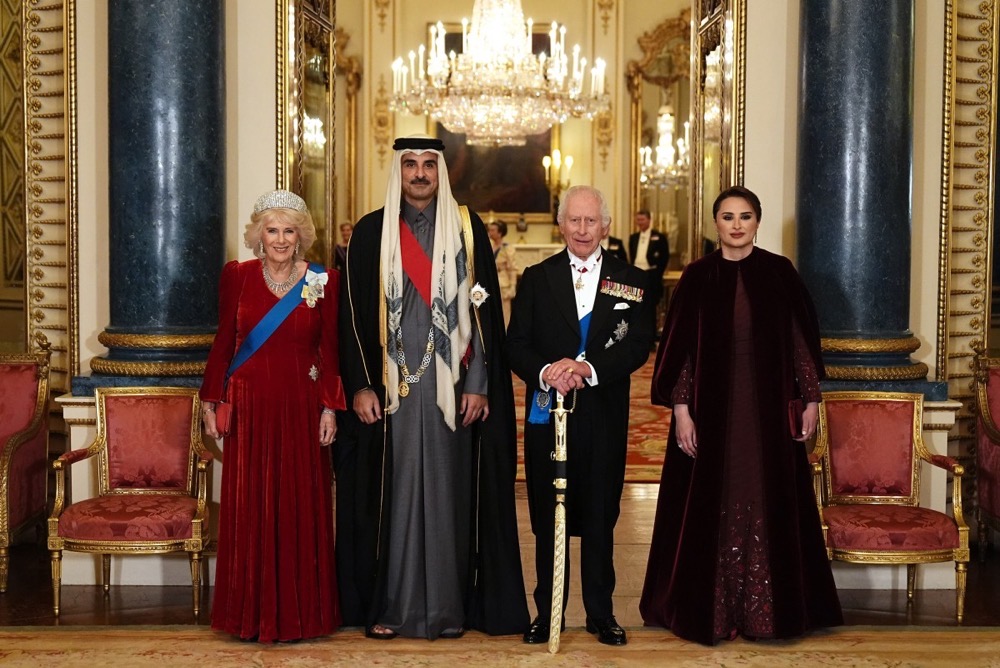
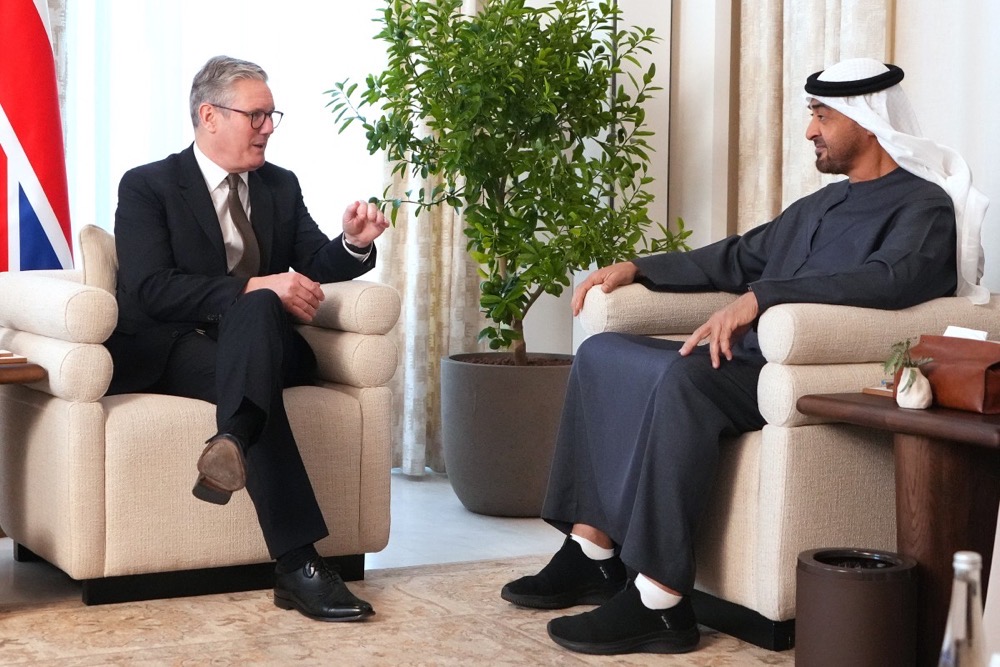
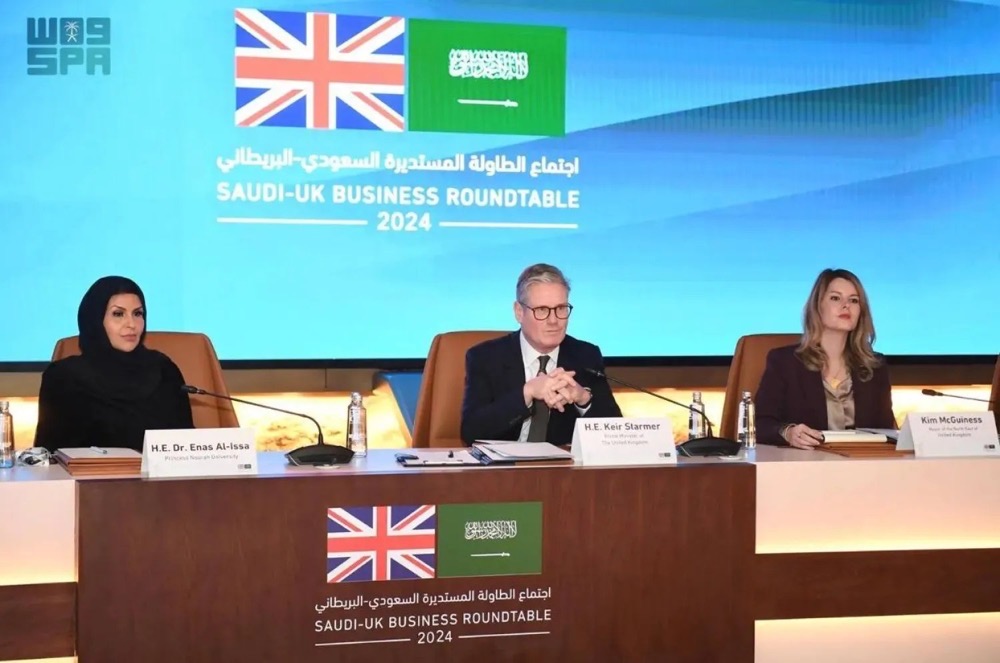
Starmer traveled to Saudi Arabia in December and met with Prime Minister and Crown Prince Mohammed bin Salman. He also visited the UAE and hosted the Qatari emir in London.
Several deals were announced during those meetings, as the new government made clear that attracting foreign investment from Gulf countries was key to its growth strategy.
At the same time, the economic pressures on Starmer’s administration have increased. Despite a relatively strong start to 2024, the UK economy failed to grow in the second half of the year.
Chancellor Rachel Reeves came under fire for her first budget, which dented business confidence with a series of tax hikes.
With UK borrowing costs hitting their highest level for several years last month, boosting trade with a bloc like the GCC through an FTA would be a significant boon for Starmer.
But it is not just the UK’s domestic economic woes that are looming over negotiators. With the US administration’s threats to impose tariffs on both allies and adversaries causing global financial uncertainty, Gulf countries will also be keen to ease trade restrictions with a major partner like the UK.
“One effect of the threat of tariffs might be to add urgency to the negotiations to conclude the UK-GCC FTA,” Reda, of the Arab-British Chamber of Commerce, told Arab News.
Primarily, the agreement would remove or reduce tariff barriers to trade between GCC countries and the UK, easing the flow of goods and services.
The average tariff applied to UK exports by the GCC is around 5.5 percent, whereas imports from the Gulf face a 5.8 percent levy. However, the UK places no tariffs on oil and gas bought from GCC countries, and this accounts for most of the import value.
Still, removing the tariffs would help businesses on both sides by reducing costs but would particularly benefit the UK given that its exports account for 60 percent of total trade.
Perhaps more important, according to Freddie Neve, lead Middle East associate at the London-based Asia House think tank, would be removing red tape faced by importers and exporters.
“While reducing tariffs on these goods is an obvious target in the negotiations, arguably a larger opportunity relates to the reduction of non-tariff barriers,” Neve said. “These relate to regulations, standards, and procedures required of foreign firms to do business.
“A government analysis published before negotiations counted over 4,500 non-tariff measures applied by the GCC on the UK. Naturally, some of these will have been ameliorated by recent Gulf economic reforms, but an FTA that reduces these barriers would make it easier for UK companies to operate in and across the GCC.”
While the timing of the FTA would be good for the UK it also fits perfectly with the timetable of economic diversification underway in the GCC.

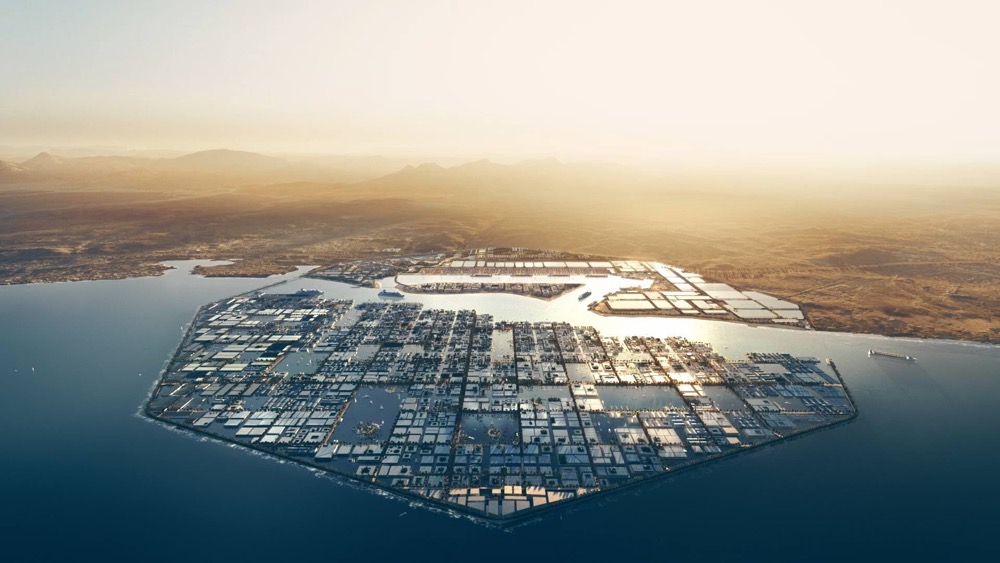
Saudi Arabia and the UAE in particular are moving away from reliance on oil revenues to modern, technology-driven economies.
Investing in the UK means they are able to tap into services and expertise in sectors where Britain has a competitive advantage, such as technology, life sciences, creative industries, education and financial services.
In particular, the UK’s 2022 assessment predicted an FTA would allow for cooperation in “industries of the future” such as artificial intelligence and renewable energy, in which Gulf countries are investing heavily.
“Over the past three years, innovations in AI and related sectors to do with the digital economy, e-commerce, advanced data and computing have developed enormously,” Reda said. “The Gulf states have all been seeking to position themselves at the forefront of these developments that are reshaping how we do business.
“These areas open up major new areas for UK-GCC cooperation as we all seek to maximize the potential offered by AI and cutting-edge tech. The FTA should give a tremendous boost to cooperation in these industries of the future.”
INNUMBERS
• 16% Potential increase in bilateral trade resulting from UK-GCC free trade agreement.
• £8.6bn What the FTA could add to the existing £57.4bn worth of annual bilateral trade.
• £1.6-£3.1bn Possible boost to UK GDP by 2035, raising wages to £1.1bn per year.
An FTA negotiation is a vast and complex process and there may well still be sticking points to be ironed out before a final deal is reached.
Douglas Alexander, the UK’s minister of state for trade policy and economic security, said in December that negotiators on the GCC agreement continued to have “constructive discussions on areas of sustainable trade,” such as environment and labor.
MPs have raised questions over whether the UK should be focusing on a GCC-wide agreement rather than individual deals with Gulf countries, citing variations in policies and regulations across the bloc.
But the GCC countries have been developing their concerted approach to trade and are pursuing similar agreements with the EU, China, and Turkiye.
“Negotiations with a bloc are always more challenging than bilateral deals,” Justin Alexander, a director at US consultancy Khalij Economics, told Arab News. “However, the GCC is functioning in the most joined-up way I have seen in my career, and all the GCC members are important partners for the UK, so it is highly motivated to make this work.”
He said he was not aware of any significant obstacles remaining in the talks and believed the deal is very near completion.
“The most significant element of the UK-GCC FTA for both sides will be the fact that it has been done, setting a precedent for further trade deals for both parties,” Alexander said. “Both sides are open, globally integrated economies and would benefit from modern trade deals.”
The Department for Business and Trade said trade deals played a “vital role” in the government’s mission for economic growth.
“We’re seeking a modern trade deal with the Gulf as a priority, and our focus is securing a deal that delivers real value to businesses on both sides, rather than getting it done by a specific date,” the department said.