Indonesia ‘strongly rejects’ Trump’s Gaza plan

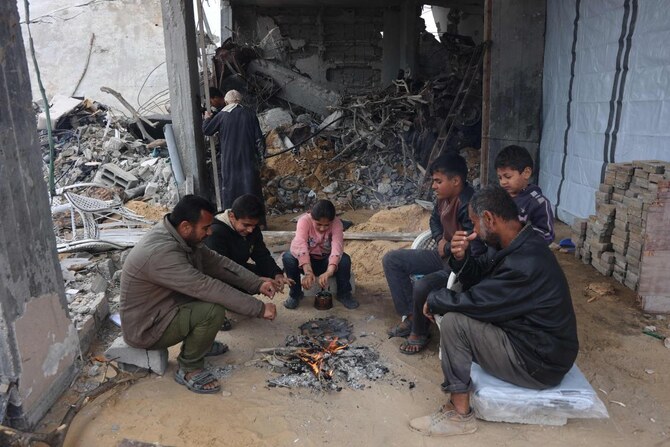
Palestinians warm themselves by a fire inside a heavily damaged building at Saftawi street in Jabalia, in Gaza, on Feb. 5, 2025 during a ceasefire deal in the war between Israel and Hamas. (AFP)
Short Url
Updated 05 February 2025
Follow

Indonesia ‘strongly rejects’ Trump’s Gaza plan

  • “Indonesia strongly rejects any attempt to forcibly displace Palestinians or alter the demographic composition of the Occupied Palestinian Territory,” the Foreign Ministry said
  • Jakarta also called on the international community to respect international law

JAKARTA: Indonesia “strongly rejects” the proposal made by President Donald Trump for the United States to assume control of Gaza and resettle Palestinians elsewhere, the Foreign Ministry said Wednesday.
Trump announced the stunning proposal Tuesday, without detailing his plans on how to move out nearly two million Palestinians from the enclave, claiming that the US will rebuild the territory and turn it into the “the Riviera of the Middle East.”
Indonesia, the world’s most populous Muslim nation, has consistently called for a two-state solution to the Israeli-Palestinian conflict.

“Indonesia strongly rejects any attempt to forcibly displace Palestinians or alter the demographic composition of the Occupied Palestinian Territory,” the Foreign Ministry said in a statement posted on social media X, formerly Twitter.
Jakarta also called on the international community to respect international law, “particularly the right to self-determination of the Palestinians as well as their inalienable right to return to their homeland,” the ministry added.
Trump claimed there was support from the “highest leadership” in the Middle East and upped pressure on Egypt and Jordan to take displaced Palestinians — despite both countries flatly rejecting the idea.
Jakarta said addressing the “root cause” of the conflict, namely “the illegal and prolonged Israeli occupation of the Palestinian territory,” was the only path to achieve a lasting peace in the region, the statement added.


Death toll rises to at least 10 in violence around Iran protests

Updated 11 sec ago
Follow

Death toll rises to at least 10 in violence around Iran protests

DUBAI: Violence surrounding protests in Iran sparked by the Islamic Republic’s ailing economy killed two other people, authorities said Saturday, raising the death toll in the demonstrations to at least 10 as they showed no signs of stopping.
The new deaths follow US President Donald Trump warning Iran on Friday that if Tehran “violently kills peaceful protesters,” the United States “will come to their rescue.” While it remains unclear how and if Trump will intervene, his comments sparked an immediate, angry response from officials within the theocracy threatening to target American troops in the Mideast.
The weeklong protests, have become the biggest in Iran since 2022, when the death of 22-year-old Mahsa Amini in police custody triggered nationwide demonstrations. However, the protests have yet to be as widespread and intense as those surrounding the death of Amini, who was detained over not wearing her hijab, or headscarf, to the liking of authorities.
The deaths overnight into Saturday involved a new level of violence. In Qom, home to the country’s major Shiite seminaries, a grenade exploded, killing a man there, the state-owned IRAN newspaper reported. It quoted security officials alleging the man carried the grenade to attack people in the city, some 130 kilometers (80 miles) south of the capital, Tehran.
Online videos from Qom purportedly showed fires in the street overnight.
The second death happened in the town of Harsin, some 370 kilometers (230 miles) southwest of Tehran. There, the newspaper said a member of the Basij, the all-volunteer arm of Iran’s paramilitary Revolutionary Guard, died in a gun and knife attack in the town in Kermanshah province.
Demonstrations have reached over 100 locations in 22 of Iran’s 31 provinces, the US-based Human Rights Activists News Agency reported.
Iran’s civilian government under reformist President Masoud Pezeshkian has been trying to signal it wants to negotiate with protesters. However, Pezeshkian has acknowledged there is not much he can do as Iran’s rial has rapidly depreciated, with $1 now costing some 1.4 million rials. That sparked the initial protests.