Saudi ambassador urges Bangladeshi companies to join FIFA World Cup 2034 projects

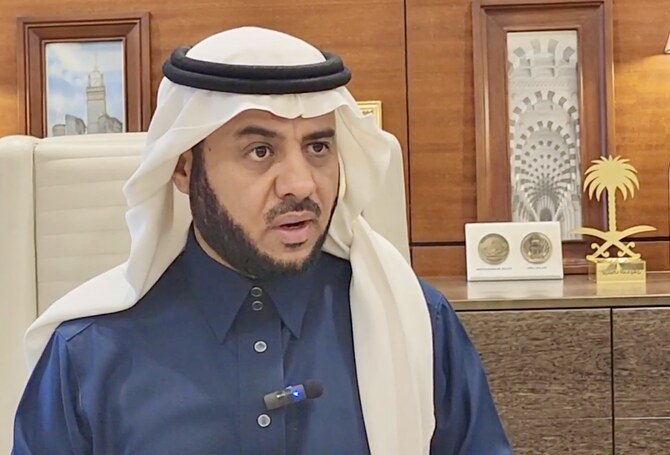
Saudi Ambassador Essa Al-Duhailan speaks to Arab News on Feb. 4, 2025. (AN Photo)
Short Url
Updated 05 February 2025
Follow

Saudi ambassador urges Bangladeshi companies to join FIFA World Cup 2034 projects

  • Ambassador cites Bangladeshis’ experience of 2022 World Cup Qatar projects
  • Bangladeshi expat workers in Saudi Arabia are hardworking and intelligent, he says

DHAKA: Saudi Arabia’s ambassador to Dhaka has invited Bangladeshi companies to bid for FIFA World Cup construction projects as the tournament, to be hosted by the Kingdom in 2034, will require the construction of new stadiums and supporting infrastructure.

Saudi Arabia won the bid to host the world’s largest sporting event, with plans to hold games across 15 stadiums in five cities. Many migrant workers will be involved in building new sports facilities, transport networks, and hotel infrastructure.

“Bangladeshi workers already have experience with the World Cup in Qatar,” Ambassador Essa Al-Duhailan told Arab News at his office in the Bangladeshi capital on Tuesday.

“I urge the construction companies from Bangladesh to go to Saudi Arabia because we will build 11 stadiums and renovate five other existing stadiums. So this will also be a big opportunity for the companies and for the workers to go and participate in this ... And not only the construction of stadiums, but hotels and resorts. This will be a very good opportunity for Bangladesh.”

Some 2 million expatriate workers in Qatar were crucial in making the 2022 World Cup mega-projects a reality. Most of them were Bangladeshis. They have constructed and renovated eight stadiums, a whole new city, Lusail, the Doha Metro, hotels, and new transportation routes.

“You have enough numbers of skilled workers. We are happy to accommodate them and to welcome them. And they will have very good opportunities,” Al-Duhailan said.

“Bangladeshi workers and migrants are hard workers, and they are intelligent, and you can rely on them.”

Around 3 million Bangladeshi nationals live and work in Saudi Arabia. They are the largest expat group in the Kingdom and the largest Bangladeshi community outside Bangladesh. Many are employed in the construction sector and more are likely to find jobs in the industry in the next few years, as the Kingdom prepares to host not only the 2034 World Cup, but also the AFC Asian Cup in 2027, the Asian Winter Games in 2029, and the World Expo in 2030.

“The business of construction will be in high demand (of workers),” Al-Duhailan said.

“We already started preparations ... We are processing 5,000 to 7,000 visas (for Bangladeshis) every day. And we are (willing) to accommodate more.”


Australia Day protesters demand Indigenous rights

Updated 7 sec ago
Follow

Australia Day protesters demand Indigenous rights

SYDNEY: Thousands of people rallied in cities across Australia demanding justice and rights for Indigenous peoples on Monday, a national holiday marking the 1788 arrival of a British fleet in Sydney Harbor.
Crowds took to the streets in Sydney, Melbourne, Canberra, Perth and other cities on Australia Day, many with banners proclaiming: “Always was, always will be Aboriginal land.”
In Sydney, police allowed the protests to go ahead despite new curbs introduced after gunmen opened fire on a Jewish Hanukkah festival on Bondi Beach on December 14, killing 15 people.
Millions of Australians celebrate the annual holiday with beers and backyard barbecues or a day by the sea, and this year a broad heatwave was forecast to push the temperature in South Australian capital Adelaide to 45C.
Shark sightings forced people out of the water at several beaches in and around Sydney, however, after a string of shark attacks in the region this month — including one that led to the death of a 12-year-old boy.
Many activists describe the January 26, 1788, British landing as “Invasion Day,” a moment that ushered in a period of oppression, lost lands, massacres and Indigenous children being removed from their families.
Aboriginal and Torres Strait Islander peoples make up about four percent of the population.
They still have a life expectancy eight years shorter than other Australians, higher rates of incarceration and deaths in custody, steeper youth unemployment and poorer education.

- Anti-immigration protests -

“Let’s celebrate on another day, because everyone loves this country and everyone wants to celebrate. But we don’t celebrate on a mourning day,” Indigenous man Kody Bardy, 44, told AFP in Sydney.
Another Indigenous protester in Sydney, 23-year-old Reeyah Dinah Lotoanie, called for people to recognize that a genocide happened in Australia.
“Ships still came to Sydney and decided to kill so many of our people,” she said.
Separately, thousands of people joined anti-immigration “March for Australia” protests in several cities, with police in Melbourne mobilizing to keep the two demonstrations apart.
In Sydney, “March for Australia” protesters chanted, “Send them back.” Some carried banners reading: “Stop importing terrorists” or “One flag, one country, one people.”
“There’s nowhere for people to live now, the hospitals are full, the roads are full, you’ve got people living on the streets,” said one demonstrator, 66-year-old Rick Conners.
Several also held aloft placards calling for the release of high-profile neo-Nazi Joel Davis, who is in custody after being arrested in November on allegations of threatening a federal lawmaker.
“There will be no tolerance for violence or hate speech on Sydney streets,” New South Wales Premier Chris Minns told reporters.
“We live in a beautiful, multicultural community with people from around the world, but we will not tolerate a situation where on Australia’s national day, it’s being pulled down by divisive language, hate speech or racism,” he said.
“Police are ready and willing to engage with people that breach those rules.”