

Diriyah Storytelling Festival breathes new life into Saudi Arabia’s literary heritage

1 / 7
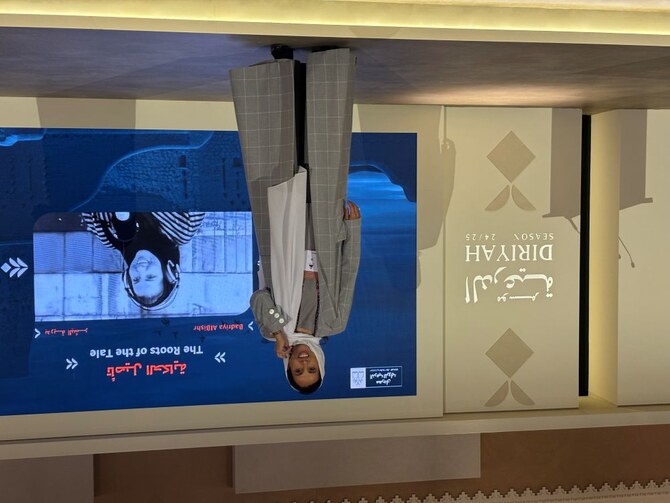
Saudi writer and journalist Badriyah Al-Bishr speaks at the Diriyah Storytelling Festival during her session The Roots of the Tale, exploring the connection between folk storytelling and modern literature. (AN Photo/Waad Hussain)
2 / 7
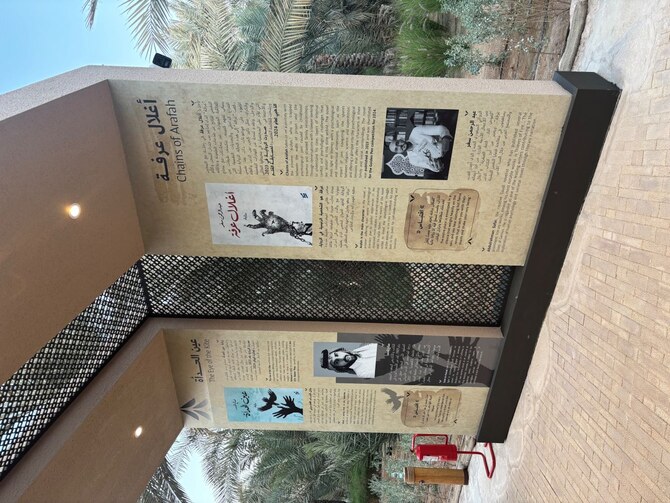
Chains of Arafah and The Eye of the Kite — A literary display at Diriyah Storytelling Festival, highlighting Saudi authors and their impactful narratives. (AN Photo/Waad Hussain)
3 / 7
Visitors engage with Mommy Reads at Diriyah Storytelling Festival, exploring bilingual books designed to foster early childhood literacy. (AN Photo/Waad Hussain)
4 / 7
A musician plays the oud in a beautifully lit traditional setting, adding a melodic touch to the storytelling experience at Diriyah Storytelling Festival. (AN Photo/Waad Hussain)
5 / 7
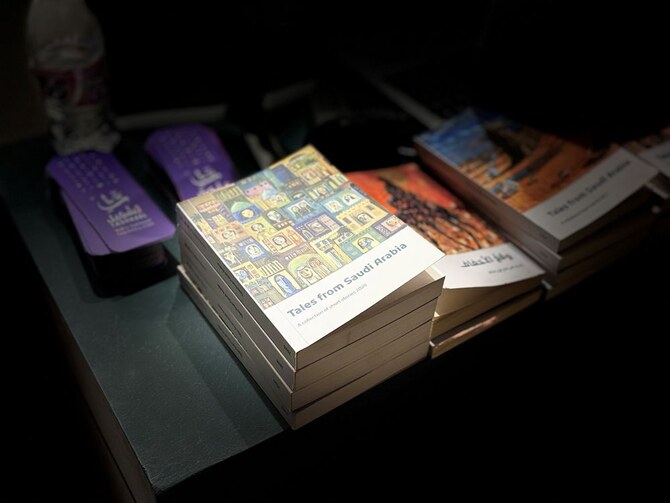
Tales from Saudi Arabia displayed at the Tashkeel Publishing House booth during the Diriyah Storytelling Festival, showcasing Saudi narratives for a global audience. (AN Photo/Waad Hussain)
6 / 7
A creative literary installation at Diriyah Storytelling Festival, with books suspended from a traditional palm-roof structure. (AN Photo/Waad Hussain)
7 / 7
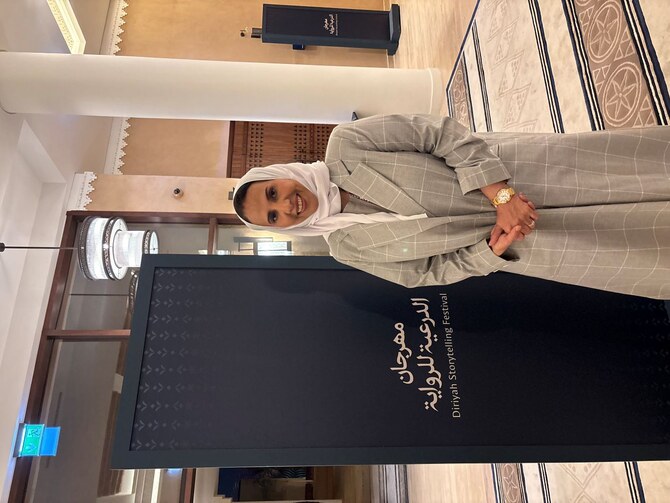
Badriyah Al-Bishr is pictured at the Diriyah Storytelling Festival, where she shared insights on the evolution of Saudi storytelling and its role in shaping contemporary narratives. (AN Photo/Waad Hussain)
Short Url
Updated 05 February 2025
Follow

Diriyah Storytelling Festival breathes new life into Saudi Arabia’s literary heritage

  • Event offers deep dive into Kingdom’s rich tradition
  • Locals, visitors explore Saudi literature

RIYADH: The Diriyah Storytelling Festival brings together literary enthusiasts, publishers, and celebrated authors and provides a deep dive into Saudi Arabia’s rich storytelling traditions and evolving literary landscape.

The event, which lasts until Feb. 8, features panel discussions, book signings, live performances, and interactive experiences.

The festival is attracting a diverse audience, including international visitors who engage with Saudi authors to explore locally published books.

One of the standout sessions, “The Roots of the Tale,” featured renowned Saudi novelist and journalist Badryah Al-Bishr, who spoke about the transformation of storytelling into modern literature.

Al-Bishr said: “My participation was all about tracing the wisdom of storytelling to the structure of novels. Since I studied folk tales in my master’s degree while also writing novels, I explored how traditional narratives evolved before written literature.

“Societies have always needed this literary and cultural influence — it serves deep and indirect functions, whether in raising children, comforting sorrowful hearts, or inspiring values and ideals.

“This is what we now call ‘soft power.’ Storytelling has always shaped minds, transferring across cultures like the tale of ‘Cinderella,’ which exists in Russia, Europe, and even Najd.”

A key aspect of the festival is its focus on showcasing Saudi literature to international visitors, offering translations and accessible editions of local works.

Modi Al-Dossari, from the Tashkeel Publishing House, noted the growing interest from foreign attendees, and added: “We’re working on something big here at the festival.

“The visitors are quite diverse, including many foreigners eager to learn about our culture.

“At Tashkeel we have Saudi books and stories translated into English, and they are among our bestsellers. It’s amazing to see our culture being shared in such a smooth and accessible way.”

The availability of translated Saudi literature has helped bridge the gap between local storytelling and a global readership, highlighting the richness of Saudi narratives and their universal appeal.

Beyond book discussions, the Diriyah Storytelling Festival provides visitors with a fully immersive cultural experience, allowing them to explore the historic and artistic depth of Diriyah.

Entry to the festival costs SR40 ($10.66) per person, which includes access to all three locations — Bujairi Terrace, Bab Samhan Hotel, and Al-Zuhayra — as well as shuttle transportation between the venues and parking areas.

The festival also features restaurants, cafes, and boutique shops, making it an ideal destination for both literary and cultural exploration.

Hind Mohammed, who was attending, said: “I loved visiting Diriyah, especially Bujairi Terrace. It’s such a beautiful and enriching experience, with a vibrant atmosphere, and fantastic cafes, restaurants, and children’s play areas.”

Visitors can witness the breathtaking sunset over Diriyah’s landscape — and see a combination of golden light, traditional architecture and peaceful surroundings creating a spectacular and serene experience.

Saudi Arabia’s literary scene has witnessed remarkable growth in recent years, with increasing global recognition for local authors and their works. Events like the Diriyah Storytelling Festival contribute to this transformation by providing a platform for dialogue, creativity, and cultural exchange.


Sheikha Al-Mayassa talks cultural patronage at Art Basel Qatar Conversations panel

Updated 04 February 2026
Follow

Sheikha Al-Mayassa talks cultural patronage at Art Basel Qatar Conversations panel

DOHA: Cultural leaders at the inaugural edition of Art Basel Qatar in Doha have discussed how patronage is reshaping art ecosystems, with Qatar’s own long-term cultural vision at the center.

The opening panel, “Leaders of Change: How is patronage shaping new art ecosystems?” brought together Sheikha Al-Mayassa bint Hamad bin Khalifa Al-Thani, chair of Qatar Museums, and Maja Hoffmann, founder and president of the Luma Foundation, in a discussion moderated by Hans Ulrich Obrist, artistic director of the Serpentine Galleries in London. The talk formed part of the Art Basel Conversations x Qatar Creates Talks program, coinciding with the debut of Art Basel Qatar which runs in Doha until Feb. 8.

Sheikha Al-Thani framed Qatar’s cultural project as a strategic, long-term endeavor anchored in national development. “Qatar has a national vision called 2030 where culture was one of the main pillars for socioeconomic development and human development,” she said. “We have always invested in culture as a means of human development.”

That vision, she explained, underpins the decision to welcome a major international fair like Art Basel to Doha after turning away many previous proposals.

“For the longest time, I can’t tell you how many art fairs came to us wanting to be here, and we never felt it was the right time,” she said. “However, this is an important year for us and we felt, with the surplus of talent and the growing gallery scene we had here, that it was time to bring industry to talent, because that’s how we will spur the economic diversification from hydrocarbon to a knowledge-based society.”

She was also keen to stress that Art Basel Qatar was not conceived as a conventional marketplace.

 “This is not your typical art fair … It’s a humane art fair where engagement is more important than transaction, discourse more important than division, and curiosity more important than conviction,” she added.

That ethos extends to the fair’s artistic leadership. Al-Thani described how the decision to have an artist — Wael Shawky — serve as artistic director emerged collaboratively with Art Basel’s team.

“He’s a global artist who’s now become a very local artist, very invested in our local art scene. And really, I think that’s the beauty of partnerships … There is a safe space for us to critique each other, support each other, and really brainstorm all the possibilities … and then come to a consensus of what would make sense for us,” she said.

Collecting art, she added, has long been embedded in Qatari society: “My grandmother is almost 100 years old. She was collecting in the 60s when Qatar was a very poor country. It’s in our DNA … always with this notion of investing in knowledge and human development.”

Today, that impulse translates into comprehensive, multi-disciplinary collections: “We are both collecting historical objects, contemporary objects, modern objects, architecture, archival material, anything that we feel is relevant to us and the evolution of this nation towards a knowledge-based economy.”

Looking ahead, Al-Thani outlined a new cultural triangle in Doha — the National Museum of Qatar, the Museum of Islamic Art and the forthcoming Art Mill Museum — as engines for both economic diversification and intellectual life.

 “That ecosystem will enhance the economic growth and diversification, but also the knowledge that’s available, because the diversity in the collections between these three institutions will no doubt inspire young people, amateurs, entrepreneurs to think outside the box and inform their next business,” she said.

The panel closed with a focus on the future of large-scale exhibitions with Rubaiya, Qatar’s new quadrennial, timed to coincide with the anniversary of the 2022 World Cup.

“Every four years in memory of the opening of the World Cup, we will open the quadrennial. This year, the theme is ‘Unruly Waters.’ At the center of the theme is Qatar’s trading route to the Silk Road,” explained Al-Thani.

“It’s important for us to trace our past and claim it and share it to the rest of the world, but also show the connectivity that Qatar had historically and the important role it has been playing in diplomacy.”