

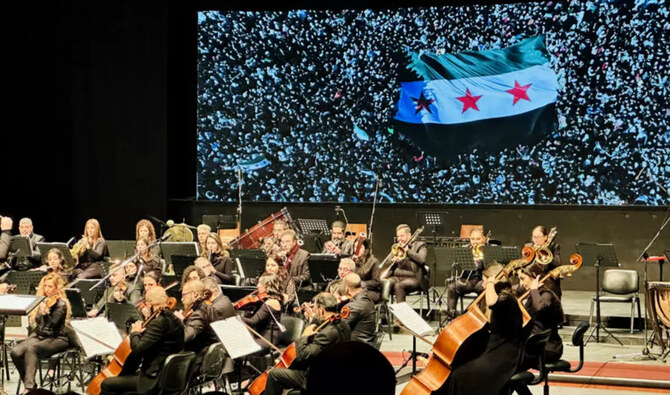

DAMASCUS: To applause, percussionist Bahjat Antaki took the stage with Syria’s national symphony orchestra, marking the first classical concert at the Damascus opera house since president Bashar Assad’s ouster.
The concert was a way of saying “we are here and able to produce art,” despite more than years of devastating war, Antaki said after last week’s performance, which drew an audience of hundreds.
“We will continue, and we will be stronger and more beautiful,” the 24-year-old said.
After opposition fighters ousted Assad on Dec. 8, the orchestra’s rehearsals and concerts were halted as Syria embarked on a delicate transition away from decades of one-family rule enforced by a repressive security apparatus.
While the country has breathed a sigh of relief, many in the capital — known for being more liberal than other parts of the country — have expressed apprehension about the direction the new leaders may take on personal freedoms and potentially the arts.
The new authorities have said repeatedly they will protect Syria’s religious and ethnic minorities, and that the country’s transition will be inclusive.
“There aren’t fears, but worries,” said violinist Rama Al-Barsha before going onstage.
“We hope for more support — under the old regime, we had no financial aid or even symbolic support,” the 33-year-old said.
The concert was conducted by Missak Baghboudarian, a member of Syria’s Armenian minority, and included works by Beethoven and Tchaikovsky but also by Syrian composers.
In the audience were European and Gulf Arab diplomats as well as new Health Minister Maher Al-Sharaa and his family.
Sharaa is the brother of interim President Ahmad Al-Sharaa, who until recently led the Hayat Tahrir Al-Sham group that spearheaded the offensive against Assad.
Last month, the opera house also hosted its first concert by well-known Islamic music singer known as Abu Ratib, who returned after decades in exile for his political views and whose recordings until recently were sold in secret.
The orchestral performance paid homage “to the martyrs and the glory of Syria.”
A minute’s silence was held for the more than 500,000 people killed during the civil war which erupted after Assad brutally repressed anti-government protests in 2011.
Images of the destruction wreaked by more than 13 years of fighting were projected on the back wall of the stage, along with pictures of mass demonstrations.
Also shown were photographs of Alan Kurdi, the toddler who became a tragic symbol of the Syrian refugee crisis when his tiny body was washed up on a Turkish beach in 2015 after his family’s failed attempt to reach EU member Greece by small boat.
In a reminder of the heavy economic cost of the war, the venue was unheated for the concert despite the winter cold.
Organizers said they could not afford the fuel, and both musicians and technical staff performed for free.
Audience member Omar Harb, 26, acknowledged concerns about the future of the arts in Syria’s political transition but said after the performance that “it seems that nothing will change.”
“We hope that these events will continue — I want to come back again,” said the young doctor, after watching his first concert at the opera house.
Yamama Al-Haw, 42, said the venue was “a very dear place.”
“What we see here today is the Syria that I love ... the music, the people who have come to listen — that’s the best image of Damascus,” she said, beaming, and wearing a white hijab.
She expressed optimism that the country was headed toward “better days.”
“Everything suggests that what will come will be better for the people ... we will have the Syria we want.”


