

Pakistan cuts this year’s Hajj costs, announces $17 million in refunds for last year’s pilgrims

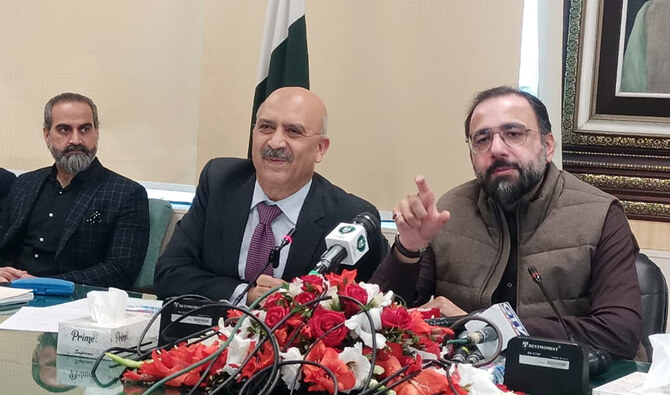
Federal Minister for Religious Affairs Chaudhry Salik Hussain (right) speaks during a press conference in Islamabad, Pakistan, on February 4, 2025. (Photo Courtesy: Ministry of Religious Affairs)
Short Url
Updated 04 February 2025
Follow

Pakistan cuts this year’s Hajj costs, announces $17 million in refunds for last year’s pilgrims

  • The religious affairs minister announces Hajj cost reductions of up to $179 for pilgrims
  • Chaudhry Salik Hussain says the government’s 2025 Hajj quota has been fully utilized

ISLAMABAD: Federal Minister for Religious Affairs Chaudhry Salik Hussain on Tuesday announced a reduction of up to Rs50,000 ($179) in this year’s Hajj packages and a refund of over Rs4.75 billion ($17 million) to 2024 pilgrims.

Last month, Pakistan and Saudi Arabia signed the Hajj Agreement 2025, under which 179,210 Pakistanis will perform the annual pilgrimage this year. The quota is divided equally between government and private schemes.
To make the pilgrimage more convenient and accessible, Pakistan has introduced a shortened Hajj program of 20 to 25 days. The Ministry of Religious Affairs initially set the cost at Rs1,075,000 ($3,854) for the long Hajj package and Rs1,150,000 ($4,122) for the short Hajj package, as shorter stays often incur higher airfare, premium accommodation rates and expedited transport services, driving up overall costs.
For the first time, the Hajj Policy 2025 also allowed pilgrims to pay in installments, easing financial constraints. Under the scheme, the first installment of Rs200,000 ($717) was required with the application, followed by Rs400,000 ($1,435) within 10 days of balloting, while the remaining amount had to be paid by February 10.
“After successful negotiations by our committee in Saudi Arabia, the cost of the 40-day long Hajj package has been reduced by Rs25,000 ($90) to Rs1,050,000 ($3,764), while the 25-day short Hajj package has been reduced by Rs50,000 ($179) to Rs1,100,000 ($3,943),” Hussain told reporters in Islamabad.
He said pilgrims must submit the third installment in designated banks between February 6 and February 14, while every pilgrim will receive a notification via the ‘Pak Hajj’ cellphone app launched by the government.
The app is designed to provide real-time updates, guidance, emergency contacts, lodging details, route navigation and complaint registration to ensure a smooth pilgrimage experience.
“Pilgrims opting for the long Hajj package will need to pay a third installment of Rs450,000 ($1,613), while the third installment for the short Hajj package will be Rs500,000 ($1,794),” Hussain said.
He further informed that over Rs4.75 billion ($17 million) will be refunded to 2024 Hajj pilgrims, citing savings in sacrificial animal costs and airfare reductions.
“Refunds will be disbursed into pilgrims’ accounts from February 7 onwards,” he added.
The minister said this year’s government Hajj quota has been fully utilized and expressed hope that pilgrims will have an even better experience than last year.
“Pilgrims will have assistance available at all times, as one Hajj assistant will be assigned for every 150 pilgrims,” he continued.
“The assistant will travel with the pilgrims from the Hajj camp, stay with them and return with them, ensuring continuous support throughout the journey,” he added.


China backs Pakistan in fight against militancy after deadly Balochistan attacks

Updated 03 February 2026
Follow

China backs Pakistan in fight against militancy after deadly Balochistan attacks

  • China is a major ally and investor in Pakistan and has pledged over $65 billion in major infrastructure projects, including in Balochistan
  • Chinese Foreign Ministry spokesperson Lin Jian says ‘we mourn for lives lost, and our hearts go out to injured and those who lost loved ones’

ISLAMABAD: China condemns the recent attacks that killed more than 200 people in Pakistan’s southwestern Balochistan province, a Chinese foreign ministry spokesperson said on Tuesday, reaffirming Beijing’s support for Pakistan in its fight against militancy.

The Baloch Liberation Army (BLA) group launched coordinated attacks in several cities across Balochistan on Saturday, killing 33 civilians and 17 security personnel. Officials said 117 militants were killed in skirmishes and follow-up operations.

Balochistan, which borders Iran and Afghanistan, is the site of a decades-long insurgency waged by Baloch separatist groups who often attack security forces, foreigners and non-local Pakistanis and kidnap government officials.

China is a major ally and investor in Pakistan and has pledged over $65 billion in investment in road, infrastructure and development projects under the China-Pakistan Economic Corridor (CPEC).

“China strongly condemns the [Balochistan] attacks... We mourn for the lives lost, and our hearts go out to the injured and those who lost their loved ones,” Chinese Foreign Ministry spokesperson Lin Jian said at a press briefing on Tuesday.

“China firmly opposes any form of terrorism and will as always firmly support Pakistan in combating terrorism, maintaining solidarity and social stability, and protecting the safety of the people.”

Chinese nationals working in Pakistan have often been targeted by militants, particularly in the southwestern Balochistan province, where China is developing a deep seaport that is touted as the crown jewel of CPEC.

Interior Minister Mohsin Naqvi said last week the attacks, claimed by the separatist Baloch Liberation Army (BLA), were planned from India. New Delhi rejected the allegation as “baseless,” saying Islamabad was attempting to deflect attention from its internal challenges.

Balochistan is home to vast reserves of minerals and hydrocarbons. Separatist militant groups such as the BLA blame Islamabad for exploiting Balochistan’s natural resources and denying locals a share in them. The military and civilian government reject these allegations and say they are investing in the province’s development.