

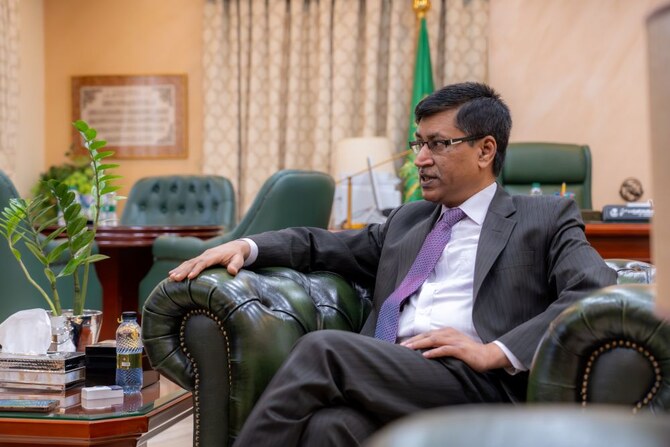

RIYADH: The newly-appointed Ambassador of Bangladesh to Saudi Arabia M. Delwar Hossain said his country seeks deeper collaboration with Riyadh to mark the 50th anniversary of diplomatic ties between the two countries.
In an exclusive interview with Arab News, Hossain said: “As far as our people are concerned, we have had a close relationship for centuries, but the state of Bangladesh was formed in 1971 and we established formal diplomatic relations with Saudi Arabia in 1975. Since then, our relationship has been growing progressively.
“We are planning to jointly celebrate. It will not be just celebration events. We want to take advantage of this milestone event to take our relationship to a new high,” said the envoy.
“We are expecting some exchange of high level visits to further consolidate our relationship. We are planning joint events in Riyadh as well as in Dhaka to mark this milestone in our diplomatic ties. There will be some exchange of cultural troupes that will help in better understanding of each other’s culture, and for better bonding between our people.”
He continued: “Bangladesh has an overwhelming Muslim population and our people view Saudi Arabia as the host of the Two Holy Mosques — we need to come here to fulfill our religious obligations, and the King of Saudi Arabia is custodian of the Two Holy Mosques. So, we see Saudi Arabia from that perspective.”
Some think that the Saudi-Bangladeshi relationship is mainly based on human resource cooperation. But, he said, that is not the full truth.
“Of course, we have right now about 3.2 million people staying in this country. Apart from that we have a very good relationship with Saudi Arabia in other sectors such as trade, investment, technical collaboration and Saudi assistance in infrastructure development in Bangladesh. In recent years our bilateral trade has witnessed considerable growth.”
Hossain said investment is significant. “We are in discussions, both at government and private level, to increase Saudi investment, and also some Bangladeshi investment in Saudi Arabia.”
Saudi companies are engaged in Bangladesh in different sectors, he said. Saudi company Red Sea Gateway is managing one seaport terminal, and other companies are interested in getting involved in managing key installations in Bangladesh.
“Until now we had mostly unskilled workers. Our target is now to bring some skilled workers, so that we can be a proud part of the ongoing development projects in the Kingdom,” said Hossain.
“We have a huge pool of professionals and wish to bring them here as there is vast employment prospects emerging from Saudi Arabia’s Vision 2030 initiatives, including mega projects like NEOM, Red Sea, Qiddiya, Amala, and Diriyah developments.
“We have a good relationship in the energy sector. We recently had a discussion at the ministerial level to further strengthen our energy cooperation. We are thinking of something big with Saudi Arabia. We are becoming an energy hub — first we want to cater our national requirement and then aim to fulfill demand of some neighboring countries. We are hoping to come up with something concrete in the near future. It’s not just energy, we are also talking about the whole range of petrochemicals and fertilizers. There could be one or two joint ventures in fertilizers in Saudi Arabia,” said the ambassador.
“Our aim is to foster deep collaboration in the energy and agriculture sectors, to be more specific, and also further strengthen relationships in education and training, including information technology. Right now we have about 1,500 Bangladeshi students studying at Saudi universities on scholarships. We are hoping that more scholarships will be in place in the near future.”
On Bangladesh signing a Hajj agreement with Saudi Arabia for this year, the ambassador said: “This year it’s about 87,000. We have concluded the agreement in January this year for a smooth Hajj experience for Bangladeshi pilgrims.”
He also addressed Saudi support for the Rohingya people. “We are currently hosting about 1.5 million Rohingyas from Myanmar. To ensure their living conditions, we need help from the international community, and the Saudi government is very generous in taking part in humanitarian operations for those oppressed people.
“We are very much grateful to King Salman and Crown Prince Mohammed bin Salman and for their overwhelming support, not only in humanitarian assistance, but also within international fora for the return and life of these people in their motherland, Myanmar,” said the ambassador.
“Saudi Arabia is extending wholehearted support for the resolution of the Rohingya crisis and also in humanitarian assistance, giving the stay in Bangladesh,” he added.
“We are thankful to the Saudi leadership. We have an excellent relationship with Saudi Arabia that is expanding rapidly. We work very closely with Saudi Arabia on many regional and global issues, within the UN and other regional and global forums, particularly under the aegis of OIC.”


