

NGOs, civil society groups urge EU to end trade with Israeli settlements

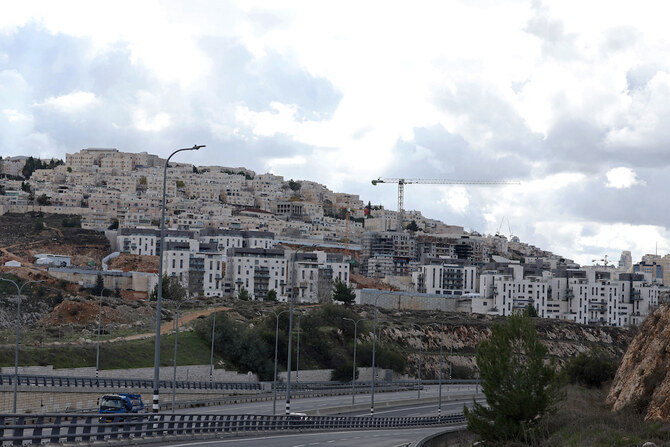
Above, construction cranes at Ramat Shlomo, a Jewish settlement in the Israeli-annexed eastern sector of Jerusalem on Jan. 24, 2025. (AFP)
Short Url
Updated 04 February 2025
Follow

NGOs, civil society groups urge EU to end trade with Israeli settlements

  • Bloc is violating ICJ ruling by allowing goods to enter European market, letter warns
  • Human Rights Watch: EU should ‘live up to its obligations under international law’

LONDON: More than 160 NGOs, civil society groups and trade unions have urged the EU to ban trade with illegal Israeli settlements in the Occupied Territories.

The appeal came in a letter addressed to European Commission President Ursula von der Leyen.

She was urged to take action to ensure that Europe complies with international law by ending its support for Israel’s illegal settlement enterprise.

It comes amid renewed international attention on the Palestinian question in the wake of the Gaza ceasefire.

Palestinians “continue suffering” in the enclave despite the “fragile” ceasefire, while in the West Bank Israeli authorities have “expanded their illegal settlements and intensified their repression of Palestinians,” Human Rights Watch said.

EU member states have repeatedly condemned Israeli settlements through unanimous voting. Two rounds of targeted sanctions against Israeli settlers were also launched by the bloc.

Last July, the International Court of Justice ruled that Israel’s occupation is illegal, and called for the dismantling of settlements.

States have an obligation to prevent trade “that assists in the maintenance of the illegal situation created by Israel in the Occupied Palestinian Territories,” the court said.

Existing EU policies breach this obligation, groups said in the letter, warning that goods exported from Israeli settlements are not excluded from entering the European market.

HRW said: “Amid sharp divisions, the EU has been unable to adopt measures that respond to Israel’s war crimes, crimes against humanity and acts of genocide in Gaza.

“But the bloc should at least be coherent with its own statements, and live up to its obligations under international law, by banning trade and business with settlements, which are inexorably linked to egregious rights abuses.”


President Abbas hopes 2026 brings progress on Palestinian statehood

Updated 6 sec ago
Follow

President Abbas hopes 2026 brings progress on Palestinian statehood

  • Leader endorses Gaza committee, cites positive indications from US administration to resolving cause

RAMALLAH: Palestinian Authority President Mahmoud Abbas said on Thursday that Palestine is determined to continue its efforts with US President Donald Trump and other relevant partners.

He expressed hope that 2026 will witness progress toward resolving the Palestinian cause, citing positive indications from the US administration.

He was speaking during a ceremony marking his receipt of an honorary doctorate from the Arab American University in Ramallah.

Abbas said the state of Palestine has announced its support for the formation of the Palestinian Administrative Committee in the Gaza Strip during the transitional phase.

He expressed appreciation for the efforts of Trump and mediators Egypt, Qatar, and Turkiye, and for moving toward the implementation of the second phase of Trump’s plan.

Abbas reaffirmed the importance of linking the institutions of the PA in the West Bank and Gaza, stressing the need to avoid creating parallel administrative, legal, or security systems that would entrench division.

He outlined his political vision based on the Palestinian people’s right to self-determination and return, and the establishment of an independent, fully sovereign Palestinian state with East Jerusalem as its capital, living in peace and security with its neighbors.

The president said the Palestinian state would be democratic, based on equal citizenship, political pluralism, freedom of expression, the formation of political parties, the rule of law, good governance, human rights, integrity, and equality.

Abbas stressed that direct legislative and presidential elections are the foundation of democratic governance and the only path to the peaceful transfer of power under the rule of law, transparency, accountability, and the empowerment of women and youth.

He noted that work is underway to draft a temporary constitution and a political parties law in preparation for the upcoming elections.

Abbas affirmed that the Palestinian state remains committed to international law and the agreements and treaties signed with other states and international organizations.

The president reiterated that peaceful popular resistance, alongside political, diplomatic, and legal action, remains the strategic choice to end the occupation.

He said the Palestinian people continue to safeguard their presence, history, identity, and national memory despite immense challenges, adding that despite the catastrophe caused by the war in Gaza, they remain determined to rebuild the enclave and what has been destroyed across the West Bank.

Abbas also voiced confidence in Palestinian universities, saying they will not only transmit knowledge but also advance it through investment in scientific research and partnerships with the private sector and the state, emphasizing that science and technology are key drivers of national progress.

He stressed that it is time for the Palestinian people to write their own complete history, present their authentic narrative, and decisively refute false and distorted accounts that seek to misrepresent the reality and history of the Palestinian people.