Nepal hikes Everest climbing fee by a third

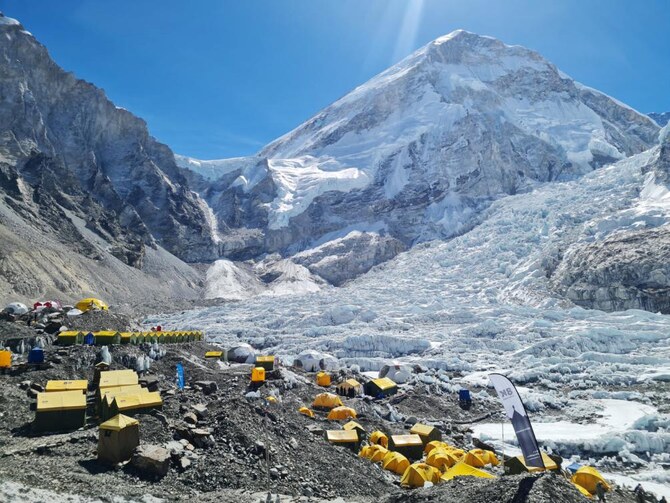
Tents of mountaineers are pictured at Everest base camp in the Mount Everest region of Solukhumbu district on April 18, 2024 on the tenth anniversary of an avalance which killed 16 Nepali guides. (AFP)
Short Url
Updated 04 February 2025
Follow

Nepal hikes Everest climbing fee by a third

Katmandu: Nepal has hiked the cost of an Everest climbing permit by a third, arguing it will help tackle pollution and boost safety on the world’s highest mountain, the tourism chief said Tuesday.
Fees for the peak spring climbing season will rise from $11,000 to $15,000 for a permit to scale the 8,849-meter (29,032-foot) peak, Narayan Prasad Regmi, director general of the tourism department, told AFP.
“The cost had remained constant for a decade and it was high time to revise that,” he said.
Costs of climbing at less popular — and more demanding — times of year such as during winter or the monsoon rains have also risen at similar rates, including from $5,500 to $7,500 during the autumn season.
Nepal is home to eight of the world’s 14 peaks over 8,000 meters and welcomes thousands of climbers each year.
Foreign climbers already spend tens of thousands of dollars in their attempt to climb Everest, with more than 400 purchasing permits last year, bringing in around $4 million to government coffers.
The funds are put toward cleaning trash from the mountain left by climbers as well as search and rescue operations.
Mountaineering expedition companies hoped the price hike would not deter climbers, warning some might look to scale Everest through China.
“Some climbers might shift to Tibet where the facilities are much better,” said Mingma G Sherpa, who runs the Imagine Nepal mountaineering company, saying the fee must be spent on improving conditions.
“Our government just increases the royalty, but doesn’t do much,” he said.
“It needs to also provide support to the climbers and guides.”
Nepal has been criticized for allowing too many climbers on Everest while doing little to keep the peak clean.
Last year, the Nepal government ordered Everest mountaineers to carry mandatory trackers and carry bags to remove their excrement.
The fee increase was approved by the government in January, but was only published in the national gazette late Monday.


USA Today Co., owner of the Detroit Free Press, says it will purchase The Detroit News

Updated 27 January 2026
Follow

USA Today Co., owner of the Detroit Free Press, says it will purchase The Detroit News

LANSING, Michigan: USA Today Co., which owns the Detroit Free Press, said Monday that it plans to acquire The Detroit News and bring both major metropolitan newspapers under its banner.
The Detroit News and the Detroit Free Press recently ended an almost 40-year agreement that allowed the two papers to operate in the same city and merge aspects of their business operations.
According to a statement from USA Today Co., the newspaper publisher formerly named Gannett, both newspapers will continue to publish separately. The company provided little other information on the planned operation of the daily newspapers.
The statement also did not disclose a price of the sale.
USA Today Co., which publishes the largest chain of newspapers in the US, said the sale is being funded through cash and financing managed by Apollo Global Management, the private equity firm that funded New Media Investment Group Inc.’s 2019 acquisition of Gannett.
The deal is expected to close “at the end of the month.”
The two newspapers have both been in operation for over 100 years. The Detroit News has won three Pulitzer Prizes and the Detroit Free Press has won 10.
“Both companies have a mutual desire to ensure that these publications and their distinct journalism continue to serve the greater Detroit area,” Guy Gilmore, chief operating officer of MediaNews Group, the current owner of The Detroit News said in a statement.
In 1989, the two papers began a joint operating agreement, a deal established under the 1970 Newspaper Preservation Act which allowed failing newspapers to be exempt from certain antitrust rules. The two newspapers worked in competition but shared some overhead resources and business operations including advertising, printing and distribution.
The Detroit Free Press and The Detroit News ended the agreement in December after 36 years.
In 2024, Gannett stopped using journalism produced by The Associated Press as financial struggles continued to mount on the news industry.