

After UN gender award, Pakistani officer shapes next generation of women soldiers

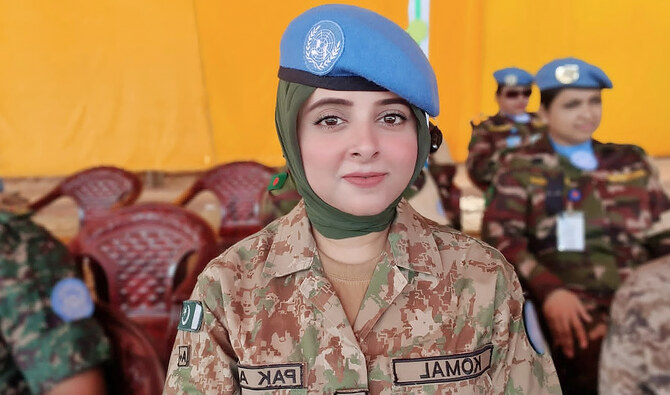
Pakistan’s Major Komal Masood poses for a picture during the United Nations Peacekeeping Force in the Central African Republic in Kaga-Bandoro in September 2023. (Major Komal Masood)
Short Url
Updated 04 February 2025
Follow

After UN gender award, Pakistani officer shapes next generation of women soldiers

  • Major Komal Masood awarded UN Certificate of Recognition for gender advocacy last year for peacekeeping work in Central African Republic
  • Masood, 33, now serves as platoon commander at Pakistan Military Academy in Kakul where she leads 17 women cadets

KAKUL, Pakistan: When Pakistan’s Major Komal Masood was posted with the United Nations Peacekeeping Force in the Central African Republic (CAR) last year, she never expected that her service would lead her to becoming the first peacekeeper from the mission to receive the 2023 Certificate of Recognition for gender advocacy.

Today, after returning from the UN mission, Masood, 33, is serving as a platoon commander at the Pakistan Military Academy (PMA) in the northwestern town of Kakul, where she leads 17 women cadets, shaping the country’s next generation of women army officers.

Every morning, Masood supervises the young cadets as they perform rigorous drills on field. She also instructs them on the use of military weapons and equipment and imparts lessons on military strategy in the classroom.

“I have 17 lady cadets under my command, including two from Bangladesh, and my job over here is to train them, to lead them, to be a better version of themselves,” Masood, who joined the Pakistan Army’s Corps of Signals in 2014, told Arab News on a crisp January morning before a training drill on the lush grounds of the military academy.

“What I have learned from the [UN] mission … I want to inculcate that change in my cadets from the very outset of their career … We are here to foster that change in them and to inculcate leadership qualities, decision-making qualities.”
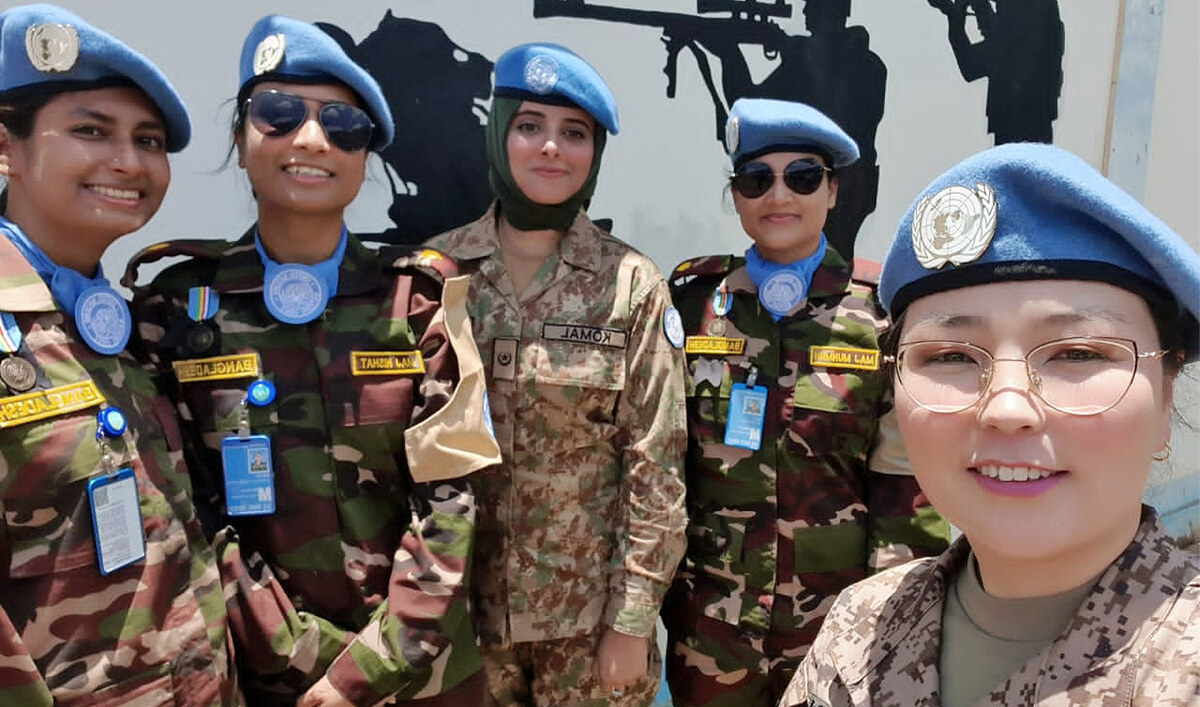


Pakistan’s Major Komal Masood (third right) poses for a picture with army officers from other countries at the United Nations Peacekeeping Force in the Central African Republic in Kaga-Bandoro in September 2023. (Major Komal Masood)

During her year-long UN mission in the CAR as a gender and protection adviser, Masood was responsible for promoting gender advocacy and integrating a gendered perspective into all aspects of the UN mission’s operations.

“My role was to integrate a gender perspective into all aspects of the mission, whether it was patrolling, intelligence, or operational planning,” she said.

“I was the sole member of the center sector headquarters over there, and I was overseeing child protection, sexual exploitation and abuse, protection of civilians and I had made many policies that were then approved by the UN headquarters in New York and then they were deployed across all the missions in the world.”

Masood also investigated multiple cases of sexual exploitation and abuse, leading to the repatriation of several individuals from the forces back to their home countries.

She said there was no policy or checklist guiding women peacekeepers in their tasks, preparations, or patrol procedures, leaving them to operate alongside male counterparts without clear directives.

“I made a consolidated checklist for women peacekeepers working, which was sent to the UN headquarters, and it got approved from there, and then it was deployed across all the missions across the world,” Masood said.

The UN recognition for her work was a “morale boost,” Masood added, because she had made a “lasting impact” by creating policy guidelines and checklists to support women peacekeepers in patrolling and engaging with affected communities even after the end of her time with the peacekeeping force.

For the officer, the journey has been anything but easy, balancing the demands of military service with motherhood as she left for the UN mission while one of her two children, who were both under six, was still an infant.

“Initially I thought that I won’t be able to leave my kids for one complete year, but if my country, my superiors, they have given me a task, I have to do it by hook or by crook so why not to do it by seeing the positivity,” said Masood.

In the end, it all worked out for the best as her family was proud of her achievements and the impact she had made.

“They feel very proud of me and my daughter always says, ‘Mama, I want to wear this uniform as well’.”

And Masood’s message to other women is clear: never stop striving.

“You are less than no one. Once you achieve something, whether as a stay-at-home woman or a professional, don’t stop there,” she said as she walked away to begin a drill with her students.

“Always strive for excellence.”


Pakistan raises fuel prices by Rs55 per liter as Middle East conflict drives oil surge

Updated 06 March 2026
Follow

Pakistan raises fuel prices by Rs55 per liter as Middle East conflict drives oil surge

  • Government says adequate fuel stocks in place despite global energy shock
  • Oil prices jump from about $78 to over $106 per barrel amid regional conflict

ISLAMABAD: Pakistan on Friday increased petrol and diesel prices by Rs55 ($0.20) per liter each as escalating conflict in the Middle East sent global oil prices sharply higher and disrupted energy supply routes, officials said.

Global oil markets have been rattled since coordinated strikes by the United States and Israel against Iran began last week, triggering retaliatory attacks across the region, raising fears of disruption to key energy shipping routes and pushing petroleum prices sharply upward.

The price adjustment in Pakistan was announced after a joint press conference by Finance Minister Muhammad Aurangzeb, Deputy Prime Minister and Foreign Minister Ishaq Dar and Petroleum Minister Ali Pervaiz Malik, who said the government was monitoring international energy markets and domestic supply conditions amid the crisis.

“So, the decision we have made by changing the levy a little bit is that we are going ahead with increasing the price of both fuels, petrol and diesel, by Rs55 ($0.20),” Malik told reporters. 

“And as soon as this matter settles, we will revise the prices downward with the same speed and take steps on how to increase people’s income and purchasing power.”

He said Pakistan entered the crisis with “comfortable energy reserves” due to earlier planning but rising global prices had forced the government to adjust domestic fuel rates to maintain supply continuity.

He said international petrol prices had climbed from roughly $78 per barrel on March 1 to around $106.8 per barrel, while diesel prices had risen to about $150 per barrel.

Malik added that the government had taken steps to minimize the burden on consumers, noting diesel plays a critical role in agriculture, transportation and public mobility.

Malik also warned that authorities would take strict action against anyone attempting to hoard fuel or manipulate supply for profiteering.

The minister said Pakistan was working with international partners to secure additional energy supplies, including arrangements with Saudi Aramco and the use of Pakistan National Shipping Corporation vessels to transport crude oil imports.

Finance Minister Aurangzeb said a high-level government committee formed by Prime Minister Shehbaz Sharif had been meeting daily to review developments in global petroleum markets and their potential impact on Pakistan’s economy.

“Pakistan currently maintains adequate energy stocks and macroeconomic stability,” Aurangzeb said, adding that the government’s response was based on preparedness rather than panic.

He said the committee, which includes senior ministers, the governor of the State Bank of Pakistan and other officials, was assessing short-, medium- and long-term implications of the crisis for inflation, foreign exchange reserves and broader economic indicators.

Deputy PM Dar said the regional conflict had significantly disrupted global energy markets, with international petroleum prices rising by as much as 50–70 percent in recent days.

The deputy prime minister added that Pakistan was also engaged in diplomatic efforts aimed at de-escalating tensions and restoring stability in the region.

Petroleum prices will now be reviewed more frequently, potentially on a weekly basis, and any reduction in global oil prices would be passed on to consumers.

Pakistan, which relies heavily on imported fuel to meet its energy needs, is particularly vulnerable to global oil price shocks that can quickly feed into inflation and pressure the country’s external accounts.