

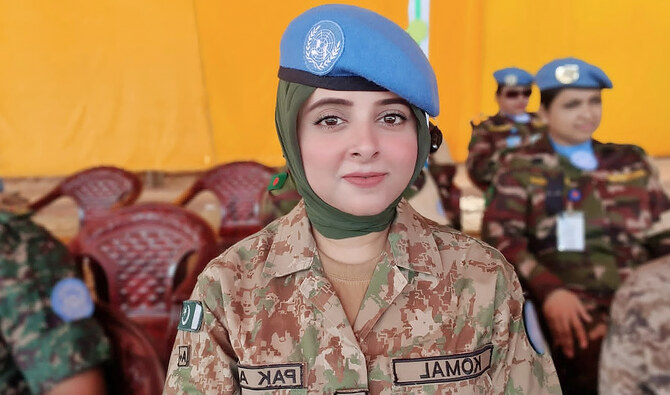

KAKUL, Pakistan: When Pakistan’s Major Komal Masood was posted with the United Nations Peacekeeping Force in the Central African Republic (CAR) last year, she never expected that her service would lead her to becoming the first peacekeeper from the mission to receive the 2023 Certificate of Recognition for gender advocacy.
Today, after returning from the UN mission, Masood, 33, is serving as a platoon commander at the Pakistan Military Academy (PMA) in the northwestern town of Kakul, where she leads 17 women cadets, shaping the country’s next generation of women army officers.
Every morning, Masood supervises the young cadets as they perform rigorous drills on field. She also instructs them on the use of military weapons and equipment and imparts lessons on military strategy in the classroom.
“I have 17 lady cadets under my command, including two from Bangladesh, and my job over here is to train them, to lead them, to be a better version of themselves,” Masood, who joined the Pakistan Army’s Corps of Signals in 2014, told Arab News on a crisp January morning before a training drill on the lush grounds of the military academy.
“What I have learned from the [UN] mission … I want to inculcate that change in my cadets from the very outset of their career … We are here to foster that change in them and to inculcate leadership qualities, decision-making qualities.”
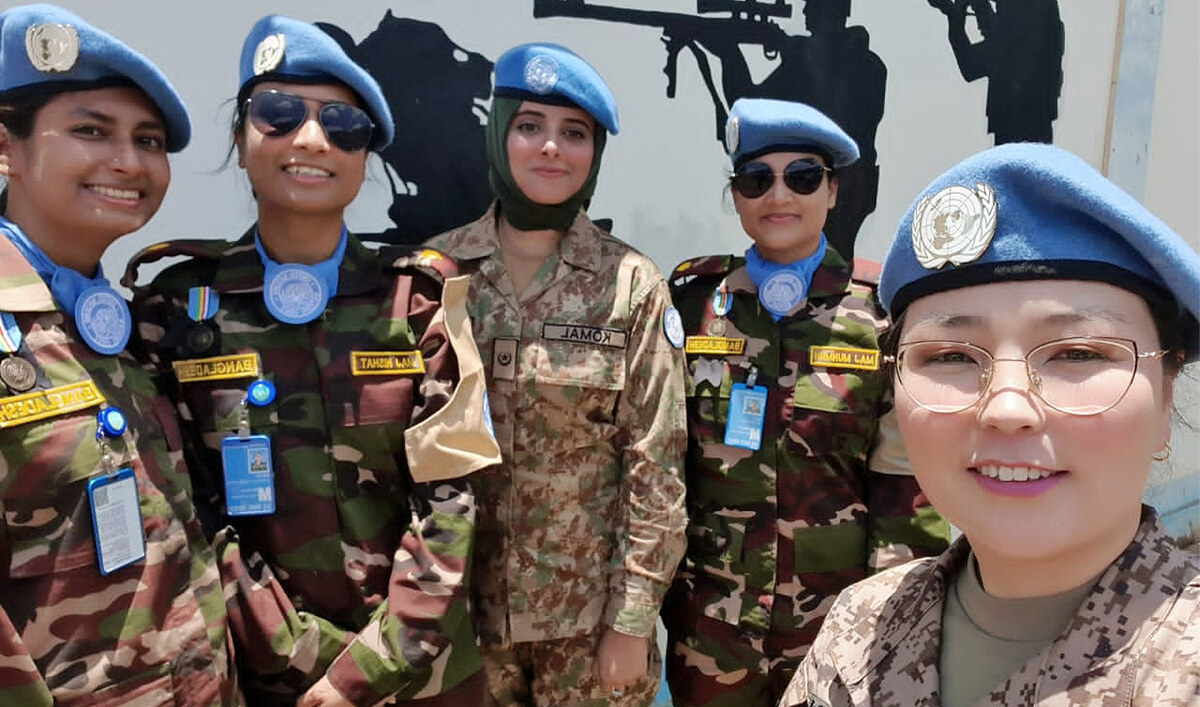
Pakistan’s Major Komal Masood (third right) poses for a picture with army officers from other countries at the United Nations Peacekeeping Force in the Central African Republic in Kaga-Bandoro in September 2023. (Major Komal Masood)
During her year-long UN mission in the CAR as a gender and protection adviser, Masood was responsible for promoting gender advocacy and integrating a gendered perspective into all aspects of the UN mission’s operations.
“My role was to integrate a gender perspective into all aspects of the mission, whether it was patrolling, intelligence, or operational planning,” she said.
“I was the sole member of the center sector headquarters over there, and I was overseeing child protection, sexual exploitation and abuse, protection of civilians and I had made many policies that were then approved by the UN headquarters in New York and then they were deployed across all the missions in the world.”
Masood also investigated multiple cases of sexual exploitation and abuse, leading to the repatriation of several individuals from the forces back to their home countries.
She said there was no policy or checklist guiding women peacekeepers in their tasks, preparations, or patrol procedures, leaving them to operate alongside male counterparts without clear directives.
“I made a consolidated checklist for women peacekeepers working, which was sent to the UN headquarters, and it got approved from there, and then it was deployed across all the missions across the world,” Masood said.
The UN recognition for her work was a “morale boost,” Masood added, because she had made a “lasting impact” by creating policy guidelines and checklists to support women peacekeepers in patrolling and engaging with affected communities even after the end of her time with the peacekeeping force.
For the officer, the journey has been anything but easy, balancing the demands of military service with motherhood as she left for the UN mission while one of her two children, who were both under six, was still an infant.
“Initially I thought that I won’t be able to leave my kids for one complete year, but if my country, my superiors, they have given me a task, I have to do it by hook or by crook so why not to do it by seeing the positivity,” said Masood.
In the end, it all worked out for the best as her family was proud of her achievements and the impact she had made.
“They feel very proud of me and my daughter always says, ‘Mama, I want to wear this uniform as well’.”
And Masood’s message to other women is clear: never stop striving.
“You are less than no one. Once you achieve something, whether as a stay-at-home woman or a professional, don’t stop there,” she said as she walked away to begin a drill with her students.
“Always strive for excellence.”


