

Pakistan threatens to deport Afghans in resettlement programs if cases not swiftly processed

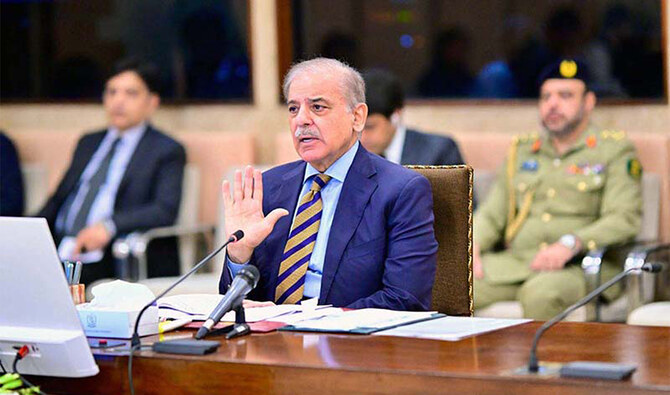
Prime Minister Muhammad Shehbaz Sharif addresses a federal cabinet in Islamabad, Pakistan on July 10, 2024. (PID/File)
Short Url
Updated 04 February 2025
Follow

Pakistan threatens to deport Afghans in resettlement programs if cases not swiftly processed

  • Tens of thousands of Afghans fled to neighboring Pakistan after Taliban took over in 2021 and were approved for resettlement in the US
  • However, after President Donald Trump paused US refugee programslast month, around 20,000 Afghans are now in limbo in Pakistan

ISLAMABAD: Pakistan threatened to deport Afghan refugees awaiting relocation unless their cases are swiftly processed by host governments, officials said Monday.

Tens of thousands of Afghans fled to neighboring Pakistan after the Taliban took over in 2021 and were approved for resettlement in the US through a program that helps people at risk because of their work with the American government, media, aid agencies and rights groups. However, after President Donald Trump paused US refugee programs last month, around 20,000 Afghans are now in limbo in Pakistan. 

The Trump administration also announced the US Refugee Admissions Program would be suspended from Jan. 27 for at least three months, fueling concerns amid Pakistani authorities.

Prime Minister Shehbaz Sharif decided last week that the refugees would be deported back to Afghanistan unless their cases were processed quickly, according to two security officials. They spoke on condition of anonymity as they were not authorized to talk to the media on the record.

The two also said March 31 has been set as a deadline to expel Afghan refugees from the capital, Islamabad, and the nearby city of Rawalpindi in preparation for their deportation if they are not relocated to their host countries.
There was no immediate response from Pakistan’s Ministry of Foreign Affairs.

News about forced deportations has panicked many Afghan nationals who fear for their lives if sent back home.

“We appeal to Pakistan’s Prime Minister Shehbaz Sharif not to be deported like this,” said Khalid Khan who has been waiting for relocation to the United States since 2023. 

Khan said some Afghans prepared to leave Islamabad and move to other cities to avoid arrest. He also urged the host countries to expedite their cases.

Another Afghan refugee who lives in Islamabad with his family, and who refused to be identified because he is worried about the Taliban reprisals and arrest by Pakistan, urged Trump to revive the refugee program “in the name of humanity.” 

Besides those living in Pakistan and the thousands awaiting travel to host countries, there are around 1.45 million Afghan nationals registered with UNHCR as refugees. Their stay has been extended until June.

Pakistan started a crackdown on foreigners who are in the country without proper documentation in November 2023. An estimated 800,000 Afghans have either gone back voluntarily or been deported since despite criticism from UN agencies, rights groups and the Taliban. 

The two officials said the crackdown will continue in the coming months.

Last month, Amnesty International expressed its concern over “reports of arbitrary detention and harassment of Afghan refugees and asylum seekers by law enforcement agencies in Islamabad.”


Pakistan’s Balochistan establishes threat assessment center amid surge in militant attacks

Updated 14 sec ago
Follow

Pakistan’s Balochistan establishes threat assessment center amid surge in militant attacks

  • Provincial Intelligence Fusion and Threat Assessment Center brings police, CTD, intelligence agencies together on one platform, says official
  • Says center helps disrupt terror financing, narcotics trafficking, organized crime and enables action against unregulated communication networks

ISLAMABAD: The government in Pakistan’s southwestern Balochistan province has established a state-of-the-art threat assessment center to strengthen early warning and prevention against “terrorism” incidents, a senior official said on Monday amid a surge in militant attacks recently. 

Balochistan Additional Chief Secretary Hamza Shafqaat wrote on social media platform X that the Provincial Intelligence Fusion and Threat Assessment Center (PIFTAC Balochistan) brings police, the counter-terrorism department (CTD), intelligence agencies and civil administration together on one platform for real-time information sharing and joint analysis. 

“PIFTAC strengthens early warning and prevention against terrorism, helps disrupt terror financing, narcotics trafficking, and organized crime, and enables coordinated action against illegal spectrum and unregulated communication networks,” he wrote.

“Information that was once scattered is now shared and acted upon in time, allowing the state to move from reacting after incidents to preventing them before they occur.”

https://x.com/beyondfiles/status/2010444397163532547

The development takes place amid a steep rise in combat-related deaths in Pakistan during 2025. According to statistics released by the Pakistan Institute for Conflict and Security Studies (PICSS) last month, combat-related deaths in 2025 rose 73 percent to 3,387.

These deaths included 2,115 militants, 664 security forces personnel, 580 civilians and 28 members of pro-government peace committees, the local think tank said. 

Pakistan military spokesperson Lt. Gen. Ahmed Sharif Chaudhry last week highlighted Pakistan’s counter-terrorism efforts in 2025, saying that security forces had conducted 75,175 intelligence-based operations (IBOs) and killed 2,597 militants last year. He also said Pakistan reported 5,397 “terrorism incidents” last year. 

Pakistan frequently accuses Afghanistan of allowing militant groups, including the Tehreek-e-Taliban Pakistan (TTP) and the separatist Balochistan Liberation Army (BLA) to operate from its soil, charges Kabul has repeatedly denied.

Islamabad also accuses India of backing these militant groups against Pakistan. New Delhi rejects the allegations.