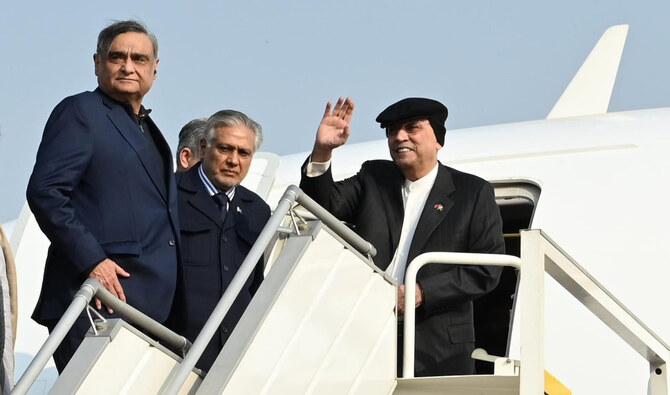
ISLAMABAD: Pakistan’s President Asif Ali Zardari will leave today, Tuesday, for Beijing on a five-day state visit to China, amid friction between the two allies over security of Chinese interests in Pakistan.
China is a major ally and investor in Pakistan that has pledged over $65 billion in investment in road, infrastructure and development projects under the China-Pakistan Economic Corridor (CPEC), a part of the Belt and Road Initiative that is a massive China-led infrastructure project that aims to stretch around the globe.
The visit comes at a time when Pakistan’s security challenges have put a strain on Islamabad’s ties with China, with separatist and religiously motivated militants attacking Chinese interests and nationals in Pakistan in recent years. In October, a suicide blast killed two Chinese nationals in Karachi, while five Chinese workers were killed in a suicide bombing in northwest Pakistan in March.
Zardari is undertaking the visit from Feb. 4 till Feb. 8 on the invitation of Chinese President Xi Jinping and will hold meetings with his Chinese counterpart, Premier Li Qiang and other senior Chinese officials in Beijing, according to the Pakistani foreign office.
“The discussions will encompass the full spectrum of Pakistan-China relations, with a particular focus on economic and trade cooperation; counter-terrorism and security collaboration, China-Pakistan Economic Corridor (CPEC) and future connectivity initiatives,” it said on Sunday.
The suicide bombing near the Karachi airport in Oct. was claimed by the separatist Balochistan Liberation Army (BLA), which has targeted Chinese interests and primarily operates in Balochistan where China is building a deep-sea port and last month opened an airport.
The BLA accuses China of plundering the province’s mineral resources with Pakistan’s help. Pakistani and Chinese authorities deny the allegation and say they are working for the uplift of the region.
In recent months, China has publicly criticized Pakistan over the attacks on its nationals and projects, while media reports have suggested that Beijing wants its own forces on the ground to protect its interests, a demand Islamabad has long resisted. Pakistan has assured China it will protect its nationals in the country from militant threats and has tightened security protocols for Chinese investors and nationals.
Pakistan’s Foreign Office said President Zardari’s visit reflects “deep commitment” of the two countries to strengthening their all-weather strategic cooperative partnership, while the two sides would also exchange views on the unfolding global and regional geopolitical landscape, and bilateral cooperation at multilateral fora.
“It reaffirms mutual support on the issues of core interests, advance economic and trade cooperation including CPEC, and to highlight their joint commitment to regional peace, development and stability,” it added


Pakistan president begins state visit to Beijing amid tensions over security of Chinese interests
https://arab.news/6u59r
Pakistan president begins state visit to Beijing amid tensions over security of Chinese interests

- Recent attacks on Chinese nationals and projects in Pakistan have strained ties between the longtime allies
- China has publicly criticized Pakistan over attacks, with media widely reporting it wants own secuirty on the ground

Pakistan IT minister in Kuwait to attend digital cooperation body meeting on AI risks
- Shaza Fatima Khawaja to attend event themed ‘Inclusive Prosperity in the Age of AI’
- Pakistan approved National AI Policy last year, launched first locally hosted AI cloud
KARACHI: Pakistan’s Information Technology (IT) Minister Shaza Fatima Khawaja on Wednesday arrived in Kuwait on a two-day visit to hold discussions on artificial intelligence (AI) and its risks at the fifth Digital Cooperation Organization General Assembly (DCOGA), her office said.
The annual gathering brings together representatives of various states and international organizations to discuss the digital economy and the challenges associated with its growth. This year’s theme is “Inclusive Prosperity in the Age of AI.”
Pakistan has been actively developing its AI landscape, marked by the approval of the National AI Policy in July last year and the subsequent launch of its first locally hosted AI cloud in a bid to integrate AI for economic growth.
“The federal minister will participate in the General Assembly of the Digital Cooperation Organization (DCO) and hold meetings with representatives of member states,” the IT ministry said in a statement on Wednesday.
“Discussions will be held on artificial intelligence and its risks, with meetings scheduled with global policymakers.”
Khawaja will hold high-level meetings with global leaders at the event and participate in the DCO thematic ministerial roundtable comprising ministers from various countries, it added.
The development comes as Pakistan seeks to position itself as a credible participant in the global AI economy to harness AI for productivity, skills development and innovation while managing regulatory risks.
Pakistan has mainly been engaging with Gulf countries on AI. In October last year, Pakistan’s Prime Minister Shehbaz Sharif announced that Saudi Arabia has offered free training in IT and AI for Pakistani youth. Last November, Pakistan and the United Arab Emirates agreed to deepen cooperation in AI, digital governance and data innovation.
Pakistan is also hosting a week-long national AI initiative, “AI Indus Week 2026,” from Feb. 9-15 to promote the responsible use of technology and accelerate the adoption of AI across the public and private sectors.


