

Pakistan police officer killed as polio vaccination drive starts — police

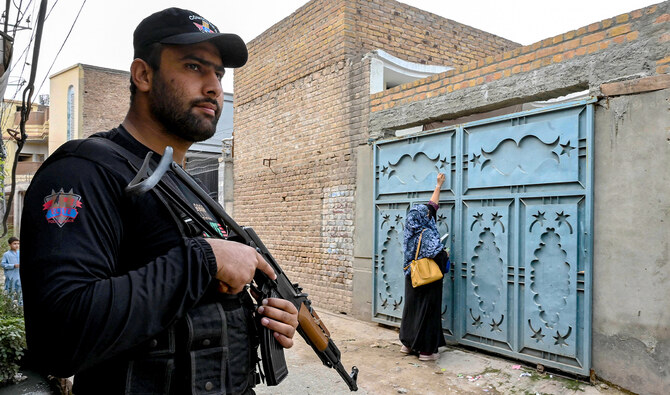
This photograph taken on October 29, 2024 shows an elite police personnel (L) standing guard as a health worker marks houses with numbers during a door-to-door poliovirus vaccination campaign for children on the outskirts of Peshawar. (AFP/File)
Short Url
Updated 03 February 2025
Follow

Pakistan police officer killed as polio vaccination drive starts — police

  • Two motorcycle riders opened fire on police officer in northwestern Jamrud town, say police
  • Pakistan launched this year’s first nationwide immunization effort today after 73 cases in 2024 

PESHAWAR, Pakistan: A Pakistan police officer traveling to guard polio vaccinators was shot dead Monday, police said, on the first day of a nationwide immunization effort after a year of rising cases.

The officer was traveling to guard polio vaccinators in the area of Jamrud town in northwestern Khyber Pakhtunkhwa province when he was killed, local police official Zarmat Khan told AFP.

“Two motorcycle riders opened fire on him,” he said. “The constable died instantly at the scene.”

Pakistan and neighboring Afghanistan are the only countries where polio is endemic and militants have for decades targeted vaccination teams and their security escorts.

Pakistan recorded at least 73 polio infections last year compared to six in 2023. The vaccination campaign which started on Monday is the first of the year and is due to last a week.

“Despite the incident, the polio vaccination drive in the area remains ongoing,” Khan said.

Abdul Hameed Afridi, another senior police official in the area, also confirmed details of the attack and said officers have “launched an investigation.”

No group immediately claimed responsibility for the attack, however Khyber Pakhtunkhwa — which neighbors Afghanistan — is a hive of militant activity.

The Pakistani Taliban are the most active group in the area.

Polio can easily be prevented by the oral administration of a few drops of vaccine, but scores of vaccination workers and their escorts have been killed over the years.

In the past, clerics falsely claimed that the vaccine contained pork or alcohol, declaring it forbidden for Muslims.

In more recent years the attacks have focused on vulnerable police escorts accompanying the vaccinators as they go door-to-door.

Last year, dozens of Pakistani policemen who accompany medical teams on campaigns went on strike after a string of militant attacks targeting them.

Pakistan has witnessed rising militant attacks since the Taliban returned to power in neighboring Afghanistan.

More than 1,600 people were killed in attacks in 2024 — the deadliest year in almost a decade — according to the Center for Research and Security Studies, an Islamabad-based analysis group.

Islamabad accuses Kabul’s new rulers of failing to rout militants organizing on Afghan soil, a charge the Taliban government routinely denies.

Pakistan’s Prime Minister Shehbaz Sharif said Sunday last year’s polio eradication efforts faced “a major setback.”

“We must eradicate polio from Pakistan at any cost,” he said as he launched the new vaccination drive.


Pakistan says 177 militants killed in Balochistan counteroffensive after wave of attacks

Updated 7 sec ago
Follow

Pakistan says 177 militants killed in Balochistan counteroffensive after wave of attacks

  • Authorities say coordinated attacks last weekend killed 31 civilians, 17 security personnel
  • Separatist BLA group claimed responsibility as operations expanded across multiple districts

ISLAMABAD: Pakistan’s security forces have killed 22 more militants in overnight counteroffensive operations in the southwestern province of Balochistan, state media reported on Monday, taking the total number of insurgents killed over the past three days to 177 following a wave of coordinated separatist attacks.

Militants launched simultaneous assaults across multiple districts in Balochistan on Friday and Saturday, targeting security installations and government facilities. The attacks marked one of the deadliest escalations in recent years in the resource-rich but restive province, with at least 31 civilians and 17 members of law enforcement agencies killed.

The banned separatist group, the Baloch Liberation Army, claimed responsibility for the attacks, saying it had launched a coordinated operation dubbed Herof, or “black storm,” targeting security forces across the province. The assault included pre-dawn strikes on high-security installations in the cities of Quetta, Gwadar, Dalbandin, Pasni, Nushki, Kalat, Turbat and Mastung.

Local residents look at a damaged bank on the outskirts of Quetta on February 1, 2026 a day after an attack by Baloch separatists. (AFP)

On Monday, state broadcaster Radio Pakistan said security forces carried out the latest “sanitization operations” against what it described as “Fitna-al-Hindustan” in Balochistan late Sunday night. Pakistan’s military and civilian authorities use the term to describe separatist militants in the province whom Islamabad alleges are supported by India, a charge New Delhi denies.

“According to security sources, 22 more terrorists were killed last night during pursuit operations,” Radio Pakistan said. “At least 177 terrorists have been eliminated in the operations conducted over the last three days.”

People gather as others collect recyclable items beside a burnt vehicle along a road on the outskirts of Quetta on February 1, 2026 a day after an attack by Baloch separatists. (AFP)

Balochistan, Pakistan’s largest province by area, has long been gripped by a separatist insurgency that has intensified in recent years. Militants frequently target security forces, government officials, infrastructure projects, foreigners and non-local workers.

Balochistan is strategically significant for Pakistan due to its vast reserves of minerals and hydrocarbons and its role as a transit hub for the multibillion-dollar China-Pakistan Economic Corridor (CPEC), a flagship component of China’s Belt and Road Initiative. The province is home to the deep-sea Gwadar Port on the Arabian Sea, which Islamabad views as critical to regional trade and energy routes linking China, Central Asia and the Middle East. 

Local residents look at a damaged bank on the outskirts of Quetta on February 1, 2026, a day after an attack by Baloch separatists. (AFP)

Separatist groups accuse the central government of exploiting the province’s natural resources while neglecting local communities. Islamabad rejects the allegations, saying it is investing in development and security to stabilize the province.