

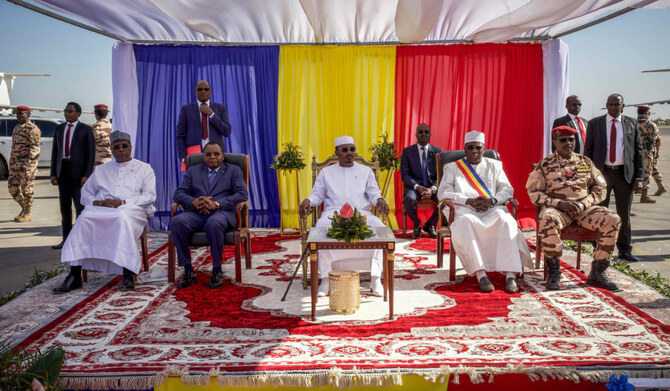
Chad president welcomes ‘complete’ departure of French forces

(From L to R) Chadian Foreign Minister Abderraman Koulamallah, Chadian Prime Minister Allamaye Halina, Chadian President Mahamat Idriss Deby, First Vice-President of the National Transition Council Ali Kolotou Tchaimi and Chief of Staff General of the Chadian Armed Forces (CEMGA ) Abakar Abdelkerim Daoud sit as they attend the ceremony marking the end of France’s presence in Chad and the Sahel at the Adji Kossei Air Base in N'Djamena on January 31, 2025. (AFP)
Short Url
Updated 31 January 2025
Follow

Chad president welcomes ‘complete’ departure of French forces

  • Soldiers and fighter aircraft from France have been stationed in Chad almost continuously since the country’s independence in 1960, helping to train the Chadian military

N’DJAMENA: President Mahamat Idriss Deby on Friday welcomed the “definitive and complete departure” of French forces from Chad, which marks the end of France’s last foothold in the wider terrorist-hit Sahel region.
After a closed-door military ceremony a day earlier, Deby addressed Chadian forces and diplomats at an event in the capital, N’Djamena.
The handover of the Kossei base, the French army’s last such facility in the central African country, follows Chad’s surprise breaking off military cooperation with its former colonial ruler in late November.
“We are not breaking off our relationship with France, but we are ending the military dimension of this cooperation,” Deby said at the base where only the Chadian flag was flying.
Chad must build an “even stronger, better-equipped army” and “forge new alliances based on mutual respect and without losing sight of the demands of independence and sovereignty,” he added.
Soldiers and fighter aircraft from France have been stationed in Chad almost continuously since the country’s independence in 1960, helping to train the Chadian military.
The country had been a key link in France’s military presence in Africa.


Thai villagers stay behind to guard empty homes as border clashes force mass evacuations

Updated 58 min 19 sec ago
Follow

Thai villagers stay behind to guard empty homes as border clashes force mass evacuations

  • Appointed by the local administration as Village Security Volunteers, they guarded the empty homes after many residents were forced to flee and with fewer security officials stationed nearby than usual

SURIN: Fighting that has flared along the Thai-Cambodian border has sent hundreds of thousands of Thai villagers fleeing from their homes close to the frontier since Monday. Their once-bustling communities have fallen largely silent except for the distant rumble of firing across the fields.
Yet in several of these villages, where normally a few hundred people live, a few dozen residents have chosen to stay behind despite the constant sounds of danger.
In a village in Buriram province, about 6 miles (10 kilometers) from the border, Somjai Kraiprakon and roughly 20 of her neighbors gathered around a roadside house, keeping watch over nearby homes. Appointed by the local administration as Village Security Volunteers, they guarded the empty homes after many residents were forced to flee and with fewer security officials stationed nearby than usual.
The latest large-scale fighting derailed a ceasefire pushed by US President Donald Trump, which halted five days of clashes in July triggered by longstanding territorial disputes. As of Saturday, around two dozen people had been reported killed in the renewed violence.
At a house on the village’s main intersection, now a meeting point, kitchen and sleeping area, explosions were a regular backdrop, with the constant risk of stray ammunition landing nearby. Somjai rarely flinched, but when the blasts came too close, she would sprint to a makeshift bunker beside the house, built on an empty plot from large precast concrete drainage pipes reinforced with dirt, sandbags and car tires.
She volunteered shortly after the July fighting. The 52-year-old completed a three-day training course with the district administration that included gun training and patrol techniques before she was appointed in November. The volunteer village guards are permitted to carry firearms provided by relevant authorities.
The army has emphasized the importance of volunteers like Somjai in this new phase of fighting, saying they help “provide the highest possible confidence and safety for the public.”
According to the army, volunteers “conduct patrols, establish checkpoints, stand guard inside villages, protect the property of local people, and monitor suspicious individuals who may attempt to infiltrate the area to gather intelligence.”
Somjai said the volunteer team performs all these duties, keeping close watch on strangers and patrolling at night to discourage thieves from entering abandoned homes. Her main responsibility, however, is not monitoring threats but caring for about 70 dogs left behind in the community.
“This is my priority. The other things I let the men take care of them. I’m not good at going out patrolling at night. Fortunately I’m good with dogs,” she said, adding that she first fed a few using her own money, but as donations began coming in, she was able to expand her feeding efforts.
In a nearby village, chief Praden Prajuabsook sat with about a dozen members of his village security team along a roadside in front of a local school. Around there, most shops were already closed and few cars could be seen passing once in a while.
Wearing navy blue uniforms and striped purple and blue scarves, the men and women chatted casually while keeping shotguns close and watching strangers carefully. Praden said the team stationed at different spots during the day, then started patrolling when night fell.
He noted that their guard duty is around the clock, and it comes with no compensation and relies entirely on volunteers. “We do it with our own will, for the brothers and sisters in our village,” he said.
Beyond guarding empty homes, Praden’s team, like Somjai, also ensures pets, cattle and other animals are fed. During the day, some members ride motorbikes from house to house to feed pigs, chickens and dogs left behind by their owners.
Although his village is close to the battlegrounds, Praden said he is not afraid of the sounds of fighting.
“We want our people to be safe… we are willing to safeguard the village for the people who have evacuated,” he said.