Sudan paramilitary chief admits setbacks, vows to expel army from Khartoum

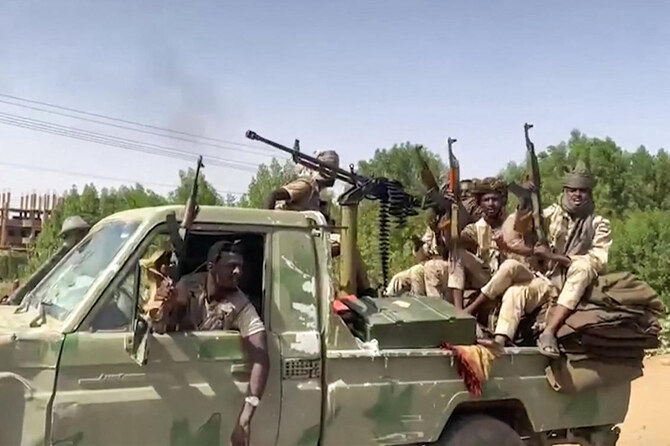
In this image grab taken from handout video footage released by the Sudanese paramilitary Rapid Support Forces (RSF) in April 2023, fighters ride in the back of a technical vehicle (pickup truck mounted with a turret) in the East Nile district of greater Khartoum. (AFP/File)
Short Url
Updated 31 January 2025
Follow

Sudan paramilitary chief admits setbacks, vows to expel army from Khartoum

  • Dagalo acknowledged setbacks in the capital but urged his troops “not to think of the army entering the General Command or the Signal Corps... “
  • Two weeks before its gains in Khartoum the army reclaimed the Al-Jazira state capital Wad Madani

PORT SUDAN: Sudan’s paramilitary commander Mohamed Hamdan Dagalo, in a rare video address on Friday, acknowledged setbacks in the capital Khartoum but vowed to expel the army from the city again.
The war since April 2023 between Dagalo’s Rapid Support Forces (RSF) and the army has killed tens of thousands of people, uprooted more than 12 million, according to the United Nations, and pushed millions to the brink of famine.
After months of apparent stalemate in Khartoum, the army one week ago broke an almost two-year RSF siege of its Khartoum General Command headquarters. On the same day, the army reported reclaiming its Signal Corps base in Khartoum North, and expelling the RSF from Jaili oil refinery north of Khartoum.
In his address on Friday, Dagalo — commonly known as Hemeti — acknowledged setbacks in the capital but urged his troops “not to think of the army entering the General Command or the Signal Corps... or taking control of Al-Jaili or Wad Madani.”
Two weeks before its gains in Khartoum the army reclaimed the Al-Jazira state capital Wad Madani, securing a key crossroads just south of the capital.
The RSF last week said army statements claiming they had broken the sieges and seized Jaili refinery were rumors intended to sway public opinion.
But on Friday, Dagalo promised his fighters that the army “will not enjoy the General Command for long, nor will they enjoy the Signal Corps.”
“We must think of what we intend to take,” he added.
Appearing behind a desk in military fatigues, with a camouflage scarf wrapped around his neck, the RSF leader said “we expelled them (from Khartoum), and we will expel them again.”
Dagalo has remained out of sight for most of the war, with his rare addresses usually delivered via voice message on social media.
His troops early in the war conquered much of Khartoum and pushed south. They still control almost all of Sudan’s vast western Darfur region.
Army chief Abdel Fattah Al-Burhan — Dagalo’s former ally before they fell out in a power struggle — on Sunday visited his troops at the General Command, which is near central Khartoum and the airport.
His push into RSF-controlled Khartoum North, also known as Bahri, enabled the army’s biggest victory since it regained Omdurman, the third district of the capital, around a year ago.
According to an army source, who was not authorized to speak to the media, fighting continued Friday for the Kafouri neighborhood in eastern Bahri.
This month, the United States sanctioned both Hemeti and Burhan, accusing the former of genocide and the latter of attacking schools, markets and hospitals, as well as using food deprivation as a weapon of war.


Ceasefire with Kurdish-led force extended for another 15 days, Syrian army says

Updated 25 January 2026
Follow

Ceasefire with Kurdish-led force extended for another 15 days, Syrian army says

  • The defense ministry said the extension was in support of an operation by US forces to transfer accused Daesh militants to Iraq
  • The Kurdish-led Syrian Democratic Forces confirmed the ceasefire extension

RAQQA, Syria: Hours after the expiration of a four-day truce between the Syrian government and Kurdish-led fighters Saturday, Syria’s defense ministry announced the ceasefire had been extended by another 15 days.
The defense ministry said in a statement that the extension was in support of an operation by US forces to transfer accused Daesh militants who had been held in prisons in northeastern Syria to detention centers in Iraq.
The Kurdish-led Syrian Democratic Forces confirmed the ceasefire extension.
“Our forces affirm their commitment to the agreement and their dedication to respecting it, which contributes to de-escalation, the protection of civilians, and the creation of the necessary conditions for stability,” the group said in a statement.
Over the past three weeks, there have been intense clashes between government forces and the SDF, in which the SDF lost large parts of the area they once controlled.
Earlier in the day, the Kurdish-led force called on the international community to prevent any escalation.
The end of the truce came as government forces have been sending reinforcements to Syria’s northeast.
Syria’s interim government signed an agreement last March with the SDF for it to hand over territory and to eventually merge its fighters with government forces. In early January, a new round of talks failed to make progress over the merger, leading to renewed fighting between the two sides.
A new version of the accord was signed last weekend, and a four-day ceasefire was declared Tuesday. Part of the new deal is that SDF members will have to merge into the army and police forces as individuals.
The SDF said in a statement Saturday that military buildups and logistical movements by government forces have been observed, “clearly indicating an intent to escalate and push the region toward a new confrontation.” The SDF said it will continue to abide by the truce.
On Saturday, state TV said authorities on Saturday released 126 boys under the age of 18 who were held at the Al-Aqtan prison near the northern city of Raqqa that was taken by government forces Friday. The teenagers were taken to the city of Raqqa where they were handed over to their families, the TV station said.
The prison is also home to some of the 9,000 members of the Daesh group who are held in northeastern Syria. Most of them remain held in jails run by the SDF. Government forces have so far taken control of two prisons while the rest are still run by the SDF.
Earlier this week, the US military said that some 7,000 Daesh detainees will be transferred to detention centers in neighboring Iraq.
On Wednesday, the US military said that 150 prisoners have been taken to Iraq.