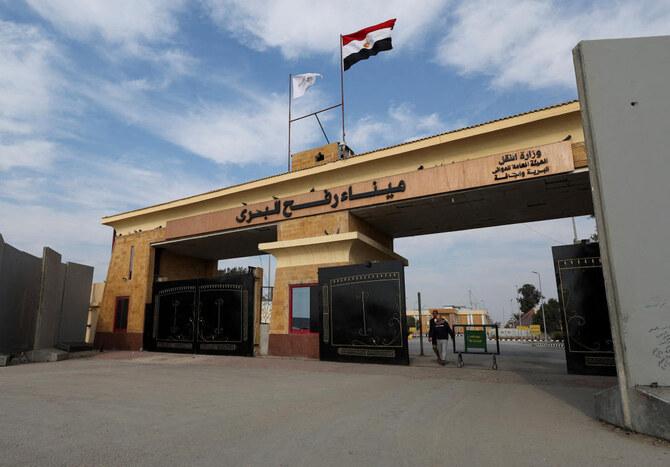
BRUSSELS: The European Union has restarted its civilian mission to monitor the border crossing between Gaza and Egypt at Rafah, a key entry and exit point for the Palestinian territory, the bloc’s foreign policy chief Kaja Kallas said on Friday.
Kallas announced on Monday that there was broad agreement among member states’ foreign ministers that the EU Border Assistance Mission (EUBAM) could play a “decisive role” in supporting the ceasefire agreement between Israel and the Hamas group that administers Gaza.
“The EU’s civilian border mission deploys today to the Rafah Crossing at the request of the Palestinians and the Israelis. It will support Palestinian border personnel and allow the transfer of individuals out of Gaza, including those who need medical care,” she posted on X.
Palestinian and Hamas officials said the crossing would now be run by members of the Palestinian Authority and European monitors.
It will be opened for 50 injured militants and 50 wounded civilians, along with individuals escorting them, according to the officials, who said a further 100 people, most likely students, would be allowed through on humanitarian grounds.
A civilian EU mission to help monitor the crossing began work in 2005 but was suspended in June 2007 as a result of Hamas’ takeover of the Gaza Strip.
In its standby mode, the mission had 10 international and eight local staff.
Italy has said it will send seven paramilitary Carabinieri officers to join the Rafah mission in addition to two Italians already there, while Germany’s interior and foreign ministries are discussing sending a German contingent.


EU restarts Rafah border crossing mission, says foreign policy chief Kallas
https://arab.news/bthk4
EU restarts Rafah border crossing mission, says foreign policy chief Kallas

- ‘The EU’s civilian border mission deploys today to the Rafah Crossing at the request of the Palestinians and the Israelis’
- The crossing would now be run by members of the Palestinian Authority and European monitors


Arab Coalition announces ‘limited’ airstrike targeting two ships that smuggled weapons to Yemen
- Coalition urges evacuation of the Port of Mukalla, signaling that a major military operation to force an STC withdrawal could be imminent
- Spokesman says the two ships transported weapons from the UAE port of Fujairah to Mukalla without getting permission from Coalition command
RIYADH: The Coalition to Support Legitimacy in Yemen on Tuesday said it conducted a “limited” airstrike targeting two ships that smuggled weapons and other military hardware into Mukalla in southern Yemen.
In a statement carried by the Saudi Press Agency (SPA), the Coalition Forces spokesman, Major General Turki Al-Maliki, said that two ships coming from the port of Fujairah in the United Arab Emirates entered the Port of Mukalla in Hadramaut without obtaining official permits from the Joint Forces Command of the Coalition.
“The crews of the two ships disabled the tracking systems of the two ships and unloaded a large quantity of weapons and combat vehicles to support the Southern Transitional Council forces in the eastern governorates of Yemen (Hadramawt, Al-Mahra) with the aim of fueling the conflict. This is a clear violation of imposing a truce and reaching a peaceful solution, as well as a violation of UN Security Council Resolution No. (2216) of 2015 AD,” said the spokesman.
The coalition urged civilians and fishermen to evacuate the Port of Mukalla, signaling that a major military operation to force an STC withdrawal could be imminent.

Al-Maliki said the Coalition Forces acted on a request by Rashad Al-Alimi, the president of the Yemeni Presidential Leadership Council, “to take all necessary military measures to protect civilians in the governorates of Hadramawt and Al-Mahra.”
Al-Alimi, the president of the Yemeni Presidential Leadership Council, warned last week that unilateral actions by the STC were pushing the country toward a dangerous tipping point.
“Given the danger and escalation posed by these weapons, which threaten security and stability, the Coalition Air Forces conducted a limited military operation this morning targeting weapons and combat vehicles unloaded from the two ships at the port of Al-Mukalla. This was done after documenting the unloading, and the military operation was carried out in accordance with international humanitarian law and its customary rules, ensuring no collateral damage occurred,” spokesman Al-Maliki said on Tuesday.
READ MORE: Analysis: The risks of carving up Yemen
He affirmed the Coalition’s "continued commitment to de-escalation and enforcing calm in the governorates of Hadramawt and Al-Mahra, and to prevent any military support from any country to any Yemeni faction without coordination with the legitimate Yemeni government and the Coalition. This is aimed at ensuring the success of the Kingdom and the Coalition’s efforts to achieve security and stability and prevent the conflict from spreading.”
Disregarding previous agreements with the Coalition, the group calling itself Southern Transitional Council, or STC, launched a sweeping military campaign early in December, seizing the governorates of Hadramaut along the Saudi border and the eastern governorate of Al-Mahra in Yemen’s border with Oman.
The UAE-backed STC forces captured the city of Seiyun, including its international airport and the presidential palace. They also took control of the strategic PetroMasila oilfields, which account for a massive portion of Yemen’s remaining oil wealth.

This prompted Saudi Arabia to issue a firm demand for the STC to withdraw and hand over the seized areas to the National Shield Forces, a Saudi-backed unit.
The coalition warned that any military movements undermining de-escalation efforts would be dealt with immediately to protect civilians, according to the Saudi Press Agency.
On Dec. 26, the UAE issued a statement welcoming Saudi Arabia’s efforts to support security and stability in Yemen.
The statement carried by state news agency WAM praised Saudi Arabia’s constructive role in advancing the interests of the Yemeni people and supporting their legitimate aspirations for stability and prosperity.


