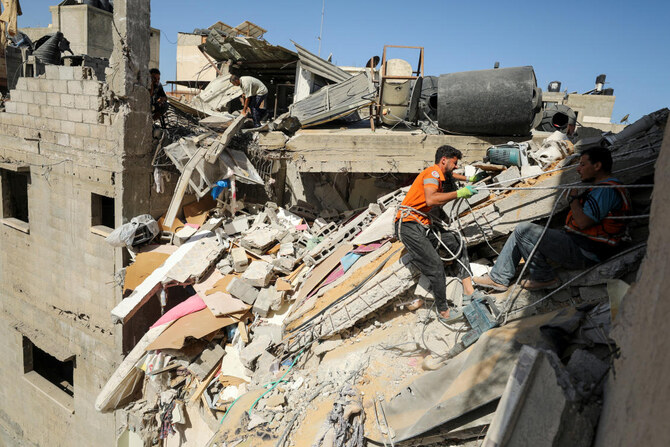

CAIRO: Israeli forces killed at least 27 Palestinians in tank and air strikes on north and central areas of the Gaza Strip on Friday, medics said, as tanks advanced further into northwest Rafah near the border with Egypt.
The unrelenting fighting between the Israelis and Hamas militants in the enclave carried on even as a parallel conflict in the Lebanon-Israel border area involving Hamas’ allies Hezbollah intensified.
Meanwhile, some Palestinians displaced by the Israeli assault on Gaza said they feared their temporary beachside camp would be inundated by high waves.
Palestinian health officials said shelling by Israeli tanks killed eight people and wounded several others in the Nuseirat refugee camp in the central area of Gaza, and six others were killed in an airstrike on a house in Gaza City.
In the northern town of Beit Hanoun, an Israeli strike on a car killed and wounded several Palestinians, medics said.
It was not clear how many of the casualties were combatants and how many were civilians.
In the southern city of Rafah, where the Israeli army has been operating since May, tanks advanced further to the northwest area backed by aircraft, residents said.
They also reported heavy fire and explosions echoing in the eastern areas of the city, where Israeli forces blew up several houses, according to residents and Hamas media.
“Our fighters are engaged in fierce gunbattles against Israeli forces, who advanced into Tanour neighborhood in Rafah,” Hamas armed wing said in a statement.
The Israeli military has said that forces operating in Rafah had in past weeks killed hundreds of Palestinian militants, located tunnels and explosives and destroyed military infrastructure.
Israel’s demand to keep control of the southern border line between Rafah and Egypt has been the focus of an international effort to conclude a ceasefire deal between Israel and Hamas.
The United States and mediators Qatar and Egypt have for months attempted to secure a truce but have failed to bring Israel and Hamas to a final agreement.
Two obstacles have been especially difficult — Israel’s demand that it keep forces in the Philadelphi corridor between Gaza and Egypt, and the specifics of an exchange of Israeli hostages for Palestinian prisoners held by Israel.
ENCROACHING SEA
In a new challenge to Palestinians displaced in the Al-Mawasi area in southern Gaza, many were concerned about the danger of high waves. Some tents put up close to the beach flooded last week.
“Enough, enough, enough. We were pushed by the occupation (Israel) to the sea, where we believed it was safe, last week the sea flooded and washed away some tents, and that could happen again, where would we go?” said Shaban, 47, an electrical engineer displaced from Gaza City.
This latest war in the decades-old Israeli-Palestinian conflict was triggered last Oct. 7 when Hamas attacked Israel, killing 1,200 people and taking about 250 hostages, according to Israeli tallies.
Israel’s subsequent assault on the Hamas-governed enclave has killed more than 41,000 Palestinians, according to the local health ministry, while displacing nearly the entire population of 2.3 million, causing a hunger crisis and leading to genocide allegations at the World Court that Israel denies.
Israel says it aims to eradicate the Iran-aligned Hamas, which it deems a threat to its own existence.