Foreign office says nearly 80,000 Afghan migrants in Pakistan resettled abroad, 40,000 remain

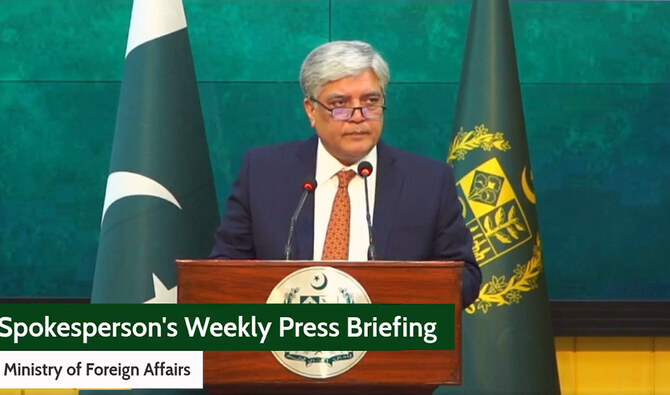
The screengrab taken from the press conference of Pakistan’s Ministry of Foreign Affairs shows the foreign office’s spokesperson Shafqat Ali Khan addressing the weekly media briefing in Islamabad on January 23, 2025. (MOFA/File)
Short Url
Updated 31 January 2025
Follow

Foreign office says nearly 80,000 Afghan migrants in Pakistan resettled abroad, 40,000 remain

  • US President Trump suspended US Refugee Admission Program through executive order on Jan. 20
  • Thousands of Afghans who had applied for resettlement in US, EU entered Pakistan after fall of Kabul

ISLAMABAD: Foreign Office spokesperson Shafqat Ali Khan said this week nearly 80,000 Afghans in Pakistan had been resettled in various countries abroad, while another 40,000 still remained in Pakistan.

The 2021 withdrawal of US-led troops from Kabul ended two decades of war but began a new exodus, as Afghans clamoured to escape Taliban government curbs and fears of reprisal for working with Washington and its allies. Thousands of Afghans who had applied for resettlement in the US and European countries entered neighboring Pakistan, where many still remain trapped in legal limbo.

The latest blow has been a decision by US President Donald Trump’s administration last week to halt visa processing for refugees for at least 90 days, blocking around 10,000 Afghans approved for entry from starting new lives in the United States, according to non-profit #AfghanEvac. Tens of thousands more applications in process have also been frozen, the US-based organization said.

“I can give you a broad figure,” Spokesman Khan said in reply to a question on the number of Afghan nationals in Pakistan who were awaiting resettlement abroad.

“Almost 80,000 have been taken by various countries for resettlement and around 40,000 are still in Pakistan.” 

Trump’s order said “the United States lacks the ability to absorb large numbers of migrants, and in particular, refugees,” and stopped the relocation scheme until it “aligns with the interests of the United States.”

But campaigners argue the country owes a debt to Afghans left in the lurch by their withdrawal, which Trump committed to in his first term but was overseen by his successor president Joe Biden.

A special visa program for Afghans who were employed by or on behalf of the United States remains active.

But the more wide-reaching refugee scheme was relied on by applicants including ex-Afghan soldiers and employees of the US-backed government, as well as their family members.

With America’s Kabul embassy shut, many traveled to neighboring Pakistan to enter paperwork, conduct interviews and undergo vetting.

Khan said Pakistan hoped the US would restart its refugee program so the remaining Afghan refugees could be resettled “as per commitments given by the US government.” He also hoped the US would resume foreign development assistance programs, which have also been suspended by Trump for at least 90 days through an executive order. 

Islamabad announced a sweeping campaign in 2023 to evict undocumented Afghans residing in the country illegally, ordering them to leave or face arrest as relations soured with the Taliban government. 

At least 800,000 Afghans have left since November 2023, according to government data. 

But Afghans awaiting refugee relocation have also reported widespread harassment to leave by authorities in Pakistan, who deny the charge.


Pakistan to promote mineral sector at Saudi forum this month with 13 companies

Updated 02 January 2026
Follow

Pakistan to promote mineral sector at Saudi forum this month with 13 companies

  • Delegation will take part in the Future Minerals Forum in Riyadh from Jan. 13-15
  • Petroleum minister will lead Pakistan, participate in a 90-minute country session

ISLAMABAD: Around 13 Pakistani state-owned and private companies will attend the Future Minerals Forum (FMF) in Saudi Arabia from Jan. 13 to 15, an official statement said on Friday, as the country seeks to ramp up global engagement to develop its mineral resources.

The FMF is an international conference and investment platform for the mining sector, hosted by mineral-rich countries to attract global investors, companies and governments.

Petroleum Minister Ali Pervaiz Malik confirmed Pakistan’s participation in a meeting with the Saudi envoy, Nawaf bin Said Al-Malki.

Pakistan hosts one of the world’s largest copper-gold zones. The Reko Diq mine in southwestern Balochistan, with an estimated 5.9 billion tons of ore, is partly owned by Barrick Gold, which calls it one of the world’s largest underdeveloped copper-gold deposits. Its development is expected to boost Pakistan’s struggling economy.

“Upon an invitation of the Government of the Kingdom of Saudi Arabia, the Federal Minister informed the Ambassador that Pakistan will fully participate in the upcoming Future Minerals Forum (FMF), scheduled to be held in Riyadh later this month,” Pakistan’s Press Information Department (PID) said in an official statement.

The Pakistani minister will lead his country’s delegation at the FMF and take part in a 90-minute country showcase session titled “Unleashing Potential: Accelerating Pakistan’s Mineral Revolution” along with local and foreign investors.

Pakistan will also establish a dedicated pavilion to highlight the vast potential of its rich geological landscape to the global mineral community.

The Saudi envoy welcomed Pakistan’s decision to participate in the forum and discussed enhancing bilateral cooperation in the minerals and energy sectors during the meeting.

According to the statement, he highlighted the potential for cooperation between Saudi Arabia and Pakistan in the minerals and energy sectors, expressing confidence that the FMF would provide a platform to expand collaboration.
Pakistan’s mineral sector, despite its rich reserves of salt, copper, gold and coal, contributes only 3.2 percent to the country’s GDP and just 0.1 percent to global mineral exports.

However, many countries, including the United States, have shown interest in Pakistan’s underdeveloped mineral sector, particularly in copper, gold and other critical resources.

In October, Pakistan dispatched its first-ever shipment of rare earth and critical minerals to the United States, according to a Chicago-based US public relations firm’s report.