

Pakistan ratifies charter of Middle East Green Initiative

Pakistan Prime Minister Shehbaz Sharif chairs the federal cabinet meeting in Islamabad on January 30, 2025. (Photo courtesy: PMO)
Short Url
Updated 30 January 2025
Follow

Pakistan ratifies charter of Middle East Green Initiative

  • Initiative announced in 2021 by Saudi crown prince to secure over $10.4 billion for investment fund, clean energy project
  • Plan aims to reduce carbon emissions from regional hydrocarbon production by over 60%, plant 50 billion trees across Mideast

ISLAMABAD: Pakistan’s federal cabinet on Thursday ratified the charter of the Middle East Green Initiative, announced in 2021 by Saudi Crown Prince Mohammed bin Salman with the aim to secure over $10.4 billion for an investment fund and clean energy project as part of efforts to reduce regional carbon emissions.
At the time of the plan’s announcement, the crown prince said the Kingdom, which is the world’s top oil exporter, would contribute 15% of the funds and would work with other states and development funds on the funding and execution of the initiatives. The Middle East Green Initiative aims to reduce carbon emissions from regional hydrocarbon production by more than 60%. It also plans to plant 50 billion trees across the Middle East and restore an area equivalent to 200 million hectares of degraded land. The initiative will help reduce global carbon levels by 2.5%.
“The federal cabinet ratified the charter of the Middle East Green Initiative on the recommendation of the Ministry of Climate Change,” a statement released by the office of Pakistani Prime Minister Shehbaz Sharif said. 
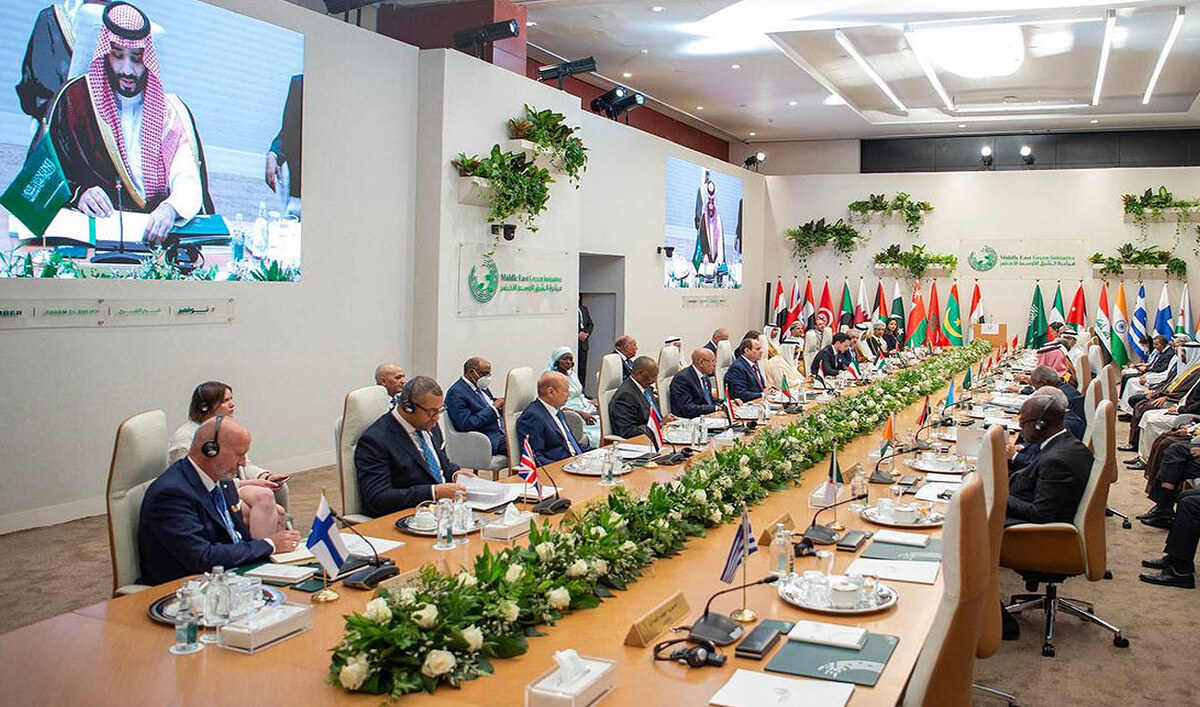


In this file photo, taken on November 7, 2022, shows Saudi Crown Prince Mohammed bin Salman speaks during the second edition of the Middle East Green Initiative Summit in Sharm El Sheikh, Egypt. (Radio Pakistan/File)

“The meeting was informed that Pakistan is one of the founding members of the said charter. Under this initiative, 200 million hectares of land area will be restored and 50 billion trees will be planted.”
Climate change is a major issue in Pakistan, causing extreme weather, droughts and rising temperatures. Although Pakistan contributes only about 0.88% of the world’s greenhouse gas
emissions, it is the fifth most vulnerable country to climate change.
Pakistan has experienced significant temperature increases over the past few decades. The average annual temperature has increased by about 0.5°C since the 1960s. By 2050, it is projected that the average temperature will rise by an additional 1.3°C to 1.5°C.
Over the past years, the intensity of climate-induced disasters in Pakistan has significantly increased. With over 1,700 deaths and 12,000 injuries, the World Bank reported the economic losses and reconstruction in flood-hit areas of Pakistan in 2022 to be over $40 billion.
An increase is also projected in the number of people affected by flooding, with a likely increase of around 5 million people exposed to extreme river floods by 2035–2044, and a potential increase of around 1 million annually exposed to coastal flooding by 2070–2100.
Rainfall patterns are becoming increasingly erratic. While annual precipitation is expected to decrease in some regions, others may see more intense and unpredictable rainfall events. This variability is already contributing to extreme weather events like floods and droughts.
The World Bank estimates that the combined risks of extreme climate-related events, environmental degradation, and air pollution are projected to reduce Pakistan’s GDP by at least 18 to 20% by 2050, which will stall progress on economic development and poverty reduction.


EU, Pakistan sign €60 million loan agreement for clean drinking water in Karachi

Updated 17 December 2025
Follow

EU, Pakistan sign €60 million loan agreement for clean drinking water in Karachi

  • Project will finance rehabilitation, construction of water treatment facilities in Karachi city, says European Investment Bank
  • As per a report in 2023, 90 percent of water samples collected from various places in city was deemed unfit for drinking

ISLAMABAD: The European Investment Bank (EIB) and Pakistan’s government on Wednesday signed a €60 million loan agreement, the first between the two sides in a decade, to support the delivery of clean drinking water in Karachi, the EU said in a statement. 

The Karachi Water Infrastructure Framework, approved in August this year by the EIB, will finance the rehabilitation and construction of water treatment facilities in Pakistan’s most populous city of Karachi to increase safe water supply and improve water security. 

The agreement was signed between the two sides at the sidelines of the 15th Pak-EU Joint Commission in Brussels, state broadcaster Radio Pakistan reported. 

“Today, the @EIB signed its first loan agreement with Pakistan in a decade: a €60 million loan supporting the delivery of clean drinking water for #Karachi,” the EU said on social media platform X. 

Radio Pakistan said the agreement reflects Pakistan’s commitment to modernize essential urban services and promote climate-resilient infrastructure.

“The declaration demonstrates the continued momentum in Pakistan-EU cooperation and highlights shared priorities in sustainable development, public service delivery, and climate and environmental resilience,” it said. 

Karachi has a chronic clean drinking water problem. As per a Karachi Water and Sewerage Corporation (KWSC) study conducted in 2023, 90 percent of water from samples collected from various places in the city was deemed unsafe for drinking purposes, contaminated with E. coli, coliform bacteria, and other harmful pathogens. 

The problem has forced most residents of the city to get their water through drilled motor-operated wells (known as ‘bores’), even as groundwater in the coastal city tends to be salty and unfit for human consumption.

Other options for residents include either buying unfiltered water from private water tanker operators, who fill up at a network of legal and illegal water hydrants across the city, or buying it from reverse osmosis plants that they visit to fill up bottles or have delivered to their homes.

The EU provides Pakistan about €100 million annually in grants for development and cooperation. This includes efforts to achieve green inclusive growth, increase education and employment skills, promote good governance, human rights, rule of law and ensure sustainable management of natural resources.