JERUSALEM: A freed ex-militant received a hero’s welcome in the occupied West Bank on Thursday after chaos during a Gaza hostage release briefly delayed the third Israel-Hamas exchange under a ceasefire deal.
At around dusk, two buses carrying released inmates left from the West Bank’s Ofer Prison after Israel said it had received assurances from mediators over the future “safe release” of captives.
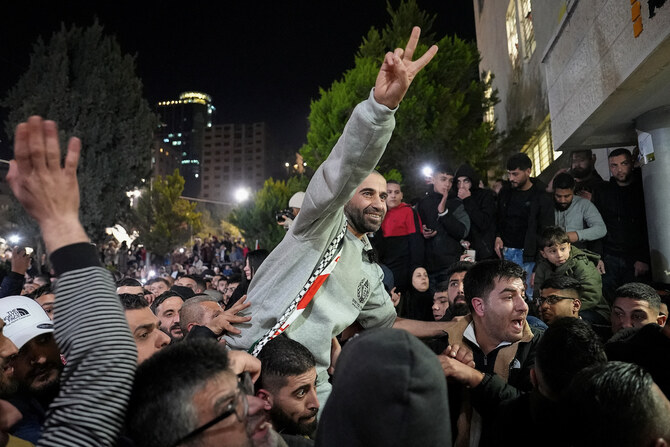
Hundreds of joyous Palestinians greeted them when they arrived in Ramallah, an AFP correspondent said.
Flashing a victory sign, the first to disembark was Zakaria Zubeidi, 49, a former top militant leader jailed for attacks that killed several Israelis.
The cheering crowd immediately hoisted him onto their shoulders.
Israel’s prison service confirmed it had freed 110 inmates in the latest hostage-prisoner swap under the January 19 ceasefire deal aimed at ending the war in Gaza.
Earlier in the day, after more than 15 months of captivity, three Israelis were freed by militants in Gaza alongside five Thais who were also captured in Hamas’s October 7, 2023 attack on Israel.
Netanyahu had denounced what he called “shocking scenes” during the hostage releases in Khan Yunis, where television images showed gunmen struggling to control hundreds of Gazans seeking to witness the handover.
First to be freed Thursday was 20-year-old Israeli soldier Agam Berger, who was handed over to officials from the International Committee of the Red Cross (ICRC) in Jabalia, northern Gaza.
Before her release, footage showed her on a stage with masked Hamas members in distinctive green headbands, being prompted to wave to onlookers.
The Red Cross said it facilitated the latest hostage-prisoner exchange but urged all parties to improve security and uphold agreements.
“The security of these operations must be assured, and we urge for improvements in the future,” ICRC president Mirjana Spoljaric said in a statement.
Another hostage and prisoner release is scheduled for Saturday, with three Israeli men set to be freed.
All the freed Israeli and Thai hostages were taken to hospitals after their return to Israel, the military said.
The two other freed Israelis are civilians Gadi Moses, 80, and Arbel Yehud, 29, both of whom also hold German nationality.
Yehud’s family, still awaiting the release of her partner and brother from Gaza, urged future releases to go ahead unhindered.
“We urge everyone not to let this open door close. Everyone must be brought home immediately so that we can heal as a society,” the family said.
Footage released by the Israeli military showed Moses, 80, in the tearful embrace of his family during their reunion at a reception center in southern Israel.
Netanyahu’s office named the freed Thais as Watchara Sriaoun, Pongsak Tanna, Sathian Suwannakham, Surasak Lamnau and Bannawat Saethao.
“It is confirmed everyone, my son did not die. Thank you, God,” a sobbing Wiwwaeo Sriaoun said at her home in rural Thailand as she heard confirmation her farm worker son was among those freed.
In war-devastated Khan Yunis, dense crowds gathered to catch a glimpse of Yehud and Moses near the childhood home of Hamas leader Yahya Sinwar, who Israel killed in October.
On August 1, Israel’s military had announced the killing of the Hamas military chief, Mohammed Deif, but Hamas had never confirmed his death — until a statement from the group on Thursday announced his “martyrdom.”
The ceasefire hinges on the release of Israeli hostages taken during Hamas’s 2023 attack, in exchange for around 1,900 people — mostly Palestinians — in Israeli custody.
The truce deal has allowed a surge of aid into Gaza, where the war has created a long-running humanitarian crisis.
But Hamas accused Israel of slowing aid deliveries, with one official citing key items such as fuel, tents, heavy machinery and other equipment.
COGAT, the Israeli defense ministry body that oversees civilian affairs in the Palestinian territories, called this “totally fake news.”
As the text of the agreement — mediated by Qatar, Egypt and the United States — has not been made public, AFP was unable to verify its terms on aid.
The ceasefire deal is currently in its first, 42-day phase, which should see 33 hostages freed in stages, excluding the Thais.
Negotiations for a second phase of the deal should start next Monday, according to a timeline given earlier by an Israeli official. This phase would cover the release of the remaining captives, the Times of Israel has reported.
US President Donald Trump has repeatedly claimed credit for sealing the agreement, which took effect before his inauguration, and his Middle East envoy Steve Witkoff, who took part in the talks, met Netanyahu in Israel on Wednesday.
Trump has invited Netanyahu to the White House on February 4, according to the premier’s office.
More than 376,000 displaced Palestinians have gone back to northern Gaza since Israel reopened access this week, according to the UN humanitarian office OCHA, with many returning to little more than rubble.
“My house is destroyed,” 33-year-old Mohammed Al-Faleh told AFP.
“The biggest problem is that there is no water,” he added. “Food aid is reaching Gaza... but there is no gas or electricity. We bake bread on a fire fueled by wood and nylon.”
Israel cut ties with the UN agency for Palestinian refugees (UNRWA) from Thursday following accusations some of its staff belong to Hamas.
UNRWA has long been the lead agency in coordinating aid to Gaza, and the United Nations said on Thursday it would continue working in all Palestinian territories despite the Israeli legislation.


![]()

Israel releases Palestinian prisoners after hostages freed
Short Url
https://arab.news/9q3wz
Israel releases Palestinian prisoners after hostages freed
- Buses carrying released inmates left from West Bank’s Ofer Prison after Israel said it had received assurances from mediators over the future “safe release” of captives


Latest updates



Recommended


© 2026 SAUDI RESEARCH & PUBLISHING COMPANY, All Rights Reserved And subject to Terms of Use Agreement.