

Pakistan envoy identifies textiles, agriculture as key sectors to focus in exports to Saudi Arabia

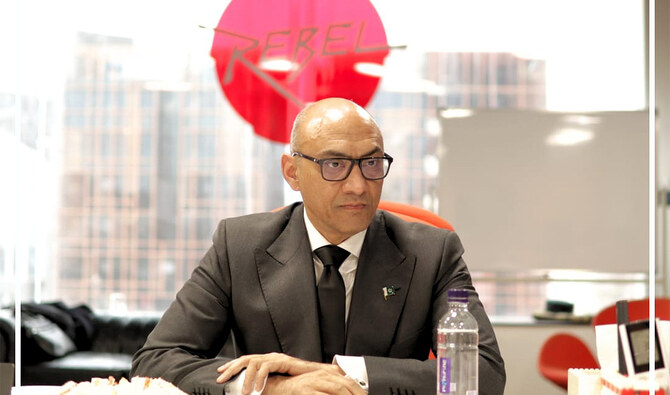
Pakistan Ambassador to Saudi Arabia Ahmad Farooq holds a meeting with IT companies in Islamabad, Pakistan, on January 29, 2025. (Pakistan Embassy in Saudi Arabia)
Short Url
Updated 31 January 2025
Follow

Pakistan envoy identifies textiles, agriculture as key sectors to focus in exports to Saudi Arabia

  • Pakistan and Saudi Arabia are close regional partners, and the Kingdom remains the largest source of remittances to the South Asian country
  • Ambassador Ahmad Farooq stresses need to improve vocational training of Pakistani workers to meet standards required for mega Saudi projects

KARACHI: Pakistan Ambassador to Saudi Arabia Ahmad Farooq on Wednesday identified textiles, agriculture and red meat as key sectors for Pakistani businesses to focus on in order to increase the country’s exports to the Kingdom.

Farooq identified the key sectors during his visit to the Karachi Chambers of Commerce and Industry (KCCI) on Wednesday, where he met with leading Pakistani businesspersons and industrialists, according to the KCCI.

The ambassador highlighted that Pakistan’s exports to the Kingdom had registered a 40 percent increase during 2023-24, with the information technology (IT) sector witnessing an impressive 50 percent growth.

Pakistan and Saudi Arabia last year signed 34 agreements worth nearly $3 billion, of which, memorandums of understanding (MoUs) worth $700 million have already entered the implementation stage, according to Farooq.

“We want large businesses to connect with local distributors in Saudi Arabia to facilitate exports,” he was quoted as saying by the KCCI. “A list of key exporters in these sectors should be shared with the [Pakistani] embassy so we can work together to strengthen trade relations.”

Farooq said Pakistani textile, agriculture and meat (beef and mutton) products had already seen a “remarkable growth” in the Saudi market, adding that the Kingdom offers vast opportunities for Pakistani businesses.

“The purpose of my visit is to discuss business opportunities with the Karachi business community and update them on how Pakistan’s embassy can support them in accessing the Saudi market,” he added.

Speaking about the rising demand for skilled manpower, the Pakistani envoy said more than 3 million Pakistanis were currently living in the Kingdom, however, 97 percent of them were “blue-collar workers.”

Saudi Arabia is currently developing its public service sectors such as health, education, infrastructure, recreation and tourism as part of a strategic framework, Vision 2030, which aims to diversify the Kingdom’s economy beyond oil. The

Kingdom’s ambitious plan coincides with Pakistan’s efforts to boost trade and foreign investment to revive its fragile economy.

“Saudi authorities have advised us to improve vocational training for Pakistani workers to meet the standards required for upcoming projects,” Ambassador Farooq said, stressing the need to enhance training programs to equip these workers with modern technical skills.

Pakistan and Saudi Arabia are close regional partners, and the Kingdom remains the largest source of remittances to the South Asian country, contributing $7.5 billion in the last fiscal year (July 2023-June 2024), according to KCCI President Jawed Bilwani.

Saudi Arabia has also regularly provided Pakistan oil on deferred payments and offered direct financial support to help shore up Pakistan’s forex reserves.

KCCI Senior Vice President Zia-ul-Arfeen stressed the need to enhance joint ventures between the two countries, urging Islamabad to further improve the ease of doing business for foreign investors.

“Saudi investors should consider Pakistan for investments, particularly in the food sector,” he added.


EU, Pakistan sign €60 million loan agreement for clean drinking water in Karachi

Updated 59 min 3 sec ago
Follow

EU, Pakistan sign €60 million loan agreement for clean drinking water in Karachi

  • Project will finance rehabilitation, construction of water treatment facilities in Karachi city, says European Investment Bank
  • As per a report in 2023, 90 percent of water samples collected from various places in city was deemed unfit for drinking

ISLAMABAD: The European Investment Bank (EIB) and Pakistan’s government on Wednesday signed a €60 million loan agreement, the first between the two sides in a decade, to support the delivery of clean drinking water in Karachi, the EU said in a statement. 

The Karachi Water Infrastructure Framework, approved in August this year by the EIB, will finance the rehabilitation and construction of water treatment facilities in Pakistan’s most populous city of Karachi to increase safe water supply and improve water security. 

The agreement was signed between the two sides at the sidelines of the 15th Pak-EU Joint Commission in Brussels, state broadcaster Radio Pakistan reported. 

“Today, the @EIB signed its first loan agreement with Pakistan in a decade: a €60 million loan supporting the delivery of clean drinking water for #Karachi,” the EU said on social media platform X. 

Radio Pakistan said the agreement reflects Pakistan’s commitment to modernize essential urban services and promote climate-resilient infrastructure.

“The declaration demonstrates the continued momentum in Pakistan-EU cooperation and highlights shared priorities in sustainable development, public service delivery, and climate and environmental resilience,” it said. 

Karachi has a chronic clean drinking water problem. As per a Karachi Water and Sewerage Corporation (KWSC) study conducted in 2023, 90 percent of water from samples collected from various places in the city was deemed unsafe for drinking purposes, contaminated with E. coli, coliform bacteria, and other harmful pathogens. 

The problem has forced most residents of the city to get their water through drilled motor-operated wells (known as ‘bores’), even as groundwater in the coastal city tends to be salty and unfit for human consumption.

Other options for residents include either buying unfiltered water from private water tanker operators, who fill up at a network of legal and illegal water hydrants across the city, or buying it from reverse osmosis plants that they visit to fill up bottles or have delivered to their homes.

The EU provides Pakistan about €100 million annually in grants for development and cooperation. This includes efforts to achieve green inclusive growth, increase education and employment skills, promote good governance, human rights, rule of law and ensure sustainable management of natural resources.