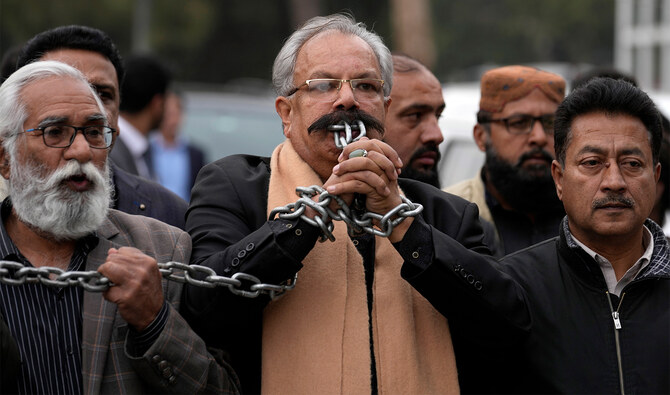

ISLAMABAD: Pakistani journalists and rights activists on Tuesday described a new law passed by both houses of parliament and aimed at regulating social media content as an attack on freedom of expression, with hundreds of journalists and activists protesting against the legislation in the federal capital and other cities.
The law, which amends the much-criticized Pakistan Electronic Crimes Act (PECA) in 2016, would establish the Social Media Protection and Regulatory Authority to perform a range of functions related to social media, including being able to order the immediate blocking of unlawful content targeting judges, the armed forces, parliament or provincial assemblies or material that promotes and encourages terrorism and other forms of violence against the state or its institutions. The authority would have its own investigation agency and tribunals. Those found to have disseminated false or fake information face prison sentences of up to three years and fines of two million rupees ($7,200).
The Pakistan Federal Union of Journalists (PFUJ) led rallies in cities including Islamabad, Karachi and Lahore on Tuesday to demand the government withdraw the bill, which has been passed by the National Assembly and Senate but has yet to be signed into law by the president.
“We do not accept this amendment bill … this law curtails our freedom of press and freedom of expression,” PFUJ secretary general Nasir Zaidi told Arab News at the protest in Islamabad.
“This is the darkest day in the history of journalism and the history of freedom of journalists, against which we are protesting.”
Zaidi explained that the new law would establish four regulatory authorities for social media platforms, digital platforms and even electronic media.
Journalist and anchorwoman Asma Shirazi blamed the government for bulldozing the legislation through the parliament without consulting stakeholders.
“We all agree that there should be some legislation [to curb fake news] but the stakeholders must be taken on board and they must be consulted in the legislation formation,” she told Arab News.
Usama Khilji, a director at Bolo Bhi, a digital rights advocacy forum, said the law posed a threat to Pakistani citizens, especially journalists and social media users who expressed their views online.
“Four new bodies related to social media, including a tribunal and an authority, are all appointed by the government and the government can fire the chairperson at any point [under new law],” Khilji said. “What we also see is a three-year jail term for sharing false or fake information but that is a very broad and vague definition.”
Khilji said the law granted regulatory authorities the power to block entire social media platforms legally.
“The broad powers that have been given will have a far-ranging impact,” he said.
Khilji also said the new law risked Pakistan’s GSP plus trade status with the European Union, under which it gets preferential access to markets for implementing international conventions on human rights, labor rights, environmental protection, and good governance.
Speaking on the floor of the Senate on Tuesday, Federal Minister Rana Tanveer Hussain, who moved the bill, said the law would not apply to TV channels or newspapers but only to “miscreants” spreading false news on social media platforms.
“Even the opposition during their speeches in the house essentially acknowledged the need for the PECA law,” he said. “They admitted that there is a lot of filth online that needs to be addressed.”
Information Minister Ataullah Tarar told reporters after the passage of the bill by the lower house of parliament last week that it would not apply to “working journalists”:
“This is the first time the government has defined what social media is. There is already a system in place for print and electronic media and complaints can be registered against them.”
The information minister said the law had to be passed because the Federal Investigation Agency, previously responsible for handling cybercrime, “does not have the capacity to handle child pornography or AI deep fake cases.”
Tarar added that the government was also aiming to bring social media journalists, including those operating YouTube accounts, under the tax framework.
The operative part of the new bill outlines that the Social Media Protection and Regulatory Authority would have the power to issue directions to a social media platform for the removal or blocking of online content if it was against the ideology of Pakistan, incited the public to violate the law or take the law in own hands with a view to coerce, intimidate or terrorize the public, individuals, groups, communities, government officials and institutions, incited the public to cause damage to governmental or private property or coerced or intimidated the public and thereby prevented them from carrying on their lawful trade and disrupted civic life.
The authority will also crackdown on anyone inciting hatred and contempt on a religious, sectarian or ethnic basis as well as against obscene or pornographic content and deep fakes.
Rights activists say the new bill is part of a widespread digital crackdown that includes a ban on X since February last year, restrictions on VPN use and the implementation of a national firewall.
The government denies the measures are aimed at censorship.