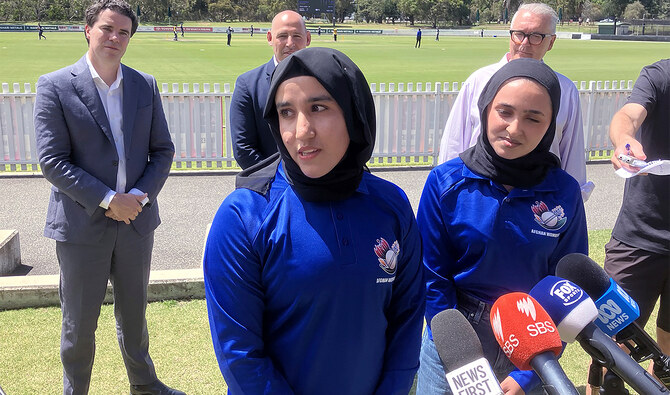

MELBOURNE: Cricketer Firooza Amiri says her team will “represent millions of women in Afghanistan who are denied their rights” when the side reunites after more than three years for an exhibition game in Australia on Thursday.
An Afghanistan Women’s XI will play a Cricket Without Borders XI in the match at Melbourne’s Junction Oval. It will bring together 21 female players who were formerly contracted by the Afghanistan Cricket Board (ACB) before the Taliban regime re-took control in August 2021.
Since fleeing Afghanistan, the women cricketers. banned from playing in their home country, have been based in Canberra and Melbourne and playing for various club teams in local competitions.
Amiri and Nahida Sapan, who will captain the Afghanistan Women’s XI, thanked the Australian government and Cricket Australia for their support in promoting women’s sport.
“It’s very special for all of us to get back together after three years, leaving everything and losing everything back home in Afghanistan and come together again,” Amiri said this week.
Amiri was forced to flee her home country when the Taliban took control. She and her family first traveled to Pakistan and then were evacuated to Australia.
“I also want to express deepest gratitude for everyone who support us. Your support means the world to us,” Sapan said. “Together we are building not just a team. We are building a movement for change and improvement.
“This is a very historic moment for all of Afghan women. This match can open doors for Afghan women for education, sport and our future.”
Sapan told the BBC in 2023 that her family received death threats from government officials after the Taliban re-took power. The threatening messages included: “If we find you, we will not let you live.”
Cricket Australia chief executive Nick Hockley praised the resilience of the players. He said it was a powerful moment when they were presented with their team shirts for the exhibition match.
“To see their playing shirts for the first time with their names and numbers on the back, you can see how much it means to them,” Hockley said. “I’m just inspired by their resilience, their love for the game.”
Hockley said CA would continue to “advocate” for change at a global level through discussions with the International Cricket Council (ICC). He said Thursday’s game represented an important first step.
“This match shines the light on the fact that in places around the world, not every woman and girl has the chance to play,” Hockley said. “We continue to advocate at the ICC and continue to engage with the ACB (Afghanistan Cricket Board).
“It’s such a complex situation. It’s bigger than cricket.”
Under Taliban rule, the Afghanistan Cricket Board cannot field a national women’s team because the country’s laws forbid women from playing sport, studying and medical education, moves that have been criticized by world groups including the International Criminal Court.
Afghanistan is a full member of the ICC and a condition of that status should require it to have a women’s side.
England and Australia are refusing to participate in direct series against Afghanistan in protest, but continue to play against it in ICC events, such as next month’s Champions Trophy global event in Pakistan.
England cricket captain Jos Buttler said last week that his side should not boycott a match against the Afghanistan men’s team when they are scheduled to play in the Champions Trophy on Feb. 26 in Lahore. South Africa’s sport minister, however, has urged the Proteas to boycott their match against Afghanistan in the same tournament.
Asked why Australia was prepared to play a men’s game against Afghanistan in an ICC event, but not in a bilateral series, Hockley said CA was “duty-bound” to play all its scheduled fixtures at ICC events.
“We’re really trying to do everything we can in our power to make a difference,” Hockley said. “We’ve played Afghanistan in other ICC events. You have to draw a line somewhere and I think we’ve made our stance pretty clear.”
Mohammad Nabi and Rashid Khan from Afghanistan’s men’s national cricket team have posted support of women’s education on social media after the Taliban closed training institutes for nursing and midwives.
Hockley said he hoped Thursday’s match, the format for which was not announced, would become an annual one and that it would “promote lots of conversations.”
“You need moments like this to prompt real change. The first piece is awareness,” Hockley said. “Hopefully this game just raises awareness. I think it’s a real beacon of hope.”