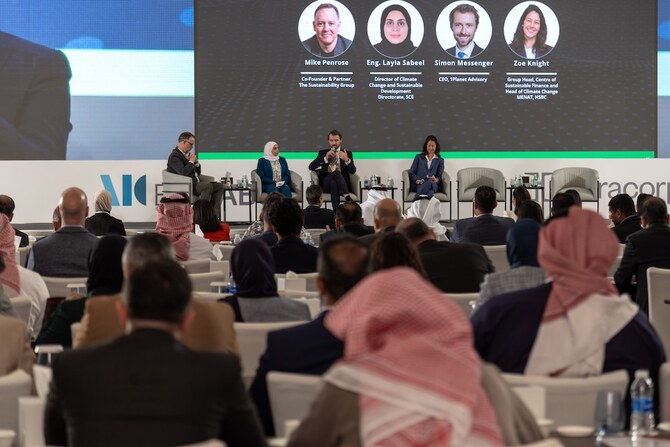

RIYADH: The Middle East North Africa region is “among the world’s best locations for renewable energy,” a UN climate official told Arab News recently, ahead of a Bahrain climate conference that opened today.
Mahmoud Mohieldin, the UN special envoy for financing the 2030 sustainable development agenda, shared his insights on the MENA region, financing climate and regional energy resilience.
The third annual Sustainability Forum Middle East takes place on Jan. 28 and 29.
Held under the patronage of Mohamed Bin Daina, Bahrain’s minister of oil and environment and special envoy for climate affairs, the SFME is supported by the Supreme Council for Environment.
The two-day event is expected to attract over 400 senior business leaders and sustainability experts from the region and beyond. The forum features more than 50 speakers from the MENA region, Europe, the UK, US and Brazil.
“The region is among the world’s best locations for renewable energy, and MENA countries are becoming increasingly prominent players in that sphere.”
“Between 2013 and 2023, the Middle East region quadrupled its share of solar energy generation, and it is currently home to record low levelized costs of electricity for solar PV (photovoltaic power),” he said.
While acknowledging the region’s unique strengths, Mohieldin also highlighted challenges posed by geopolitical tensions and strained economic conditions.
He stressed the importance of exploring mechanisms including carbon markets and debt swaps.
“Egypt’s launch of its first regulated voluntary carbon market is a significant step toward achieving economic and environmental sustainability,” he noted.

Mahmoud Mohieldin, the UN special envoy for financing the 2030 sustainable development agenda. (Supplied)
Commenting on the forum, Mohieldin said: “Events like the Sustainability Forum Middle East are essential to building on the momentum generated by successive COPs (Conference of the Parties) in the region and driving further action.”
On the topic of public-private collaboration, Mohieldin said: “The private sector enjoys significant financial resources that can be directed toward sustainability. Almost half of climate finance provided worldwide between 2011 and 2020 came from the private sector.”
Mohieldin also highlighted the transformative potential of technology and innovation in addressing climate challenges.
“Innovation is what made renewables today ubiquitously cheaper than any other energy source. Solar panel costs, for example, have fallen by around 20 percent for every doubling of global cumulative capacity,” he said.
Mohieldin pointed to the rapid advancements in artificial intelligence as a double-edged sword, offering tools for predictive modeling and climate risk assessment while also raising concerns about the “AI divide,” which could disadvantage developing countries.
When asked about his expectations for this year’s forum, Mohieldin outlined several key areas of focus, including hydrogen, water security, and Carbon Border Adjustment Mechanisms.
“The imminent implementation of CBAM will have notable consequences on critical industries in the region. Discussions at the forum should focus on synthesizing policy solutions to mitigate risks while using CBAM as an opportunity to nurture domestic or regional carbon markets,” he said.
Mohieldin also called for a greater emphasis on turning the region into a contributor to advanced technologies, rather than just a user, to strengthen its role in global sustainability.