

Saudi Arabia, France to collaborate on 3 renewable energy projects: Al-Falih

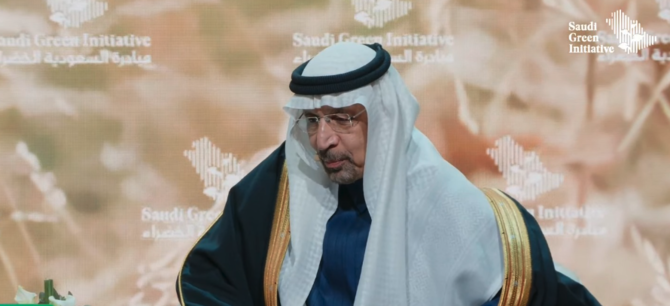
Minister of Investment Khalid Al-Falih speaking at the Saudi Green Initiative Forum. Screenshot
Short Url
Updated 03 December 2024
Follow

Saudi Arabia, France to collaborate on 3 renewable energy projects: Al-Falih

RIYADH: Three renewable energy projects are set to be developed in Saudi Arabia with the involvement of French companies, according to Minister of Investment Khalid Al-Falih.

The initiatives, which will be officially announced by the Saudi Energy Minister Prince Abdulaziz bin Salman in the presence of French President Emmanuel Macron, are part of the Kingdom’s growing efforts to lead the global transition toward sustainable energy. 

“I don’t know if the news is out, but I’ll break it in. There will be three major renewable projects announced by His Royal Highness Prince Abdulaziz and signed in the presence of President Macron,” Al-Falih said during the Saudi Green Initiative Forum held in Riyadh at COP16. 

Speaking on the broader shift toward sustainability, Al-Falih emphasized that green finance is central to the future of global investment, highlighting its alignment with Saudi Arabia’s vision for sustainable development. 

“Globally, I think the world today is really moving toward financing, investing, and supporting sustainability and energy and materials,” he said, emphasizing key areas such as water management and combating desertification. 

According to Al-Falih, trillions of dollars in annual investments are required globally to address these challenges. 

The minister remarked that the amount of capital across the world available for sustainable investments is vast and growing rapidly. 

“We estimate that as of last year, $3 trillion was the pool of money available last year. And I think what is more astonishing, what is more wow to me is it is projected to grow by a factor of seven of the $3 trillion by 2033, eight years. So the funds are there,” he said. 

He added that governments must play a key role in making investments attractive by de-risking them for private capital. 

“It needs to go to a place where there is demand, and demand is key,” he explained. “It needs governments and systems that (investors) can trust and that has all of the elements of stability, predictability. And we believe Saudi Arabia is that place for them to look at,” he said. 

The Kingdom is positioning itself as a global hub for green investment, backed by robust demand, investor trust, and stable governance. 

“The future of finance is green. It is green, which happens to be the color of our flag. It happens to be the theme of this great initiative His Highness has launched — Green Saudi, Green Middle East,” Al-Falih said, adding that the country provides a stable environment for investors by managing risks and offering predictable opportunities. 

Al-Falih also pointed to Saudi Arabia’s advances in renewable energy production, particularly wind and solar power, describing these sectors as a “win, win, win” for the nation. 

“The lowest hanging fruit, which we started with, and His Royal Highness Prince Abdulaziz is doubling down on in a massive way, is the green electrons producing electricity from wind and solar,” he said, explaining that these projects not only boost sustainability but also create economic opportunities. 

“This is for us, you know, win, win, win because we displace liquids that can be exported to places that need liquid hydrocarbons for that economic longevity.” 

In addition to renewable energy, Al-Falih highlighted the Kingdom’s rapid growth in venture capital and its efforts to foster a startup ecosystem. 

He also underlined that Saudi Arabia has risen to become the leading venture capital market in the Middle East, with VC growing “by a factor of 21 over the last few years.” 

The government has supported this growth through initiatives such as Biban, LEAP, and the Garage, a flagship incubator inspired by France’s STATION F. 

“We are awarding thousands of premium residencies to all of these entrepreneurs because we want them to feel at home,” he added. 

“The system of venturing and startups is not only linked to Saudi companies. I think what’s exciting is when we have our conferences. We just had Biban. A few months earlier, we had LEAP; hundreds, if not thousands, of startups came from around the world, and we’re licensing them at MISA (Ministry of Investment).” 

Al-Falih also underscored the Kingdom’s commitment to driving global green investment, envisioning Saudi Arabia as the primary hub for sustainable finance. 

“We will be launching many investment schemes around green investments. And as I mentioned, the future for finance is green, and the hub of that green investment is going to be in Saudi Arabia. And those funds will naturally flow to where the hub is, where the center of gravity is going to be,” he said. 


SIDF finances 5k projects with over $53.3bn 

Updated 4 sec ago
Follow

SIDF finances 5k projects with over $53.3bn 

RIYADH: The Saudi Industrial Development Fund has approved up to 5,000 projects — representing about 40 percent of the Kingdom’s industrial base — with a total investment value nearing SR200 billion ($53.3 billion), according to Khalil Al-Nammari, executive vice president for strategic planning and business development at the fund, who spoke to Al-Eqtisadiah.

This brought the fund’s total approved investments since its establishment in the 1970s to more than SR700 billion. 

During the Vision 2030 period alone, the fund approved loans ranging between SR86 billion and SR90 billion, Al-Nammari said. 

These loans attracted nearly SR190 billion in investments, highlighting the scale of expansion and growth in industrial lending and related sectors. 

Repositioning within national ecosystem 

Al-Nammari noted that the fund has repositioned itself within the national economic ecosystem in recent years, benefiting from the major transformation driven by Saudi Vision 2030. 

He said the fund, which marked its 50th anniversary last year, has shifted from its traditional role of financing industry to a broader mandate covering industry, energy, mining, and logistics, adding that the expansion required a comprehensive strategic shift in lending mechanisms, services, and programs offered to these new sectors. 

The fund launched innovative financing solutions and established the Industrial Fund Academy, which has so far trained more than 11,000 trainees from the public and private sectors. 

According to the executive vice president, the scale of work and results achieved since the launch of Vision 2030 is equivalent to what was achieved over 36 years since the fund's establishment, underscoring the momentum generated by the vision and its derived strategies. 

Long-term development partnership 

Al-Nammari stressed that the fund's success is measured by the ability of projects to be built, operated, exported, and scaled, not only by the size of financing, pointing out that relationships with clients often extend 15 to 20 years due to the long-term nature of development loans. 

On measuring development impact, Al-Nammari said economic feasibility studies, market analysis, and engineering assessments form the foundation before any loan is approved. 

He added that the SIDF evaluates project performance after operations begin by monitoring financial statements, operational progress, production capacity, and sales growth, as well as export capabilities. 

He added that the fund also assesses job creation and quality, all of which are indicators factored into lending decisions from the outset and monitored throughout the loan term. 

As part of this effort, the fund conducts regular visits to more than 1,000 active projects in its portfolio to track construction and operational phases, assess financing needs, and provide solutions, advisory support, and academic services. 

The goal is to ensure factories achieve their production targets, adhere to business plans, and enter local and global markets, contributing to industrial growth, higher exports, and greater sector contribution to gross domestic product. 

New financing channels to attract capital 

In the coming years, the fund will continue to focus on the sectors identified by the national strategy, spanning 12 areas, including food and pharmaceutical security, as well as future-oriented sectors such as clean energy, hydrogen, and electric vehicle components, as well as renewable energy, and supporting supply chains. 

Al-Nammari said the fund has recently focused on creating new financing channels aimed at attracting capital from the private sector, banks, and investment funds. 

In this context, the fund has launched the SIDF Investment Co., which holds existing commitments of SR50 million in funds and firms that support investment in the industrial sector. 

Moreover, it has introduced the Supply Chain Financing program, the largest of its kind globally, aimed at providing financing solutions for the invoices of suppliers to major national companies. 

The program is currently operating with firms such as Saudi Aramco and the Saudi Electricity Co., helping to support national supply chains and enhance the sustainability of small, medium, and advanced industrial projects alike.