ZAATARI REFUGEE CAMP, Jordan: They have lived for years in Zaatari, the world’s biggest refugee camp for Syrians, but many are unsure they want to return home from Jordan even after the ouster of former president Bashar Assad.
They fear the security situation might once again deteriorate after 13 years of civil war, and some say their homes have been destroyed while others lost their jobs and feel they have nothing to go back to.
In 2012, a year into the war in Syria, neighboring Jordan opened Zaatari camp to host people fleeing the conflict.
It is now home to 75,000 people, according to UN figures.
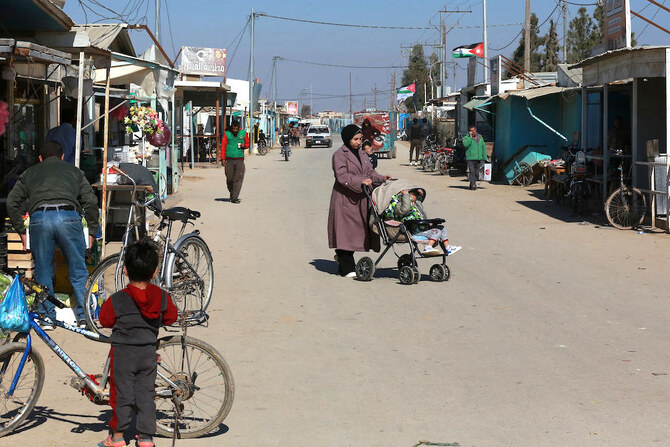
To begin with, it was a squalid collection of tents dotting an arid landscape, but over time, it grew into a town of prefabricated homes, supplied with free electricity, water, health and schools.
On a street named the Champs-Elysees, after the famed Parisian avenue, 60-year-old shop owner Yousef Hariri told AFP he wanted to stay in Zaatari with his family, where they feel safe.
“I can’t go back. That would mean losing everything and selling the shop would be hard,” said Hariri, whose store sells construction materials.
“The situation in Syria is not good at the moment and it is not clear what will happen. Prices are through the roof and there are armed rebels. Our houses are destroyed.”
The war in Syria, which began with Assad’s crackdown on democracy protests in 2011, forced millions of people to flee the country, with most of them seeking refuge in neighboring countries.
Tens of thousands have returned since an Islamist-led coalition ousted Assad on December 8, but most refugees have yet to make the journey home.
Most of the refugees in Zaatari came from the south Syrian province of Daraa, near the Jordanian border.
It was, earlier in the conflict, home to 140,000 people.
Refugees in the camp receive cash assistance for food, and they have the right to work outside the camp.
“Where are we going to go back to?” said Khaled Al-Zoabi, 72, who has lived in the camp since 2012, and who cited the destruction wrought by the war.
“The refugees’ finances aren’t good enough for anyone to return, and no one knows what will happen in Syria,” he said.
“We fled the injustice and tyranny of Assad’s gangs in Syria, where human life had no value. Here, I feel I am a human being, and I prefer to stay,” said the shop owner.
To date, there is no financial assistance to help people return.
Radwan Al-Hariri, a 54-year-old father of three, said his contacts in Syria had all advised him to stay put.
An imam at a mosque, the grandfather of 12 children all born in Zaatari said that in Syria, “no one helps you and there is no work.”
According to the Jordanian authorities, 52,000 Syrians have returned home through the Jaber border crossing between the two countries since Assad’s overthrow.
“Insecurity remains a concern. There is still a lot of instability, armed clashes in some parts of the country and an increasing number of civilian casualties due to remnants of war and unexploded ordnance,” UN High Commissioner for Refugees spokesperson in Jordan Roland Schoenbauer said.
“Every refugee has the right to return to their homeland,” he said. “However, when it is the right time to voluntarily cross into Syria will have to remain their decision.”
The UN says around 680,000 Syrians were registered in Jordan from 2011 onwards, though the kingdom says it welcomed 1.3 million.
Not all Syrians in Zaatari were hesitant to return.
Mariam Masalmeh, 63, said she and her husband have decided to go home, as have their children.
But she said she would be “sad to leave Zaatari, which has become my homeland,” as she showed off her garden of rosebushes and apple trees.
Mohammed Atme, 50, could not wait to go home.
“It is time to go back to my family, I haven’t seen my mother and brothers for 13 years,” he said.
“Here, we were treated with respect and our dignity was preserved. But everyone’s destiny is to go back to their country.”


![]()

Syrian refugees in Jordan camp say they have nothing to go home to
Short Url
https://arab.news/4gehh
Syrian refugees in Jordan camp say they have nothing to go home to
- Refugees fear the security situation might once again deteriorate after 13 years of civil war
- In 2012, neighboring Jordan opened Zaatari camp and is now hosting 75,000 Syrians


Latest updates


© 2026 SAUDI RESEARCH & PUBLISHING COMPANY, All Rights Reserved And subject to Terms of Use Agreement.