

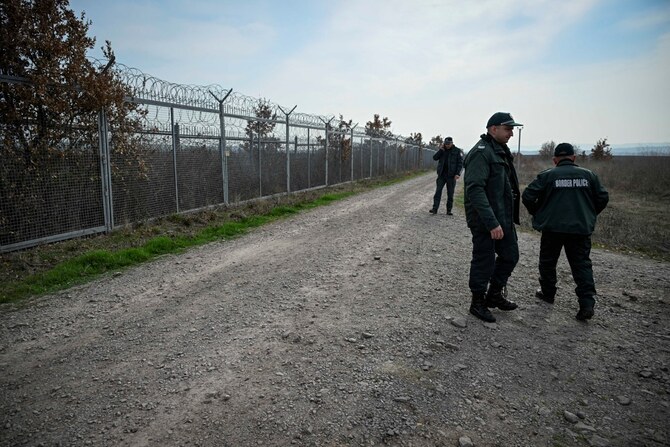

LONDON: Authorities in Bulgaria have been accused of letting three Egyptian teenagers die by ignoring emergency calls and delaying attempts to rescue them, The Guardian reported.
The incident took place in sub-zero temperatures near the Bulgarian-Turkish border late last month.
Evidence of the authorities’ failure to save the boys was collected in a dossier produced by two humanitarian organizations, No Name Kitchen and Collettivo Rotte Balcaniche.
The dossier, seen by The Guardian, contains photos, geolocations and personal testimonies, and reveals a wider pattern of brutality against migrants on the borders of Europe.
The Bulgarian border with Turkiye is a common crossing point for asylum-seekers but contains treacherous terrain, as well as freezing winter weather.
The two humanitarian organizations said that they were first alerted that an appeal for help had been made on Dec. 27 by the Egyptian trio.
Calls had been made to an emergency charity hotline, referring to three teenagers “at immediate risk of death.”
The GPS location of the three Egyptians, who were lost in the forests of southeastern Bulgaria, was sent to the hotline.
Charity workers then forwarded the information to the official 112 emergency number and attempted to locate the boys themselves.
But Bulgarian border police allegedly hindered the charity rescue attempts even after being shown a video of one of the Egyptian teenagers in the snow.
The boys were later identified as Ahmed Samra, 17, Ahmed El-Awdan, 16, and 15-year-old Seifalla El-Beltagy.
They were later found dead, with the former having “dog paw prints and boot prints around his body.”
This “indicates that the border police had already found him, maybe still alive or dead, but had chosen to leave him there in the cold,” the dossier said.
After charity staff later returned to the scene, they discovered that all traces of the prints had been removed.
One of the bodies of the deceased was found to have been partly eaten by an animal.
The dossier released by the two organizations also details harassment of charity rescue teams as well as vandalism of one of their cars.
Staff belonging to one rescue team had their passports and phones seized by Bulgarian police.
Human rights organizations have warned that authorities in European border countries are deploying tactics to target humanitarian groups helping asylum-seekers.
No Name Kitchen and Collettivo Rotte Balcaniche called for an “independent, formal investigation” into “systemic violence and negligence by Bulgarian authorities” and “degrading treatment of people on the move.”
Bulgaria’s Interior Ministry rejected the allegations and said that investigations into the case continued.
“In 2024, there were 515 search-and-rescue operations conducted by (the) general directorate border police of Bulgaria with the purpose (of providing) medical assistance to third-country nationals who managed to enter the country irregularly,” the ministry said.
“Our patrols reacted to all of those signals in a timely manner, considering how crucial this is when a person is exposed to extreme weather conditions.”
One activist described the reaction of Bulgarian border police to the three Egyptian teenagers as “utterly shocking.”
They said: “It should not be the responsibility of worried activists to reach people in the forest — border police are trained and paid to do so.
“It is utterly shocking that three minors froze to death in the forest even though multiple alerts to 112 had been placed. This is a huge failure for everyone.”


