

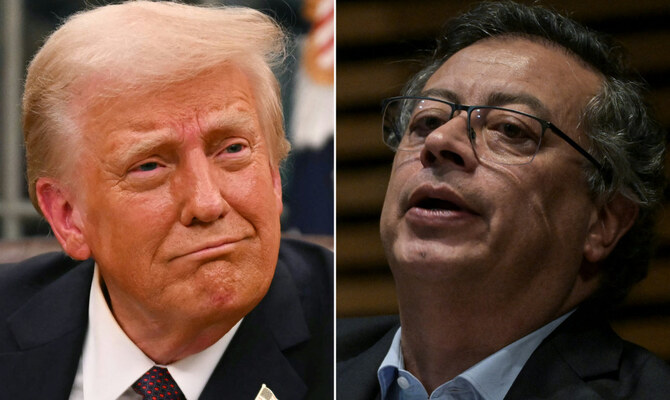

WASHINGTON: Colombia on Sunday backed down and agreed to accept deported citizens sent on US military aircraft, hours after President Donald Trump threatened painful tariffs to punish the defiance to his mass deportation plans.
Colombia’s leftist president, Gustavo Petro, had earlier said he would only take back citizens “with dignity,” such as on civilian planes, and had turned back two US military aircraft with repatriated Colombians.
Trump, less than a week back in office, responded furiously and threatened sanctions of 25 percent that would quickly scale up to 50 percent against Latin America’s fourth largest economy.
Petro initially sought to hit back and impose his own tariffs on US products, but by the end of the volatile Sunday he had backed down.
Colombian Foreign Minister Luis Gilberto Murillo told a late-night news conference that his country had “overcome the impasse” and would accept returned citizens.
A White House statement said that Colombia has agreed to “unrestricted acceptance of all illegal aliens from Colombia returned from the United States, including on US military aircraft, without limitation or delay.”
“Today’s events make clear to the world that America is respected again,” it said.
“President Trump will continue to fiercely protect our nation’s sovereignty, and he expects all other nations of the world to fully cooperate in accepting the deportation of their citizens illegally present in the United States.”
Trump said he would suspend implementation of the tariffs.
It had been unclear even earlier how quickly Trump could impose tariffs on Colombia, historically one of Washington’s closest allies in Latin America, which enjoys a free-trade agreement with the United States.
Secretary of State Marco Rubio, whose wife is Colombian-American, suspended issuance of visas at the US embassy in Bogota and said visas would be revoked to Colombian government officials and their immediate family members.
The White House said the visa measures would stay in place until the first planeload of deportees returns.
Trump also vowed to subject Colombians to greater scrutiny at US airports.
Trump – who during his campaign said that immigrants were “poisoning the blood” of the United States – took office with promises to round up and swiftly deport undocumented people.
While some countries including Guatemala have accepted military deportation flights, Trump had faced resistance from Petro, a former guerrilla elected in 2022 as Colombia’s first left-wing leader.
“The United States cannot treat Colombian migrants as criminals. I forbid entry to our territory to US planes carrying Colombian migrants,” Petro wrote earlier on X.
The Colombian government earlier said it was instead ready to send its presidential plane to the United States to transport the migrants “with dignity.”
Petro also said there were 15,600 undocumented Americans living in his country and asked them to “regularize their situation,” while ruling out raids to arrest and deport them.
Petro’s initial hard-ball tactics infuriated his many critics in the historic US ally.
Former right-wing president Ivan Duque accused Petro of “an act of tremendous irresponsibility” for refusing what he called Colombia’s “moral duty” to take back illegal migrants and warned US sanctions would take an “enormous” toll.
Trump’s deportation threats have put him on a potential collision course with governments in Latin America, the original home of most of the United States’ estimated 11 million undocumented migrants.
Brazil, which is also led by a left-wing president, voiced outrage over treatment by the Trump administration of dozens of Brazilian migrants deported back to their country on Friday.
The migrants, who were deported under a bilateral agreement predating Trump’s return, were handcuffed on the flight, in what Brazil called “flagrant disregard” for their basic rights.
Edgar Da Silva Moura, a 31-year-old computer technician who was among the 88 deported migrants, said: “On the plane they didn’t give us water, we were tied hands and feet, they wouldn’t even let us go to the bathroom.”
“It was very hot, some people fainted.”
The president of Honduras, Xiomara Castro, called for an urgent meeting of leaders from the Community of Latin American and Caribbean States (CELAC) to take place Thursday in Tegucigalpa to discuss migration following the latest US moves.
While previous US administrations also routinely carried out deportations, the Trump administration has begun using military aircraft, with at least one landing in Guatemala this week.


