

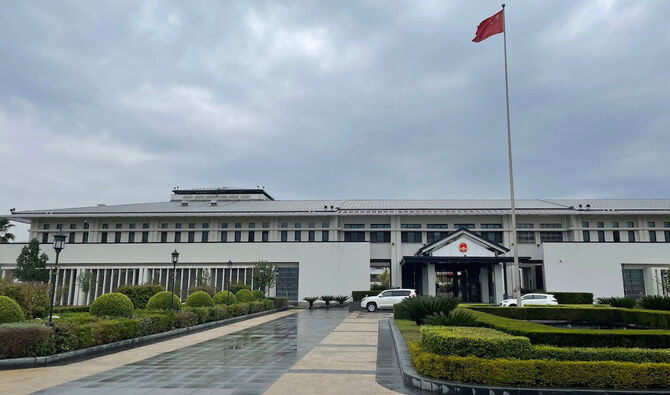


ISLAMABAD: Beijing’s embassy in Islamabad on Monday refuted a story in the Guardian newspaper quoting a top Chinese official criticizing Pakistan’s “false rhetoric” around projects that are part of a joint multi-billion-dollar economic corridor and expressing “serious concerns” over the scheme’s future due to security challenges.
Beijing has pledged to build energy, infrastructure and other projects as part of the over $60 billion China-Pakistan Economic Corridor (CPEC) scheme launched in 2015 as a flagship of President Xi Jinping’s Belt and Road Initiative to grant China access to trade routes in Asia and Africa.
Recent attacks, including one in October 2024 in which two Chinese workers were killed in a suicide bombing in the Pakistani port city of Karachi, have forced Beijing to publicly criticize Pakistan over security lapses and media has widely reported in recent months that China wants its own security forces on the ground to protect its nationals and projects, a demand Islamabad has long resisted.
Progress on the economic corridor has been slow, particularly in the restive southwestern Balochistan province where China is building a deep-sea port and last week opened Pakistan’s largest airport in the coastal town of Gwadar, among other mega projects. Ethnic separatist groups target Chinese interests in the area, blaming both the governments in Pakistan and China of exploiting the province’s natural resources and neglecting the local population, allegations both Beijing and Islamabad deny. Gwadar residents have held intermittent protests for months, saying Chinese projects in the area have not improved the lives of the local population.
In a report published on Sunday, the Guardian quoted China’s political secretary to Islamabad, Wang Shengjie, speaking about enduring security challenges in Pakistan.
“We have noted that the recent article in The Guardian, allegedly quoted the remarks of a Chinese diplomat, which is completely untrue. The rhetoric and wording imposed is obviously not credible, lacking the basic understanding of China’s position,” the Chinese embassy said in a statement, adding that the report violated “professional ethics and breaches basic respect for the common understanding.”
The Guardian article had reported Shengjie as accusing the Pakistani government of using “false rhetoric” around CPEC projects, which had given unrealistic expectations to locals.
“We don’t work in rhetoric like Pakistan – we just focus on development,” he was quoted as saying. “If this kind of security situation persists, it will hamper development.”
The report said the Chinese official expressed “serious concerns” over the future of CPEC due to security challenges.
“If the security is not improved, who would come and work in this environment? There is hatred against the Chinese in Gwadar and Balochistan,” Shengjie was quoted as saying. “Some evil forces are against the CPEC, and they want to sabotage it.”
Pakistan has repeatedly assured China it would protect its nationals in the country from militant outfits and has tightened security protocols for Chinese investors and nationals. Islamabad says attacks on Chinese nationals are an “international conspiracy” to sour ties between the two longtime allies.
“China has always supported the construction of Gwadar Port and the development of Balochistan,” the Chinese embassy statement said, refuting the Guardian report and listing development efforts in Balochistan in recent months.
“In March last year, we provided $100,000 in emergency cash assistance for disaster relief work in Balochistan,” the statement said.
“In May, China transported 10,000 sets of solar lighting equipment to be distributed in Balochistan. In June, we handed over the Gwadar China-Pakistan Friendship Hospital and Gwadar desalination plant.”
In July, China organized a media delegation from Balochistan to visit China while in August, 20,000 sets of health kits were distributed to Balochistan.
“In October, the new Gwadar International Airport was successfully completed. In November, we organized delegations from all walks of life in Gwadar to visit China. In December, outstanding Pakistani staff of the CPEC project, including those in Balochistan were awarded.”
The embassy said it would soon award “Chinese Ambassador Scholarships” to students in Balochistan University, Sardar Bahadur Khan University and Gwadar University.
“Those tangible achievements represent China’s determination and confidence for the development of Gwadar and Balochistan,” the embassy concluded. “We sincerely hope that China-Pakistan practical cooperation and livelihood projects can better benefit the local people.”


