UN Security Council demands pullout of Rwanda-backed armed group from DR Congo

1 / 3
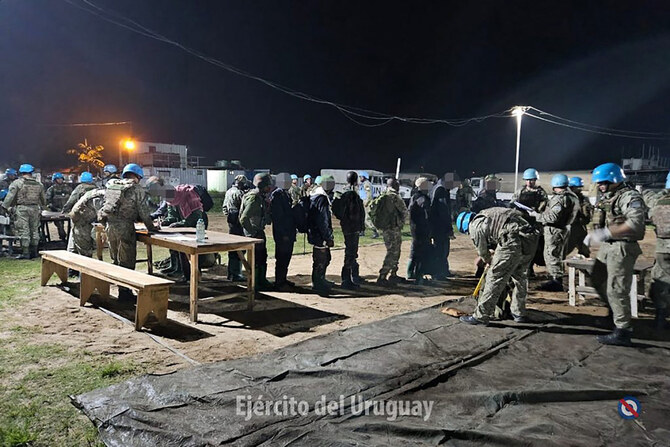
Congo Army soldiers are seen handing over their weapons to Uruguayan soldiers of the United Nations peacekeeping mission, MONUSCO, as demanded by the advancing M23 armed group in Goma, easter DR Congo. (Handout / Uruguayan Army / AFP)
2 / 3
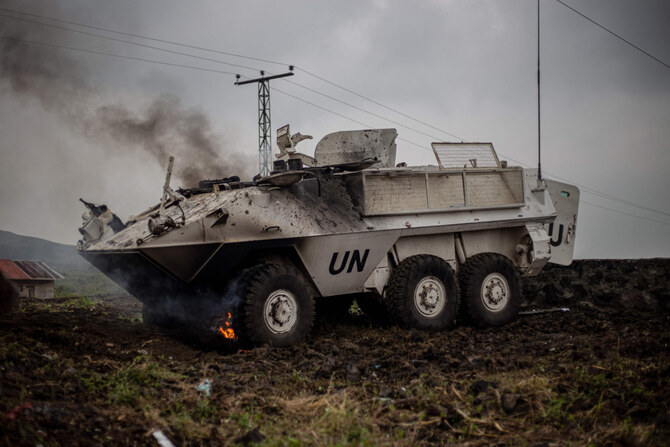
Smoke billows from an armored personnel carrier (APC) of the United Nations peacekeeping mission in Nzulo, on the main road linking the North Kivu capital Goma to the town of Sake, on January 25, 2025. (AFP)
3 / 3
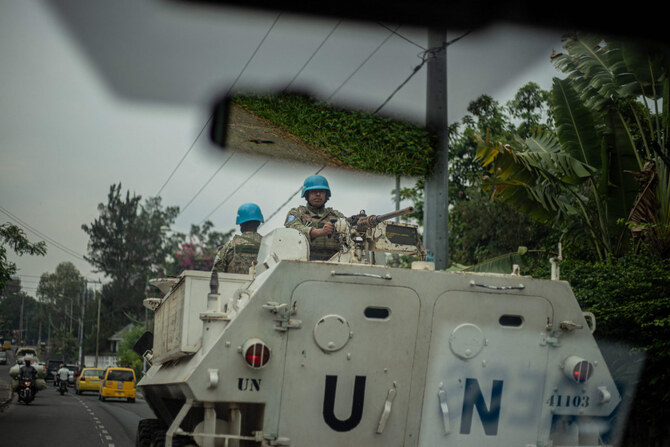
Uruguayan soldiers of the United Nations peacekeeping mission travel on their armored personnel carrier in Nzulo, on the main road linking the North Kivu capital Goma to the town of Sake, on January 25, 2025. (AFP)
Short Url
Updated 27 January 2025
Follow

UN Security Council demands pullout of Rwanda-backed armed group from DR Congo

  • UN Security Council condemns ‘flagrant disregard’ for sovereignty in DR Congo
  • Congo late Saturday broke off relations with Rwanda, which has denied backing the M23 despite evidence collected by UN experts and others
  • US, France tells Rwanda to back off, warning that the US would hold accountable those responsible for sustaining the armed conflict

UNITED NATIONS/GOMA, Congo: The UN Security Council on Sunday denounced the “flagrant disregard” for the sovereignty and territorial integrity of the Democratic Republic of Congo (DRC), demanding the withdrawal of “external forces” without explicitly naming them.
The Council “condemned the ongoing flagrant disregard for the sovereignty and territorial integrity of the DRC, including the unauthorized presence in the Eastern DRC of external forces as reported by the Group of Experts and demanded that these forces withdraw immediately,” it said in a statement Sunday evening, referencing a UN expert report that criticized the presence of Rwandan forces and their support for the M23 armed group fighting the Congolese army.
During an emergency meeting of the Security Council, UN‘s special representative for Congo said the attacking forces has caused “mass panic” in eastern Congo’s largest city, Goma, a humanitarian and security hub and home to 2 million people.

“M23 has declared the airspace over Goma closed,” UN special representative, Bintou Keita said. “In other words, we are trapped.” 
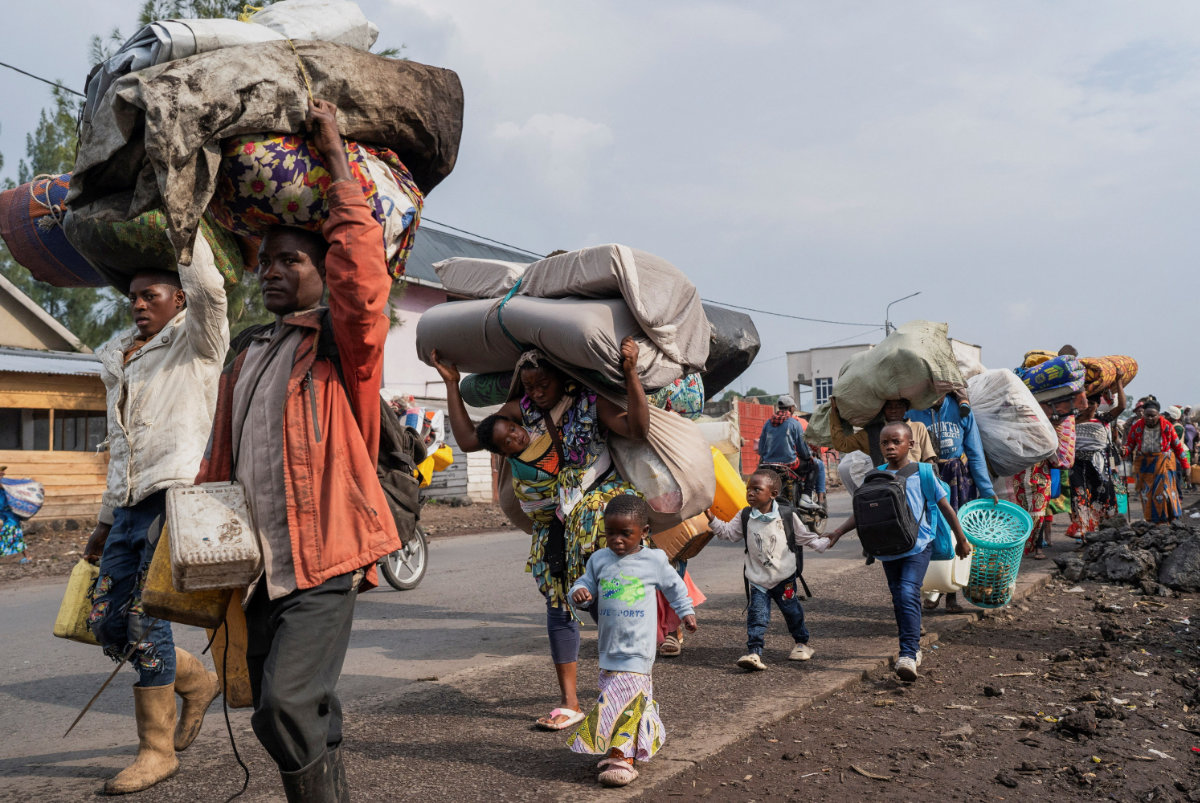


Internally displaced civilians from the camps in Munigi and Kibati, carry their belongings as they flee following the fight between M23 rebels and DR Congo forces in Goma on January 26, 2025. (REUTERS)

Keita said M23 fighters were using residents “as human shields” as they advanced, while others fled for their lives.

The M23 rebels’ offensive at the heart of the mineral-rich region threatens to dramatically worsen one of Africa’s longest wars and create further misery for what is already one of the world’s largest humanitarian crises, with millions of people displaced.

‘Declaration of war’

Congo late Saturday broke off relations with Rwanda, which has denied backing the M23 despite evidence collected by UN experts and others. Congo’s government called it a “declaration of war.”

The surge of violence has killed at least 13 peacekeepers over the past week. And Congolese were again on the run.

The M23 has made significant territorial gains along Congo’s border with Rwanda in recent weeks, after months of regional attempts to make peace failed. On Sunday night, the rebels called on Congo’s army to surrender their arms and present themselves at a local stadium by 3 a.m. or they would take the city.

The Uruguayan army, who are in Goma serving with the UN peacekeeping mission, said in a statement on X late Sunday that some Congolese soldiers have laid down their weapons.

“More than a hundred FARDC soldiers are sheltered in the facilities of the “Siempre Presente” base awaiting the (Disarmament, Demobilization and Reintegration) process,” the statement said.

In photos shared with the statement, armed men are seen registering with the peacekeepers in a mix of military uniforms and civilian clothing.
Congo’s foreign minister, Thérèse Kayikwamba Wagner, told the Security Council that Rwanda was committing “a frontal aggression, a declaration of war which no longer hides itself behind diplomatic maneuvers.”
Rwanda’s ambassador to the UN, Ernest Rwamucyo, did not confirm or deny Congo’s claims. He blamed Congo’s government, saying the crisis could have been been averted if it had “demonstrated a genuine commitment to peace.”

US and France weigh in

The United States and France called for a ceasefire and appealed to Rwanda to withdraw its support to M23, with acting US Ambassador Dorothy Shea warning that the US would “consider all the tools at its disposal” to hold accountable those responsible for sustaining the armed conflict.
In the past 48 hours, two UN peacekeepers from South Africa and one from Uruguay were killed and 11 others were injured and hospitalized, UN Secretary-General Antonio Guterres’ spokesman said ahead of the Security Council meeting.
The UN chief reiterated his “strongest condemnation” of the M23 offensive “with the support of the Rwanda Defense Forces,” and called on the rebel group to immediately halt all hostile action and withdraw, spokesman Stephane Dujarric said.
Congo, the United States and UN experts accuse Rwanda of backing M23, which is mainly made up of ethnic Tutsis who broke away from the Congolese army more than a decade ago. It’s one of about 100 armed groups that have been vying for a foothold in the mineral-rich region, where a long-running conflict has created one of the world’s largest humanitarian crises.


Rwanda’s government denies backing the rebels, but last year acknowledged that it has troops and missile systems in eastern Congo to safeguard its security, pointing to a buildup of Congolese forces near the border. UN experts estimate up to 4,000 Rwandan forces are in Congo.
Congo’s foreign ministry said late Saturday it was severing diplomatic ties with Rwanda and pulling all diplomatic staff from the country “with immediate effect.”
Rwandan Foreign Minister Olivier Nduhungirehe told The Associated Press on Sunday that the decision to cut ties was a unilateral move by Congo.
“For us, we took appropriate measures to evacuate our remaining diplomat in Kinshasa, who was under permanent threat by Congolese officials,” Nduhungirehe said.
The M23 took Goma once before in 2012, withdrawing after considerable international pressure was put on Rwanda.


Civilians flee the rebel advance
On Sunday morning, heavy gunfire resonated across Goma, a few kilometers (miles) from the front line. Scores of children and adults fled the Kanyaruchinya camp, one of the largest in eastern Congo for displaced people, near the Rwandan border.
“We are fleeing because we saw soldiers on the border with Rwanda throwing bombs and shooting,” said Safi Shangwe, who was heading into the city.
Some of the displaced worried they would not be safe in Goma, either. “I heard that there are bombs in Goma, too, so now we don’t know where to go,” said Adèle Shimiye.
Hundreds of people attempted to flee to Rwanda. Migration officers at a border crossing east of Goma carefully checked travel documents.
“I am crossing to the other side to see if we will have a place of refuge because for the moment, security in the city is not guaranteed,” Goma resident Muahadi Amani told the AP.
UN deputy humanitarian chief Joyce Msuya said the situation was rapidly deteriorating. “If hostilities spill into Goma – a densely populated urban center – the impact on civilians could be devastating,” she said.
Congo’s army has said it was fending off the M23 offensive with the help of allied forces, including UN peacekeepers and soldiers from the Southern African Development Community Mission, also known as SAMIDRC.
In addition to the two South African peacekeepers, seven South African troops with SAMIDIRC have been killed in recent days, South Africa’s defense ministry said.
Since 2021, Congo’s government and allied forces — including the 14,000-strong UN mission — have been keeping M23 away from Goma.
Goma resident Bahati Jackson’s family has been hearing gunfire and remembers fleeing M23’s seizure of the city in 2012. But this time, they’re staying.
“If we’re going to die, it’s better to die here,” Jackson said.


US intel did not suggest a preemptive strike from Iran before US-Israeli attacks, AP sources say

Updated 58 min 25 sec ago
Follow

US intel did not suggest a preemptive strike from Iran before US-Israeli attacks, AP sources say

  • The official said a variety of factors created a golden opportunity to take out much of Iran’s leadership

WASHINGTON: Trump administration officials told congressional staff in private briefings Sunday that US intelligence did not suggest Iran was preparing to launch a preemptive strike against the US, three people familiar with the briefings said.
The administration officials instead acknowledged there was a more general threat in the region from Iran’s missiles and proxy forces, two of the people said. The third person, however, said the administration emphasized that Iran’s missiles and proxy forces posed an imminent threat to US personnel and allies in the region.
The officials did not provide any clarity about what would happen next in Iran after the joint US-Israeli operation, the two people said. All three people insisted on anonymity to discuss details that have not been made public.
The information conveyed to the congressional staff contrasts with the message from President Donald Trump. “Our objective is to defend the American people by eliminating imminent threats from the Iranian regime. A vicious group of very hard, terrible people,” he said in a video message after launching strikes on Iran.
Senior Trump administration officials, who like others were not authorized to comment publicly and spoke on condition of anonymity, had told reporters Saturday that there were indicators that the Iranians could launch a preemptive attack.
The White House and Pentagon did not immediately reply to requests for comment on Sunday night. Details of the briefing were first reported by Politico.
On Tuesday, Secretary of State Marco Rubio, Defense Secretary Pete Hegseth, CIA Director John Ratcliffe and Gen. Dan Caine, chairman of the Joint Chiefs of Staff, will brief the full membership of Congress on the US military operation against Iran, the White House said Sunday. Rubio also was slated to brief Hill leadership Monday, the same day Hegseth and Caine are planning a press conference about the operation.
Three strikes, three locations, within a single minute
The military operation came after authorities from Israel and the US spent weeks tracking the movements of senior Iranian leaders, including Supreme Leader Ayatollah Ali Khamenei, and shared information that allowed the strikes to be carried out in a surprise daylight attack, according to an Israeli military official and another person familiar with the operation.
The eventual barrage of US-Israeli attacks on Iran came so quickly that they were nearly simultaneous — with three strikes in three locations hitting within a single minute — killing Khamenei and some 40 senior figures, including the head of the paramilitary Revolutionary Guard and the country’s defense minister, the Israeli military official said Sunday.
The official said a variety of factors created a golden opportunity to take out much of Iran’s leadership, like weeks of training and monitoring the movements of senior figures as well as intelligence in real-time before the attack began that key targets were gathered together.
Striking by day also gave an additional element of surprise, said the official, who said so many major, rapid-fire strikes were critical to keep key officials from fleeing after the first strike. The official said Israel closely cooperated with its US counterparts and had used a similar tactic at the beginning of last June’s war — which resulted in the killing of several senior Iranian figures.
The official also noted Khamenei having posted defiant tweets taunting President Donald Trump in the days before the attack.
The details about the strikes came as the conflict entered its second day, with Trump saying in a video message Sunday that he expected it would continue until “all of our objectives are achieved.” He did not spell out what those objectives were.
The Republican president also said the US military and its partners hit hundreds of targets in Iran, including Revolutionary Guard facilities, Iranian air defense systems and nine warships, “all in a matter of literally minutes.”
CIA had long tracked top Iranian leaders
Before the attacks, the CIA had for months tracked the movements of senior Iranian leaders, including Khamenei.
The intelligence was shared with Israeli officials, and the timing of the strikes was adjusted in part because of that information about the Iranian leaders’ location, according to the person familiar with the planning.
The intelligence-sharing between US and Israel reflects the preparation that went into the strikes, which threw the future of the Islamic Republic into uncertainty and raised the risk of escalating regional conflict.
The US regularly shares intelligence with allies including Israel. Those partnerships, and the accuracy of the intelligence they yield, is often critical not only to the success of a military operation but also to the public’s support for it.
Virginia Sen. Mark Warner, the senior Democrat on the committee, told The Associated Press that, historically, “our working relationship with the Mossad and Israel is really strong.” Mossad is the Israeli spy agency.
Warner said he has serious concerns about the justification for the strikes, Trump’s long-term plans for the conflict and the risks that US service members will face. The military announced Sunday that three American troops had been killed in the Iran operation.
“No tears will be shed over their leadership being eliminated, but always the question is: OK, what next?” Warner said.
Iran has signaled it’s open to talks with the US
A senior White House official said Iran’s “new potential leadership” has suggested it is open to talks with the United States. That official, who spoke on condition of anonymity to discuss internal administration deliberations, said Trump has indicated he’s “eventually” willing to talk but that for now the military operation “continues unabated.”
The official did not say who the potential new Iranian leaders are or how they made their alleged willingness to talk known. Separately, Trump told The Atlantic that he planned to speak with Iran’s new leadership.
“They want to talk, and I have agreed to talk, so I will be talking to them,” he said Sunday, declining comment on the timing.