

Congo severs ties with Rwanda as rebels close in on Goma

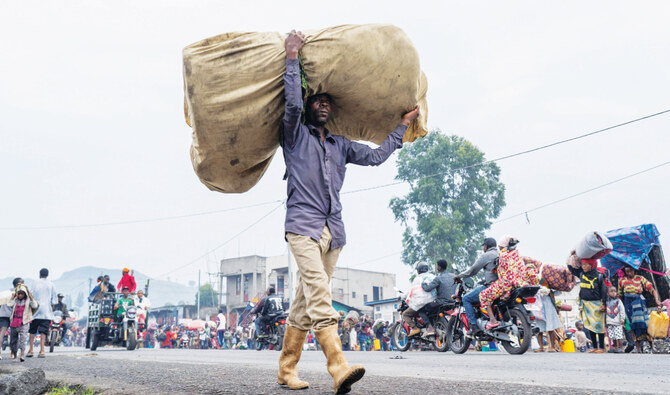
Internally displaced civilians flee Goma following the fight between M23 rebels and the armed forces. (Reuters)
Short Url
Updated 26 January 2025
Follow

Congo severs ties with Rwanda as rebels close in on Goma

  • M23 is one of about 100 armed groups vying for a foothold in the mineral-rich region

GOMA: Congo has severed diplomatic ties with Rwanda as fighting between Rwanda-backed rebels and government forces rages around the key eastern city of Goma, leaving at least 13 peacekeepers and foreign soldiers dead and displacing thousands of civilians.

The M23 rebel group has made significant territorial gains along the border with Rwanda in recent weeks, closing in on Goma, the provincial capital that has a population of around 2 million and is a regional hub for security and humanitarian efforts.

Congo, the US and UN experts accuse Rwanda of backing M23, which is mainly made up of ethnic Tutsis who broke away from the Congolese army more than a decade ago. It’s one of about 100 armed groups that have been vying for a foothold in the mineral-rich region, where a long-running conflict has created one of the world’s largest humanitarian crises.

Rwanda’s government denies backing the rebels, but last year acknowledged that it has troops and missile systems in eastern Congo to safeguard its security, pointing to a buildup of Congolese forces near the border. UN experts estimate there are up to 4,000 Rwandan forces in Congo.

The Congolese Foreign Ministry said late Saturday it was severing diplomatic ties with Rwanda and pulling out all diplomatic staff from the country “with immediate effect.”

Rwanda’s Foreign Minister Olivier Nduhungirehe said on Sunday the decision to sever diplomatic ties was a unilateral move by Congo “that was even published on social media before being sent to our embassy.”

“For us, we took appropriate measures to evacuate our remaining diplomat in Kinshasa, who was under permanent threat by Congolese officials. And this was achieved on Friday, one day before the publication of this so-called note verbale on social media,” he said.

The UN Security Council moved up an emergency meeting on the escalating violence in eastern Congo to Sunday. Congo requested the meeting, which had originally been scheduled for Monday.

On Sunday morning, heavy gunfire resonated across Goma, just a few kilometers from the front line, while scores of displaced children and adults fled the Kanyaruchinya camp, one of the largest in eastern Congo, right near the Rwandan border, and headed south to Goma.

“We are fleeing because we saw soldiers on the border with Rwanda throwing bombs and shooting,” said Safi Shangwe, who was heading to Goma.

“We are tired and we are afraid, our children are at risk of starving,” she added.

Some of the displaced worried they will not be safe in Goma either.

“We are going to Goma, but I heard that there are bombs in Goma, too, so now we don’t know where to go,” said Adèle Shimiye.

Hundreds of people attempted to flee to Rwanda through the “Great Barrier” border crossing east of Goma on Sunday. Migration officers carefully checked travel documents.

“I am crossing to the other side to see if we will have a place of refuge because for the moment, security in the city is not guaranteed,” Muahadi Amani, a resident of Goma, said.

Earlier in the week, the rebels seized Sake, 27 kilometers from Goma, as concerns mounted that the city could soon fall.


Left homeless by blaze, Muslims in southernmost Philippines observe Ramadan as month of trial

Updated 23 February 2026
Follow

Left homeless by blaze, Muslims in southernmost Philippines observe Ramadan as month of trial

  • Thousands lost their homes when parts of Bongao in Tawi-Tawi were burnt to ashes
  • Many trying to fully observe the fasting month say they are grateful to be alive

Manila: As Annalexis Abdulla Dabbang was looking forward to observing the month of Ramadan with her family, just days before it began they lost everything when an enormous fire tore through whole neighborhoods of their city in the southernmost province of the Philippines.

Bongao is the capital of Tawi-Tawi, an island province, forming part of the country’s Muslim minority heartland in the Bangsamoro region. The city experienced its worst fire in years in early February, when flames swept through the coastal community, leaving more than 5,000 people homeless.

“We were swimming for our lives. We had to swim to escape from the fire ... We swam in darkness, and (even) the sea was already hot because of the fire,” Dabbang, a 27-year-old teacher, told Arab News.

“Everything we owned was gone in just a few hours — our home, our memories, the things we worked hard for, everything turned to ashes.”

Trying to save their 2-year-old daughter and themselves, she and her husband left everything behind — as did hundreds of other families that together with them have since taken shelter at the Mindanao State University gymnasium — one of the evacuation centers.

Unable to secure a tent, Dabbang’s family has been sleeping on the bleachers, sharing a single mat as their bed. When Ramadan arrived a few days after they moved to the makeshift shelter, they welcomed it in a different, more solemn way. There is no family privacy for suhoor, no room or means to welcome guests for iftar.

“Ramadan feels different now. It’s painful but at the same time more real. When we lost our home, we began to understand what sacrifice really means. When you sleep in an evacuation center, you understand hunger, discomfort in a deeper way,” Dabbang said.

“We don’t prepare special dishes. We prepare our hearts.”

While she and thousands of others have lost everything they have ever owned, she has not lost her faith.

“Our dreams may have turned to ashes, but our prayers are still alive,” she said.

“This Ramadan my prayers are more emotional than ever. I pray for strength, not just for myself, but for my family and for every neighbor who also lost their family home. I pray for healing from the trauma of fire. I pray that Allah will replace what we lost with something better. I pray for the chance to rebuild not just our house, but our sense of security.”

Juraij Dayan Hussin, a volunteer helping the Bongao fire victims, observed that many of them were traumatized and the need to cleanse the heart and mind during Ramadan was what kept many of them going, because they are “thankful that even though they lost their property, they are still alive.”

But the religious observance related to the fasting month is not easy in a cramped shelter.

“It’s hard for Muslims to perform their prayers when they do not have their proper attire because they usually have specific clothes for prayer,” he said. “Sanitation in the area is also an issue ... when you fast and when you pray, cleanliness is essential.”

For Abdulkail Jani, who is staying at a basketball court with his brother and more than 70 other families, this Ramadan will be spent apart from their parents, whom they managed to move to relatives.

“The month of Ramadan this year is a month of trial ... there will be a huge change from how we observed Ramadan in the past, but we will adjust to it and try to comfort ourselves and our family. The most important thing is that we can perform the fasting,” he told Arab News.

“Despite our situation now, despite everything, as long as we’re alive, we will observe Ramadan. We’ll try to observe it well, without missing anything.”