

Imran Khan calls on overseas Pakistanis to halt remittances amid renewed political tensions

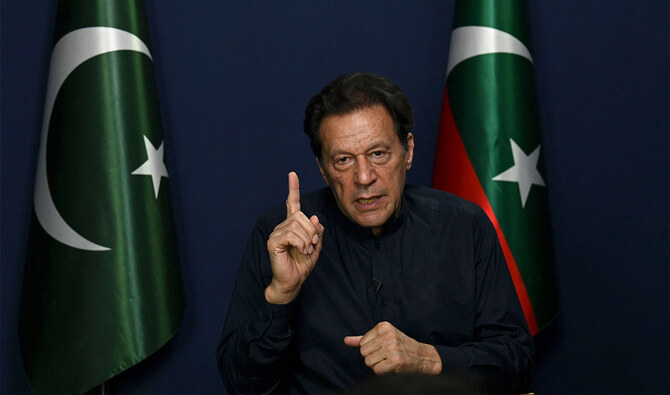
Pakistan's former prime minister Imran Khan gestures as he speaks during an interview with AFP at his residence in Lahore on May 18, 2023. (AFP/File)
Short Url
Updated 26 January 2025
Follow

Imran Khan calls on overseas Pakistanis to halt remittances amid renewed political tensions

  • In social media post, ex-PM Khan calls for nationwide protests on Feb. 8 anniversary of Pakistan election
  • Pakistan’s government blames Khan and his party for breakdown of negotiations to ease political tensions 

ISLAMABAD: Jailed former prime minister Imran Khan on Sunday reiterated his demand for overseas Pakistanis to boycott sending remittances to the country, amid renewed political tensions between his Pakistan Tehreek-e-Insaf (PTI) party and the government. 

The development takes place as talks between the government and the PTI that began last month broke down this week. Talks were suspended after Khan’s party told the government it would not partake in the process if judicial commissions to investigate anti-government protests of May 9, 2023 and November 2024 are not formed. 

On May 9, 2023, angry Khan supporters are accused of rampaging through military offices and installations while on Nov. 26, 2024, they gathered in Pakistan’s capital to demand Khan’s release. The government says four troops were killed in the November protests while the PTI says its supporters also died in clashes. 

Pakistan’s Information Minister Ataullah Tarar this week criticized the PTI for ending talks “unilaterally,” saying the party took the decision in a hurry. The government’s negotiation committee says it will respond to the PTI’s demands formally on Jan. 28. 

“Once again, I urge overseas Pakistanis to continue their boycott of foreign currency remittances,” a post on Khan’s X account read. “Sending money to this government strengthens the very hands that are tightening the noose around your necks.”

Foreign workers’ remittances from countries such as Saudi Arabia, United Arab Emirates, US, UK and others are important for cash-strapped Pakistan to shore up its foreign reserves and stabilize its fragile economy. 

Khan also repeated his demand for supporters to mark Pakistan’s election anniversary on Feb. 8 as a “Black Day.” The PTI alleges that the results of the contentious election last year, marked by delayed vote results and suspension of Internet and mobile services countrywide, were manipulated by the caretaker government at the time and Pakistan’s election commission to keep it away from power. Both deny Khan’s allegations 

“Prepare to observe a nationwide ‘Black Day’ on February 8th,” the post read. “People from Khyber Pakhtunkhwa and northern Punjab should gather in Swabi for protests, while others must hold demonstrations in their respective cities.”

Khan was ousted from power in 2022 after what is widely believed to be a falling out with the country’s powerful top generals. The army denies it interferes in politics.

He has been in prison since August 2023 and faces a slew of legal challenges that ruled him out of the Feb. 8 general elections and which he says are politically motivated to keep him and his party away from power. 

Khan has either been acquitted or his sentences have been suspended in most cases. However, in the latest blow, Khan was handed a 14-year jail sentence in a land corruption case last week. 

All cases against Khan have been tried inside prison, away from the public or media eye, on security grounds.


Pakistan’s OGDC ramps up unconventional gas plans

Updated 4 sec ago
Follow

Pakistan’s OGDC ramps up unconventional gas plans

  • Pakistan has long been viewed as having potential in tight and shale gas but commercial output has yet to be proved
  • OGDC says has tripled tight-gas study area to 4,500 square km after new seismic, reservoir analysis indicates potential

ISLAMABAD: Pakistan’s state-run Oil & Gas Development Company is planning a major expansion of unconventional gas developments from early next year, aiming to boost production and reduce reliance on imported liquefied natural gas.

Pakistan has long been viewed as having potential in both tight and shale gas, which are trapped in rock and can only be released with specialized drilling, but commercial output has yet to be proved.

Managing Director Ahmed Lak told Reuters that OGDC had tripled its tight-gas study area to 4,500 square kilometers (1,737 square miles) after new seismic and reservoir analysis indicated larger potential. Phase two of a technical evaluation will finish by end-January, followed by full development plans.

The renewed push comes after US President Donald Trump said Pakistan held “massive” oil reserves in July, a statement analysts said lacked credible geological evidence, but which prompted Islamabad to underscore that it is pursuing its own efforts to unlock unconventional resources.

“We started with 85 wells, but the footprint has expanded massively,” Lak said, adding that OGDC’s next five-year plan would look “drastically different.”

Early results point to a “significant” resource across parts of Sindh and Balochistan, where multiple reservoirs show tight-gas characteristics, he said.

SHALE PILOT RAMPS UP

OGDC is also fast-tracking its shale program, shifting from a single test well to a five- to six-well plan in 2026–27, with expected flows of 3–4 million standard cubic feet per day (mmcfd) per well.

If successful, the development could scale to hundreds or even more than 1,000 wells, Lak said.

He said shale alone could eventually add 600 mmcfd to 1 billion standard cubic feet per day of incremental supply, though partners would be needed if the pilot proves viable.

The company is open to partners “on a reciprocal basis,” potentially exchanging acreage abroad for participation in Pakistan, he said.

A 2015 US Energy Information Administration study estimated Pakistan had 9.1 billion barrels of technically recoverable shale oil, the largest such resource outside China and the United States.

A 2022 assessment found parts of the Indus Basin geologically comparable to North American shale plays, though analysts say commercial viability still hinges on better geomechanical data, expanded fracking capacity and water availability.

OGDC plans to begin drilling a deep-water offshore well in the Indus Basin, known as the Deepal prospect, in the fourth quarter of 2026, Lak said. In October, Turkiye’s TPAO with PPL and its consortium partners, including OGDC, were awarded a block for offshore exploration.

A combination of weak gas demand, rising solar uptake and a rigid LNG import schedule has created a surplus of gas that forced OGDC to curb output and pushed Pakistan to divert cargoes from Italy’s ENI and seek revised terms with Qatar.