Pakistani court sentences four people to death for blasphemy

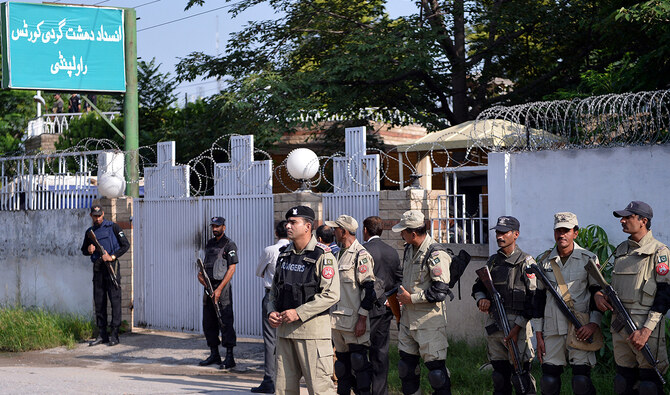
In this file photo, taken on August 20, 2013, Pakistani paramilitary soldiers stand guard outside the anti-terrorist court in Rawalpindi. (AFP/File)
Short Url
Updated 25 January 2025
Follow

Pakistani court sentences four people to death for blasphemy

  • Under Pakistan’s laws, anyone found guilty of insulting Islam or its figures can be sentenced to death
  • Authorities have yet to carry out such a penalty, although opposition to the law can incite reprisals

MULTAN: A Pakistani court Saturday sentenced four people to death for blasphemy, allegedly because they posted sacrilegious material on social media about Islamic religious figures and the Holy Qur’an. Their lawyer said appeal preparations are underway.
Under the country’s blasphemy laws, anyone found guilty of insulting Islam or its religious figures can be sentenced to death. Authorities have yet to carry out such a penalty, although the accusation of blasphemy and opposition to the law can incite mob violence or reprisals.
Judge Tariq Ayub in the city of Rawalpindi declared that blasphemy, disrespect to holy figures, and desecration of the Holy Qur’an were unforgivable offenses and left no room for leniency.
Along with the death sentences, the judge imposed collective fines of 4.6 million rupees (around $16,500) and handed down jail terms to each of the four should a higher court overturn their death sentences.
The men’s lawyer, Manzoor Rahmani, criticized the court’s decision and investigating authorities’ lack of evidence.
“The doubts and uncertainties that arise in such cases are ignored by the courts, likely due to the fear of religious backlash and potential mob violence against the judge if the accused is acquitted,” said Rahmani.
“We are preparing our appeals against the decision and will go to the High Court.”
Anti-blasphemy measures introduced in Pakistan in the 1980s made it illegal to insult Islam.
Since then, people have been accused of insulting the religion, desecrating its texts, or writing offensive remarks on the walls of mosques. Critics of the law say it is used to settle personal disputes.


Nine Afghan citizens killed, 10 injured in accident in southwestern Pakistan— police 

Updated 5 sec ago
Follow

Nine Afghan citizens killed, 10 injured in accident in southwestern Pakistan— police 

  • Pickup truck carrying Afghan nationals collided with oil tanker in Nokundi town, says police official
  • Says Afghan nationals were attempting to enter Europe illegally via Iran as per preliminary probe

QUETTA: At least nine Afghan nationals were killed and 10 others injured in southwestern Pakistan on Sunday when the pickup truck they were traveling in collided with an oil tanker, a police official said.

The collision occurred in Nokundi, a town located on Pakistan’s border with Iran in the southwestern Balochistan province. District Police Officer Muhammad Shareef Kalhoro told Arab News that the Zamyad vehicle (a pickup truck made by Iranian automobile manufacturer Zamyad Co.) was transporting Afghan nationals illegally when the accident took place.

“Twenty-one illegal Afghan migrants were onboard the Zamyad vehicle when it was hit by an oil tanker in the kacha [remote] area of Nokundi,” Kalhoro said.

“Nine Afghans were killed on the spot and 10 were injured in the serious accident,” he added.

The police official said the bodies and injured persons were sent back to Afghanistan through cross-border coordination and in accordance with legal protocol.

Kalhoro said preliminary investigations indicate the Afghan nationals were attempting to enter Europe illegally from Afghanistan via Iran, facilitated by an organized human smuggling network.

“All legal proceedings have been initiated, and the human smuggling network is being traced for further action,” he said.

Pakistan launched a nationwide crackdown against people living in the country illegally in 2023, with Afghan refugees bearing the brunt of the deportation drive. Pakistan says it has deported over 1.5 million Afghans since then. The crackdown was launched after a spate of suicide attacks in the country that Islamabad blamed on Afghan nationals without providing proof.

Thousands of migrants travel illegally through the desolate areas of Chaghi district in Balochistan every year in an attempt to reach Europe via Iran.

Balochistan, home to the multi-billion-dollar China-Pakistan Economic Corridor project, is considered by experts to be Pakistan’s most underdeveloped province across almost all social and economic indicators.

The province is also home to multi-billion-dollar mineral projects such as Saindak and Reko Diq. However, most districts in Balochistan have dilapidated roads, which often lead to fatal accidents.