Philippines accuses China’s forces of harassing fisheries vessels in the South China Sea

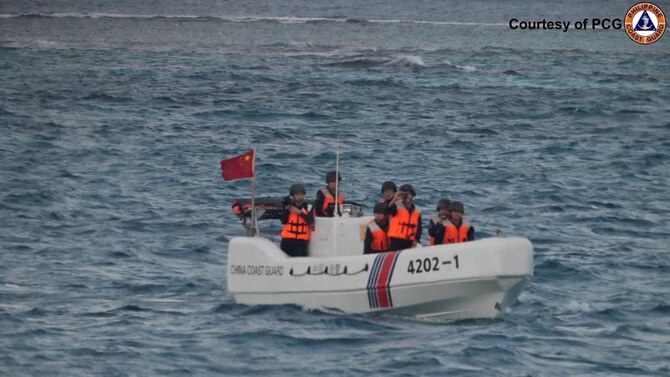
China coast guard officers check an incident with Philippine Bureau of Fisheries and Aquatic Resources during a marine scientific survey near Thitu Island in disputed waters of the South China Sea on Jan. 24, 2025. (Philippine Coast Guard/AFP)
Short Url
Updated 25 January 2025
Follow

Philippines accuses China’s forces of harassing fisheries vessels in the South China Sea

  • The Chinese coast guard and navy’s harassment of the Philippine vessels took place Friday near Sandy Cay
  • China has repeatedly asserted sovereignty over most of the South China Sea and accused rival claimant states

MANILA: Chinese coast guard ships and a Chinese navy helicopter harassed a group of Philippine fisheries vessels conducting a scientific survey in a hotly disputed area of the South China Sea, forcing them to cancel the operation, the Philippine coast guard said Saturday.
The Chinese coast guard and navy’s harassment of the Philippine vessels took place Friday near Sandy Cay, three small uninhabited sandbars planked by an artificial island base of Chinese forces and a Philippines-occupied island in the Spratlys archipelago, the coast guard said.
The coast guard ships approached two larger vessels, which maneuvered to avoid a collision, and a Chinese navy helicopter flew low over two smaller boats deployed by the ships, forcing the survey to be called off.
Videos released by the Philippine coast guard show a Chinese coast guard ship sailing very close to a ship officials identified as one of the Philippine vessels. Another video shows a Chinese military helicopter hovering low over the rough seas near a vessel flying a Philippine flag.
There was no immediate response from Chinese officials, but China has repeatedly asserted sovereignty over most of the South China Sea and accused rival claimant states, including the Philippines, Vietnam and Malaysia of encroachment. China has demarcated its territorial claims with a 10 dashed-line printed in maps but has not provided the exact coordinates.
The latest flare-out of the long-simmering territorial disputes in one of the world’s busiest trade and security passageways could test President Donald Trump’s commitment to maintain America’s role as a counterweight to China, which has increasingly carried out assertive actions in the disputed waters.
His predecessor, Joe Biden, strengthened an arc of security alliances in Asia while in office in a bid to curb China’s aggressive actions in the South China Sea, East China Sea and around Taiwan, a self-governed island which Beijing has vowed to take by force if necessary.
Secretary of State Marco Rubio in a telephone call on Wednesday with his Philippine counterpart, Enrique Manalo, discussed issues of mutual concern, including “the People’s Republic of China’s dangerous and destabilizing actions in the South China Sea,” State Department spokesperson Tammy Bruce said.
Rubio “conveyed that that the PRC’s behavior undermines regional peace and stability and is inconsistent with international law,” Bruce said in a readout of the call.
Rubio “underscored the United States’ ironclad commitments to the Philippines under our Mutual Defense Treaty,” Bruce said.
Biden and his administration had repeatedly warned China that the US is obligated to help defend the Philippines, its oldest treaty ally in Asia, if Filipino forces, ships and aircraft come under armed attack including in the South China Sea. China has warned the US to stay away from what it says is a purely Asian dispute.


Hong Kong election turnout in focus amid anger over deadly fire

Updated 07 December 2025
Follow

Hong Kong election turnout in focus amid anger over deadly fire

  • Security tight as city holds legislative elections
  • Residents angry over blaze that killed at least 159

HONG KONG: Hong Kong’s citizens were voting on Sunday in an election where the focus is on turnout, with residents grieving and traumatized after the city’s worst fire in nearly 80 years and the authorities scrambling to avoid a broader public backlash.
Security was tight in the northern district of Tai Po, close to the border with mainland China, where the fire engulfed seven towers. The city is holding elections for the Legislative Council, in which only candidates vetted as “patriots” by the China-backed Hong Kong government may run.
Residents are angry over the blaze that killed at least 159 people and took nearly two days to extinguish after it broke out on November 26. The authorities say substandard building materials used in renovating a high-rise housing estate were responsible for fueling the fire.
Eager to contain the public dismay, authorities have launched criminal and corruption investigations into the blaze, and roughly 100 police patrolled the area around Wang Fuk Court, the site of the fire, early on Sunday.
A resident in his late 70s named Cheng, who lives near the charred buildings, said he would not vote.
“I’m very upset by the great fire,” he said during a morning walk. “This is a result of a flawed government ... There is not a healthy system now and I won’t vote to support those pro-establishment politicians who failed us.”
Cheng declined to give his full name, saying he feared authorities would target those who criticize the government.
At a memorial site near the burned-out residential development, a sign said authorities plan to clear the area after the election concludes close to midnight, suggesting government anxiety over public anger.
Beijing’s national security office in Hong Kong has said it would crack down on any “anti-China” protest in the wake of the fire and warned against using the disaster to “disrupt Hong Kong.”
China’s national security office in Hong Kong warned senior editors with a number of foreign media outlets at a meeting in the city on Saturday not to spread “false information” or “smear” government efforts to deal with the fire.
The blaze is a major test of Beijing’s grip on the former British colony, which it has transformed under a national security law after mass pro-democracy protests in 2019.
An election overhaul in 2021 also mandated that only pro-Beijing “patriots” could run for the global financial hub’s 90-seat legislature and, analysts say, further reduced the space for meaningful democratic participation.
Publicly inciting a vote boycott was criminalized as part of the sweeping changes that effectively squeezed out pro-democracy voices in Hong Kong. Pro-democracy voters, who traditionally made up about 60 percent of Hong Kong’s electorate, have since shunned elections.
The number of registered voters for Sunday’s polls — 4.13 million — has dropped for the fourth consecutive year since 2021, when a peak of 4.47 million people were registered.
Seven people had been arrested as of Thursday for inciting others not to vote, the city’s anti-corruption body said.
Hong Kong and Chinese officials have stepped up calls for people to vote.
“We absolutely need all voters to come out and vote today, because every vote represents our push for reform, our protection of the victims of  disaster, and a representation of our will to unite and move forward together,” Hong Kong leader John Lee said after casting his vote.
Hong Kong’s national security office urged residents on Thursday to “actively participate in voting,” saying it was critical in supporting reconstruction efforts by the government after the fire.
“Every voter is a stakeholder in the homeland of Hong Kong,” the office said in a statement. “If you truly love Hong Kong, you will vote sincerely.”
The last Legislative Council elections in 2021 recorded the lowest voter turnout — 30.2 percent — since Britain returned Hong Kong to Chinese rule in 1997.