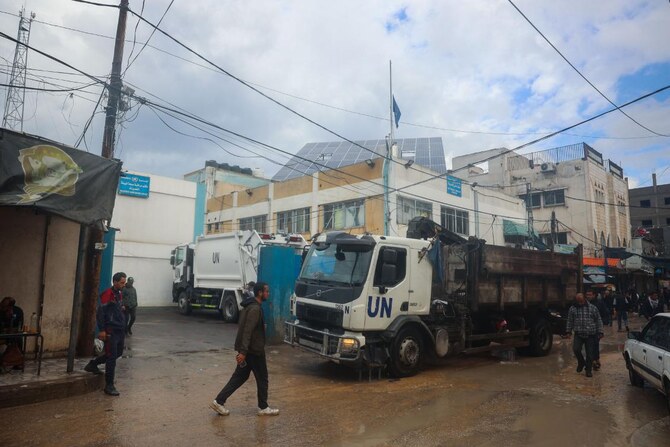

NEW YORK: Israel’s Permanent Representative to the UN Danny Danon on Friday called on the UN relief agency for Palestine refugees to halt its operations in Jerusalem, and evacuate its premises in the city “no later than Jan. 30,” the day an Israeli ban on the organization is due to take effect.
Legislation blocking UNRWA from operating within Israel was approved overwhelmingly by the Knesset in October. The ban also prevents the country’s authorities from maintaining any contact with the relief agency.
Delivery of aid to Gaza and the West Bank requires close coordination between UNRWA and Israeli authorities. If the legislation is implemented as planned, Israel will no longer issue agency staff with work or entry permits, and coordination with the Israeli military that is essential for ensuring safe passage for aid deliveries will no longer be possible.
Since the start of the war in Gaza, Israel has relentlessly condemned and attacked the aid agency. More than 260 of its staff have been killed, while its schools — used by displaced Palestinians for shelter — have been bombed. A coordinated Israeli media campaign has attempted to discredit the agency by portraying it as a tool of Hamas.
As the date for enforcement of the Israeli ban approaches, Danon told UN Secretary-General Antonio Guterres that UNRWA’s premises in Jerusalem must be vacated as stipulated by law.
The Israeli envoy said that the legislation came “as a direct response to the acute national security risks posed by the widespread infiltration of UNRWA’s ranks by Hamas and other terrorist organizations, and the agency’s persistent refusal to address the very grave and material concerns raised by Israel, and to remedy this intolerable situation.”
He added: “Months of good-faith engagement with the United Nations, and years of related grievances conveyed to UNRWA, have been met with blatant disregard, compromising its fundamental obligation to impartiality and neutrality beyond repair.”
Most UN member states consider UNRWA, the largest aid agency for Palestinians, to be the irreplaceable backbone of humanitarian operations. However, few levers have been pulled to try to ensure the agency’s existence.
Asked by Arab News about this discrepancy between public statements of support and meaningful action, and whether it means Western countries are undermining the same multilateral values on which they were founded, UNRWA Commissioner-General Philippe Lazzarini said: “The same question could be asked about the importance of international humanitarian law and the blatant and constant disregard of that law.
“You can ask the same question about the disrespect for the resolutions of the Security Council and the General Assembly. And you can ask the same question about the International Court of Justice’s ruling that Israel’s presence in the West Bank and East Jerusalem is illegal, and the court’s call for its withdrawal.
“And so, it’s obviously frustrating,” Lazzarini added. “What we have witnessed is an extraordinary ‘crisis of impunity,’ to the extent that international humanitarian law is almost becoming irrelevant if no mechanism is put in place to address this impunity.”