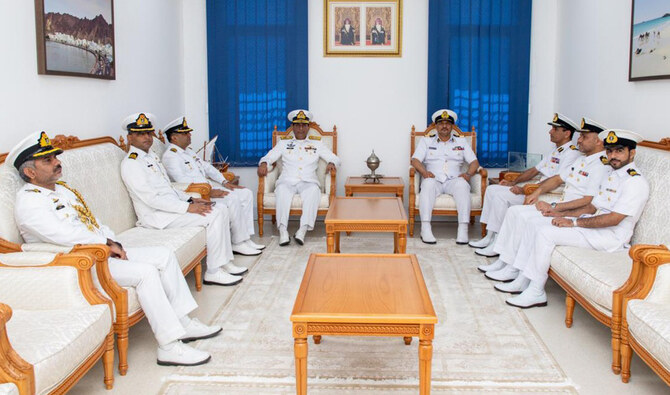
ISLAMABAD: Pakistani and Omani navies have conducted a joint exercise to enhance interoperability between the two forces, Pakistan Navy said on Friday, following a port call in Muscat by two Pakistan Navy ships.
Pakistan Navy’s Tabuk and Rah Naward ships visited Port Sultan Qaboos, where they were warmly received by Omani authorities, according to the Directorate General Public Relations (DGPR) of Pakistan Navy.
During the visit, Pakistani mission commander and commanding officers held meetings with Royal Navy of Oman’s director-general operations and plans, Maritime Security Center commander and commandant of the Said bin Sultan naval base.
“During these interactions, matters of mutual interest, Navy-to-Navy engagements, and cooperation in maritime security were discussed,” the DGPR said in a statement.
“Following the port call, PNS Tabuk conducted a passage exercise with a Royal Oman Navy ship Al Shamikh. The exercise at sea aimed to enhance interoperability between the two navies and promote shared learning through coordinated activities.”
Pakistan Navy ships were also opened for visitors, including ambassadors, diplomats and military attaches of various countries as well as a large number of Pakistani community members.
Pakistan and Oman are maritime neighbors and frequent visits of dignitaries, port calls by ships, joint exercises and coordinated patrols have been a regular feature of bilateral ties between the two countries.
“The visit of PNS Tabuk and Rah Naward will further strengthen bilateral relations between the two navies,” the DGPR added.

Omani, Pakistani navies hold joint exercise to enhance interoperability
https://arab.news/gedg7
Omani, Pakistani navies hold joint exercise to enhance interoperability
- Pakistan, Oman are maritime neighbors and hold frequent port calls, joint exercises and coordinated patrols
- During visit to Port Sultan Qaboos, Pakistan Navy officials discussed maritime cooperation with Omani counterparts
Pakistan, Uzbekistan eye increasing bilateral trade to $2 billion within two years
- Pakistani PM’s aide on commerce, Ihsaan Afzal, meets Uzbekistan’s deputy investment minister in Tashkent
- Uzbek delegation identifies textiles, leather, pharmaceuticals as sectors for joint ventures, technology transfer
ISLAMABAD: Senior officials from Pakistan and Uzbekistan have agreed to fast-track their countries’ Preferential Trade Agreement (PTA) to raise bilateral trade to $2 billion within the next two years, Pakistan’s commerce ministry said on Friday.
Uzbekistan was the first Central Asian nation with which Pakistani officials signed a bilateral Transit Trade Agreement (UPTTA) and a Preferential Trade Agreement (PTA) covering 17 items. The PFA was signed between the two countries in March 2022 and became operational in 2023.
The two sides discussed the PFA again in Tashkent on Dec. 11 when Ihsaan Afzal, coordinator to the Pakistani prime minister on commerce and industry, held in-depth talks with Shohrukh Gulamov, Uzbekistan’s deputy minister of investment, industry and trade.
“Both sides reaffirmed their firm commitment to elevate bilateral trade to $2 billion within the next two years, in line with the vision of the Prime Minister of Pakistan and the President of Uzbekistan,” Pakistan’s commerce ministry said.
Gulamov confirmed that the two countries are actively finalizing a “significantly broadened product list,” stating that a formal understanding on the expanded PTA is expected “very soon.”
Afzal stressed the need to standardize documentation, harmonize customs procedures and inspection protocols. The Pakistani officials also called for establishing digital connectivity to reduce delays and enhance trade predictability.
Gulamov assured his full support to Pakistan, confirming that technical teams on both sides are working to operationalize an Electronic Data Interchange (EDI) system between the relevant authorities of the two countries.
“The Uzbek side identified textiles, leather, pharmaceuticals and surgical instruments as key sectors where Uzbekistan seeks joint ventures and technology transfer from Pakistan,” the statement said.
Both delegations agreed to intensify business-to-business contacts and exchange of trade delegations to translate political will into “concrete commercial results.”
Uzbekistan, Central Asia’s largest consumer and its second-largest economy, is central to Pakistan’s plans to establish itself as a key transit and trade hub to landlocked Central Asian states.
Islamabad has increasingly eyed greater trade and investment relations with regional allies as it targets sustained economic growth.



