


DUBAI: Savvy logistics investments and business-friendly policies are transforming Saudi Arabia into a global trade hub, a Davos panel was told on Thursday.
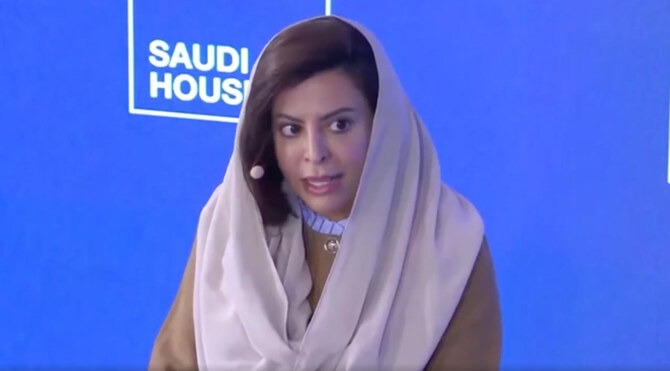
Nouf Al-Fares, assistant deputy minister at the Saudi Ministry of Transport and Logistics Services; and Ehab Aziz, chief financial officer of Agility, were speaking at Saudi House during the World Economic Forum’s annual meeting.
The panel highlighted the Kingdom’s ambitious logistics and investment targets, which are being met partly through international deals.
Al-Fares said: “A strategy was announced in mid 2021 by His Royal Highness Crown Prince Mohammed bin Salman. At the beginning I thought it to be intimidating having to raise SR1 trillion ($266 billion) in investments, but we are already halfway there through various established projects like the Riyadh Metro, and the new expansions of seaports and airports.
“We are now in motion to open a metro in Jeddah as well.”
The Kingdom’s shifting policies on foreign investment are also playing a role in surging growth, Al-Fares added.
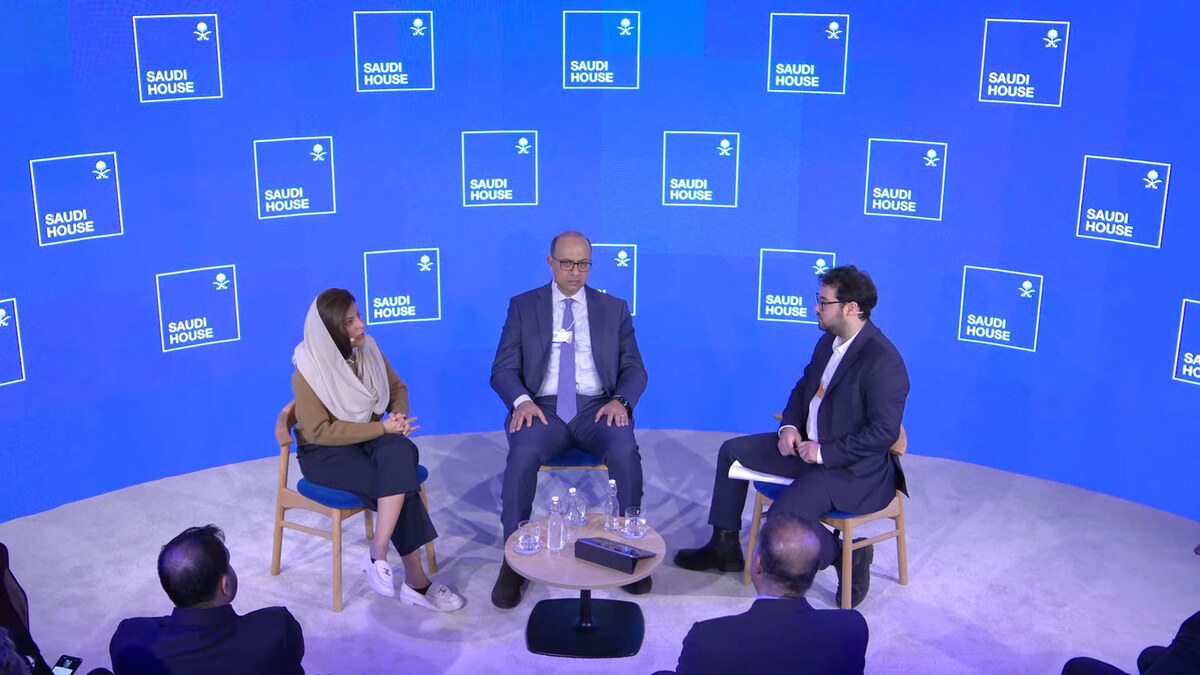
Nouf Al-Fares, Saudi assistant deputy minister of transport and logistics, participates in the panel discussion at the WEF in Davos on Thursday. (WEF photo)
Foreign investors are now able to claim 100-percent ownership of their Saudi-based businesses — a crucial policy in attracting investment.
“International companies are increasingly seeing the value of investing in Saudi Arabia,” the assistant deputy minister said.
“Chinese companies have already entered the Saudi market, with investments so far reaching over SR1 billion, and there are still more incoming projects.”
Saudi Arabia is preparing to open five new airports in the coming years that will further boost the Kingdom’s connectivity and infrastructure, she added.
“This aligns with our vision and position to being the gateway to Asia, Africa and Europe. We are also preparing projects to back the tourism sector as we are witnessing a surge in numbers of tourists, not including the religious ones.
“A lot of programs and funds that have been developed by our government are geared at attracting the youth, and those leaders with an appetite for change. We are excited for the upcoming completion of projects like the railway, which is to be completed within four years.
“The railway will connect the Kingdom to its GCC neighbors, namely Abu Dhabi, Kuwait and Doha.
Aziz praised the Saudi government’s proactive role in fostering a business-friendly environment.
He highlighted several schemes that have attracted domestic and foreign investment, particularly since the launch of Vision 2030.
The chief financial officer shared the details of his own company’s development in Saudi Arabia.
Agility, a logistics and supply chain leader, has been in operations for more than two decades, beginning as a Kuwaiti public company that constructed warehouses.
“Since its privatization Agility has become a global operator,” Aziz said.
“Today, the company has $11 billion worth of assets spread across various businesses. We also own one of the largest aviation companies that operates within 250 countries.”
A conviction that the Kingdom “would be the place to be in the future” led the company into a Saudi expansion, Aziz said, adding: “And so we have so far not been proved wrong.”
He said: “The story in Saudi is getting better and better over time. It is rare to find a country with a clear vision that is tangible with an educated government.
“The government incentivizing its employees through bonuses is also a new, atypical characteristic. All the infrastructure projects are very important but so is the mindset and attitude.
“And all that has been extremely positive. It has gotten to a level where you feel like you can completely count on the government; this increases your confidence in investing more in the country.”
Al-Fares and Aziz highlighted their optimism over the future of investment in the Kingdom’s transport and logistics sector.
The industry is poised for continued growth thanks to the government’s clear vision and investments that are providing a solid foundation for future development, they said.
“I think 2030 is carrying a lot and we are very optimistic,” Al-Fares added.


